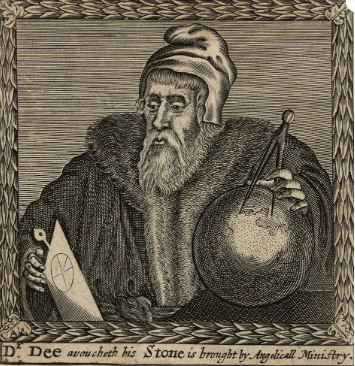
In the twilight decades of the sixteenth century, the sprawling riverside estate at Mortlake housed the largest private library in England. Its custodian, Dr. John Dee, stood as one of the towering intellectual figures of the Elizabethan Renaissance. A brilliant mathematician, cartographer, alchemist, astronomer, and trusted advisor to Queen Elizabeth I, who selected the date of her coronation upon his astrological counsel. Dee was the very archetype of the Renaissance polymath. Yet for all his mastery of terrestrial sciences, Dee’s intellectual ambition refused to stop at the edge of the empirical world. Beyond geometry and navigation lay the ultimate metaphysical pursuit: recovering the divine syntax of creation itself.
Dee operated under the prevailing Hermetic conviction that before the Fall of Man and the fragmentation of tongues at Babel, humanity shared a single, pristine dialect with God. This was the primordial speech of Adam, a language of divine essence in which names and things were identical. To speak a word in this lost tongue was not merely to represent an object, but to command its fundamental nature. Persuaded that centuries of mortal philosophy had reached an impasse, Dee concluded that this linguistic key could only be retrieved through direct revelation from heaven.
Lacking the innate gift of psychic clairvoyance himself, Dee took into his confidence a shadowy, itinerant medium named Edward Kelley. An enigmatic alchemist and convicted forger whose cropped ears bore physical testimony to past deceits, Kelley presented himself as an instrument capable of penetrating the celestial veil. Together, in dim chambers illuminated only by tallow candles, the scholar and the scryer began their nocturnal conferences with the other side.
The Obsidian Mirror
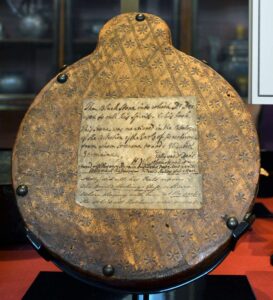
Their instrument of communion was a polished Aztec obsidian mirror, an artifact brought back from the New World that Dee believed could serve as a conduit between dimensions. Staring into its glossy, volcanic depths, Kelley claimed to behold the archangel Uriel and other celestial messengers. The transmission process was intricate and laden with dread. The spirits allegedly dictated an entirely new alphabet of twenty-one angular, talismanic glyphs, delivering texts strictly in reverse. According to Kelley, to utter the phrases forward during the transcription would unleash chaotic, reality-altering forces that mortal wards could not contain.
The result of these exhaustive sessions was what modern occultists term the Enochian language, complete with an intricate grammar, distinct syntax, and a series of poetic invocations known as the Angelic Keys. Modern scholars and cryptographers continue to debate its origins: was it an early, remarkably sophisticated synthetic language engineered by Kelley to manipulate a desperate patron, a political Renaissance cipher designed to conceal state intelligence, or a genuine psychological anomaly born of Dee’s singular obsession?

Whatever the truth behind the Mortlake sessions, the legacy of the angelic tongue did not vanish with the Elizabethan court. Three centuries later, the 19th-century occult revivalists of the Hermetic Order of the Golden Dawn resurrected Dee’s notebooks, transforming the Enochian script into the ritual cornerstone of modern ceremonial magic. Today, the obsidian mirror rests quietly beneath the glass cases of the British Museum—cool, dark, and silent, keeping the secrets of two men who tried to transcribe the architecture of heaven.
Leave a Reply