Category: magic

  • The Language of Angels? John Dee and the Enochian Alphabet

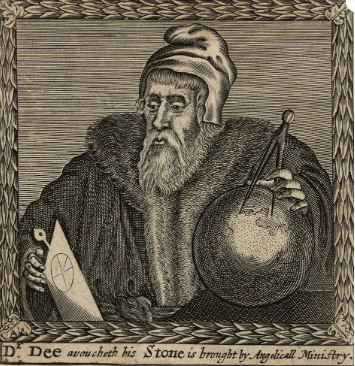
    Portrait of John Dee
    Portrait of John Dee

    In the twilight decades of the sixteenth century, the sprawling riverside estate at Mortlake housed the largest private library in England. Its custodian, Dr. John Dee, stood as one of the towering intellectual figures of the Elizabethan Renaissance. A brilliant mathematician, cartographer, alchemist, astronomer, and trusted advisor to Queen Elizabeth I, who selected the date of her coronation upon his astrological counsel. Dee was the very archetype of the Renaissance polymath. Yet for all his mastery of terrestrial sciences, Dee’s intellectual ambition refused to stop at the edge of the empirical world. Beyond geometry and navigation lay the ultimate metaphysical pursuit: recovering the divine syntax of creation itself.

    Dee operated under the prevailing Hermetic conviction that before the Fall of Man and the fragmentation of tongues at Babel, humanity shared a single, pristine dialect with God. This was the primordial speech of Adam, a language of divine essence in which names and things were identical. To speak a word in this lost tongue was not merely to represent an object, but to command its fundamental nature. Persuaded that centuries of mortal philosophy had reached an impasse, Dee concluded that this linguistic key could only be retrieved through direct revelation from heaven.

    Lacking the innate gift of psychic clairvoyance himself, Dee took into his confidence a shadowy, itinerant medium named Edward Kelley. An enigmatic alchemist and convicted forger whose cropped ears bore physical testimony to past deceits, Kelley presented himself as an instrument capable of penetrating the celestial veil. Together, in dim chambers illuminated only by tallow candles, the scholar and the scryer began their nocturnal conferences with the other side.

    The Obsidian Mirror
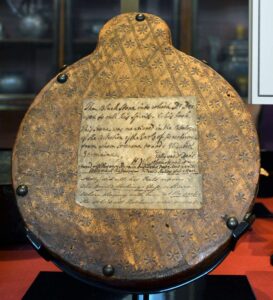
    John Dee's obsidian mirror
    John Dee’s Obsidian Scrying Mirror

    Their instrument of communion was a polished Aztec obsidian mirror, an artifact brought back from the New World that Dee believed could serve as a conduit between dimensions. Staring into its glossy, volcanic depths, Kelley claimed to behold the archangel Uriel and other celestial messengers. The transmission process was intricate and laden with dread. The spirits allegedly dictated an entirely new alphabet of twenty-one angular, talismanic glyphs, delivering texts strictly in reverse. According to Kelley, to utter the phrases forward during the transcription would unleash chaotic, reality-altering forces that mortal wards could not contain.

    The result of these exhaustive sessions was what modern occultists term the Enochian language, complete with an intricate grammar, distinct syntax, and a series of poetic invocations known as the Angelic Keys. Modern scholars and cryptographers continue to debate its origins: was it an early, remarkably sophisticated synthetic language engineered by Kelley to manipulate a desperate patron, a political Renaissance cipher designed to conceal state intelligence, or a genuine psychological anomaly born of Dee’s singular obsession?

    Whatever the truth behind the Mortlake sessions, the legacy of the angelic tongue did not vanish with the Elizabethan court. Three centuries later, the 19th-century occult revivalists of the Hermetic Order of the Golden Dawn resurrected Dee’s notebooks, transforming the Enochian script into the ritual cornerstone of modern ceremonial magic. Today, the obsidian mirror rests quietly beneath the glass cases of the British Museum—cool, dark, and silent, keeping the secrets of two men who tried to transcribe the architecture of heaven.
    Explore Further: The Hermetic Order of the Golden Dawn, a Victorian magical society that is still active today in various guises, used the Enochian language extensively in its rituals. 

  • The Hand of Glory: A Light No One Wants to Follow

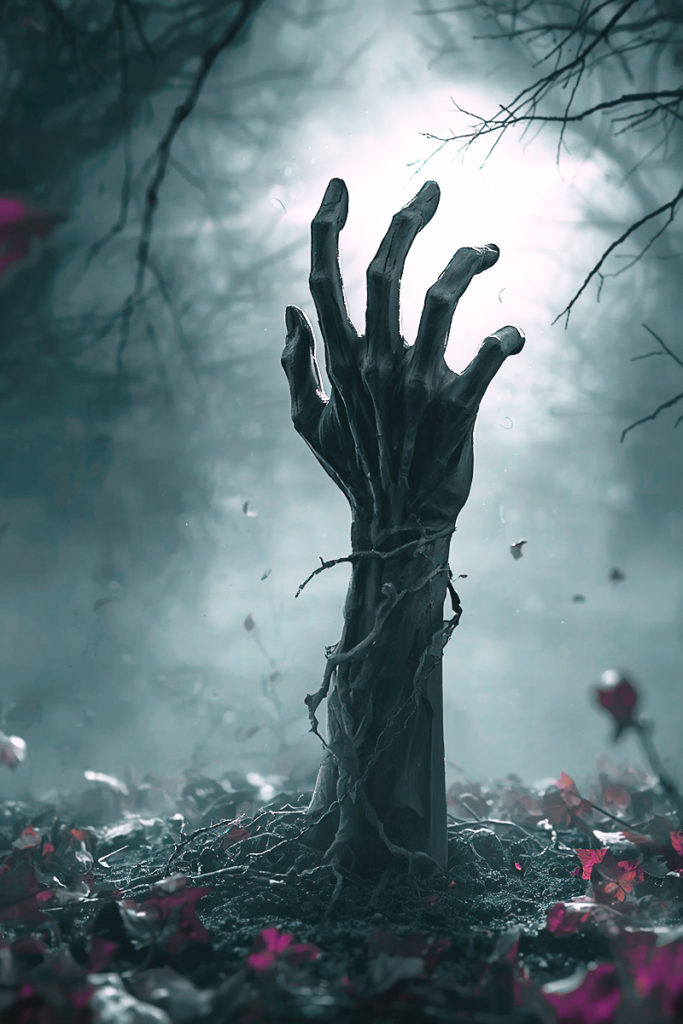
    A hand rising from the earth.


    There are objects that seem made for candlelit cabinets: rusted keys, cracked rosaries, and pressed flowers hidden in old books. And then there is the Hand of Glory—a relic so grim, so strangely poetic, that it feels less like a piece of folklore than something dreamed up during a fever in a locked library.

    Traditionally, a Hand of Glory was said to be the dried, preserved hand of an executed criminal—often a man hanged at the gallows. In some versions of the tale, it had to be the left hand, the sinister hand; in others, it was the hand that had committed the crime. The hand was prepared through a grotesque ritual of salting, drying, herbs, and smoke, then used as a holder for a candle made from human fat and wax.

    It is difficult not to pause at the sheer darkness of the image: a dead hand, stiff with age, fingers curled around a flame.

    Yet the Hand of Glory was not imagined merely as a horror. It was a tool, at least in folklore. A thief’s aid. A key to the sleeping world.

    Old European stories claimed that when its candle was lit, everyone in the house would be rendered motionless. The inhabitants would sleep so heavily, or stand so still, that a burglar could pass unseen through rooms of silver, sealed letters, and family portraits. The hand could supposedly unlock doors as well, making it the perfect companion for anyone with criminal intentions and an appetite for the supernatural.

    It is a magical object born from fear: fear of thieves, of the gallows, of the dead returning with unfinished business. But it is also born from a more intimate dread—that the locks and walls we trust might not protect us after all.

    The name itself is elusive. Despite the sinister clarity of the English phrase, “Hand of Glory” may have nothing to do with glory in the usual sense. The etymologist Walter Skeat suggested that it developed from the French main de gloire, itself a corruption of mandragore: mandrake. This is fitting. Mandrake, with its uncanny root sometimes imagined as a tiny human body, had its own long history of folklore, medicine, danger, and nocturnal enchantment. In old accounts, the plant was even said to shine like a lamp in the dark.

    Perhaps the Hand of Glory inherited some of that eerie radiance—a false little lantern glowing where no lantern should be.

    The most detailed recipes for making one appear in old magical texts, including the eighteenth-century grimoire Petit Albert. These instructions are less a reliable historical record than a glimpse into the imagination of occult Europe. They call for a hanged criminal’s hand, a sequence of preservation rituals, and an especially dreadful candle. The language itself becomes part of the spell: obscure ingredients, mistranslated words, regional dialects, and cryptic measures that blur into one another over centuries.

    Even scholars have disagreed over what some of the ingredients were meant to be. A word in one version may refer to an unfamiliar substance; in another, a copyist’s error turns it into something entirely different. That uncertainty only improves the legend. A true Hand of Glory should not come with a clean recipe. It should live in the margin of a damaged book, written in ink the color of old tea, where each reader suspects the previous one omitted something important.

    There were defenses, naturally. Folklore rarely gives darkness the final word. One old counter-charm advised householders to smear their threshold with an unguent of bizarre animal substances, prepared under particular conditions. Whether anyone truly believed in such protections is almost beside the point. The existence of the remedy tells us what the Hand of Glory represented: an intrusion into domestic safety, a spell that crossed the threshold while everyone slept.

    A preserved hand said to be a Hand of Glory is held at the Whitby Museum in North Yorkshire. Its presence is unsettling precisely because it is material. Legends are easy to hold at a distance when they remain ink on a page. A hand in a museum case, however—brown, withered, and silent—reminds us that the past was not composed only of elegant gothic fictions. It was made of bodies, punishments, superstitions, and people searching for power wherever they thought it might be found.

    Today, the Hand of Glory survives most comfortably in novels, occult illustrations, museum displays, and the shadowed corners of popular culture. It has appeared in fantasy stories and magical worlds, sometimes softened into a theatrical curiosity: a hand that carries a private candlelight, visible only to its owner.

    But the original folklore remains colder than fantasy.

    The Hand of Glory is not simply an artifact of the dead. It is a symbol of the forbidden shortcut—the desire to pass through locked doors without consequence, to move through a world made helpless by enchantment. Its light promises access, silence, and invisibility. But it is the light of a gallows road, and there is no comfort in following it.

    Some objects belong in glass cases. Some belong in stories.

    And some, one suspects, should be left unlit.


    Interested in eerie and cursed objects? Check out The Curse of the Delhi Purple Sapphire.