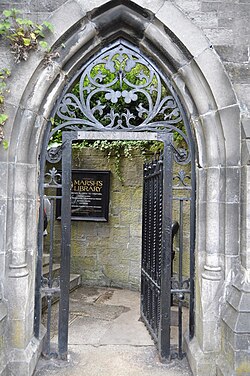
In the heart of Dublin, tucked beside the towering presence of St. Patrick’s Cathedral, stands a place where time seems reluctant to move forward. The city rushes and evolves around it, but behind weathered brick walls and ancient oak bookcases, Marsh’s Library remains suspended in another age.
Founded in 1707 and still functioning as a public library today, Marsh’s is not merely a repository of books. It is a monument to forgotten scholarship, a sanctuary of intellectual obsession, and, according to many visitors, one of Ireland’s most haunted historic sites.
For lovers of dark academia, few places embody the aesthetic so completely: candlelit scholarship, centuries-old manuscripts, hidden histories, and the persistent feeling that someone unseen may be standing just beyond the next shelf.
A Library Born at the Dawn of the Enlightenment
The story begins with Archbishop Narcissus Marsh, a scholar and collector who envisioned a library accessible to the public at a time when books were rare and expensive possessions.
When Marsh established the institution in the early eighteenth century, Ireland possessed few public libraries. His collection included theology, science, medicine, philosophy, law, and literature—subjects that represented the intellectual frontiers of the age.
Remarkably, much of the original structure survives today. Visitors walking through the library encounter the same dark oak shelving, winding galleries, and reading spaces that scholars used more than three centuries ago.
Unlike many historic libraries that have become museums, Marsh’s remains a working research library. Scholars still consult its collections, creating the unusual sensation that the building exists simultaneously in the eighteenth century and the modern world.
The Reader Cages: Ireland’s Most Unsettling Study Rooms
Perhaps the most famous feature of Marsh’s Library is also its most visually disturbing. Along one side of the library stand a series of enclosed wire reading cages. At first glance they resemble prison cells.
Their purpose was practical rather than punitive. During the eighteenth century, books were extraordinarily valuable. Readers would request rare volumes and then be locked inside these cages while they studied them. The arrangement prevented theft while allowing scholars access to precious texts.
Yet practical explanations do little to diminish the eerie atmosphere.
The cages evoke images of isolated academics poring over forbidden knowledge, trapped among ancient books and flickering candlelight. Visitors often describe feeling a profound sense of confinement when standing inside them.
Many visitors report an inexplicable feeling of being watched while standing in these enclosures. Whether psychological suggestion or something stranger, the sensation is difficult to ignore.
The Archbishop Who Never Left
Among Marsh’s most persistent ghost stories is that of Archbishop Narcissus Marsh himself. According to legend, the founder continues to wander the library he created.
The tale is linked to a deeply personal tragedy. Marsh’s beloved niece, Grace, reportedly eloped against her family’s wishes. Distraught, the Archbishop spent years searching for traces of her whereabouts and correspondence.
Stories claim that he would pace endlessly through the library, consumed by regret and longing. Even after death, some believe his search continues.
Staff, researchers, and visitors have occasionally reported hearing footsteps echoing through empty corridors. Others describe the sensation of a presence moving among the shelves late in the day when the library grows quiet.
Some accounts speak of a shadowy figure glimpsed between bookcases only to vanish moments later. Skeptics point to the creaking of centuries-old wood and the suggestive atmosphere of the building. Believers are less certain.
The Ghost of Dr. Stillingfleet
Another figure associated with the library’s legends is Dr. Edward Stillingfleet, whose extensive collection formed an important part of Marsh’s holdings.
Reports suggest that a spectral gentleman dressed in period clothing has occasionally been seen among the shelves. Witnesses often describe the figure as calm rather than threatening, appearing absorbed in scholarly pursuits before fading from view.
It is exactly the kind of haunting one might expect in a library: a stubborn scholar who simply never stopped researching, even after death.
Voices in Empty Rooms
Paranormal investigators have long been drawn to Marsh’s Library.
The reasons are obvious. The building contains centuries of history, original furnishings, and countless personal stories. It has witnessed political upheaval, religious conflict, scientific revolutions, and the private obsessions of generations of scholars.
Visitors have reported:
- Unexplained footsteps.
- Soft whispers when no one else is present.
- Sudden cold spots in otherwise stable rooms.
- Sensations of being followed between shelves.
- Fleeting shadows observed in peripheral vision.
- Books seemingly appearing in unexpected locations.
Such experiences remain anecdotal, but they contribute to the library’s reputation as one of Dublin’s most intriguing paranormal locations.
The Egyptian Mummy
Among Marsh’s more unusual historical attractions is an Egyptian mummy, acquired during the period when European fascination with ancient Egypt reached extraordinary levels.
The mummy became a source of curiosity, speculation, and occasional unease. It became popular enough to get a nickname: Maurice the Mummy.
Victorian society often treated Egyptian remains as objects of scientific inquiry, exotic spectacle, and even entertainment. Yet modern audiences tend to view them differently, seeing them as reminders of mortality and humanity’s complicated relationship with the dead.
The presence of an ancient Egyptian body inside an eighteenth-century Irish library creates an uncanny juxtaposition.
Some visitors have jokingly referred to the mummy as the library’s oldest resident. Others have wondered whether a building already associated with ghost stories truly needed an artifact so closely connected with death and ancient rituals.
Whether one believes in curses or not, the mummy contributes significantly to the library’s atmosphere of mystery.
Shelves Filled with Forgotten Worlds
Beyond its legends, Marsh’s Library possesses something equally captivating: the genuine mystery of old books themselves.
Its collections contain works on:
- Alchemy.
- Early medicine.
- Theology.
- Astronomy.
- Classical literature.
- Exploration and travel.
Many volumes preserve ideas that have vanished from mainstream thought. Some contain theories that were once cutting-edge science and are now historical curiosities. Others reveal the fears, hopes, and obsessions of previous centuries.
A Living Monument to Scholarship and Mystery
The building has remained largely unchanged throughout that time. Unlike modern structures that are continually renovated, Marsh’s preserves much of its original fabric.
To believers in paranormal phenomena, this continuity may help explain reports of unusual experiences. To historians, the same continuity explains why the building feels so powerful. Either way, Marsh’s offers an environment where the past seems unusually close.
The building serves simultaneously as archive, museum, academic resource, and cultural landmark. In an age of digital information and endless illumination, Marsh’s remains a sanctuary of shadows —a cathedral of books where the past has never quite agreed to leave.