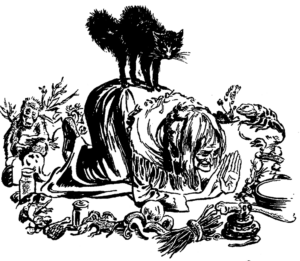
Illustration: Weird Talesv 36 N 1 Pg 044 Witch and Cat from Wikimedia Commons
We all know the common saying that a cat has nine lives. But in the Gaelic lore of the Scottish Highlands, nine was never a measure of luck—it was an unyielding curse.
According to ancient accounts, the creature known as the Cait Sidhe was not born in the fairy mounds. It was a witch granted the power to shift her shape into a black cat eight times to walk unseen. But on the ninth crossing, the door closed forever, trapping her in the skin of a beast with the lingering memory of a woman.
Listen to our full 3-minute audio dispatch narrated by Shaun and read the historical archive notes on ourInk and Shadow Archive Substack.
To discover how an ancient Cait Sidhe guards a buried relic on modern shores, read about our upcoming novella, The Druid’s Egg: A Cait Sidhe Tale, arriving November 20th.
In Celtic lore, not all fairy encounters carried the pastoral wonder of popular Victorian retellings. For centuries across windswept moors and ancient coastal hollows, the veil between the mortal world and the Otherworld was thin, perilous, and populated by entities that demanded strict, cautious respect.
Among the most unsettling of these beings was the Cait Sidhe (also spelled Cait Sith, pronounced caught-shee)—a spectral creature whose shadow stretched across medieval superstition, fairy traditions, and early modern witchcraft lore.
The Steer-Sized Specter of the Moors
Unlike the domesticated familiars that curled beside hearth fires, the Cait Sidhe was not regarded as a common stray. Tradition described the creature as a formidable beast, often said to rival a calf or steer in stature, draped in jet-black fur broken only by a stark, irregular white patch upon its breast. It moved with unnatural silence across misty peat bogs and craggy hills, its back arched and bristled as though harboring an eternal grievance against mankind.
Ancient communities held one particular terror regarding the creature: the theft of human souls.
During traditional wakes, mourners would stand vigil over the deceased night and day without sleep. Fires were extinguished in the death-chamber, music and riddles were deployed to keep attendants alert, and sharp iron blades were laid near the bier. All of this vigilance served a single purpose: to prevent a Cait Sidhe from vaulting over the unburied corpse. It was believed that should the fairy cat leap across the body before burial, it would claim the departed soul for the Otherworld before heaven or earth could intervene.
Witch, Familiar, or Fairy King?
By the late sixteenth century, the folklore shifted and intertwined with the escalating panic of witchcraft trials.
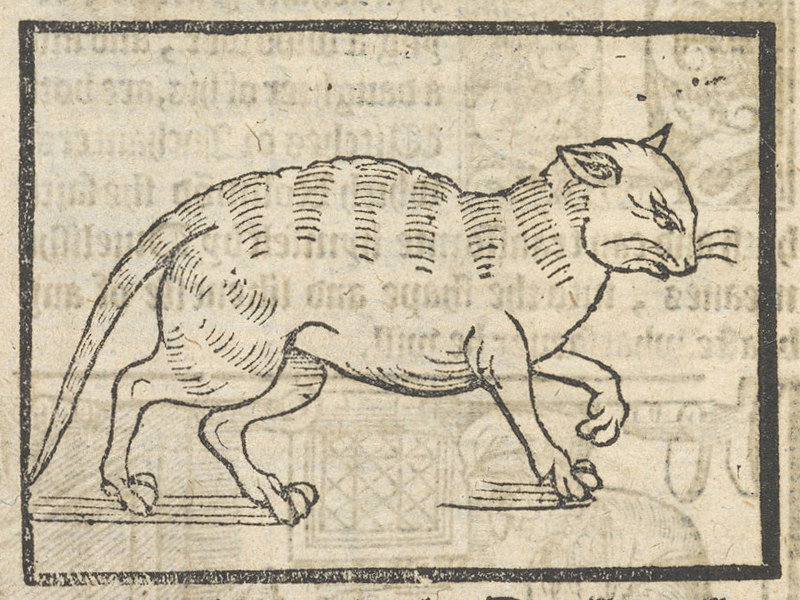
Pamphlets such as the 1579 London treatise A Rehearsall both Straung and True…(from where the above illustration was taken) documented public anxieties surrounding feline familiars. Folk tradition whispered that a Cait Sidhe was not necessarily a pure fairy spirit, but a witch possessing the dark art of transformation. She could slip into the skin of a black cat up to eight times at will. Yet the power carried a fatal boundary: should she dare to assume the feline shape for a ninth time, the transformation would solidify forever, stripping away her humanity and binding her to the shadows of the Otherworld.
Others, however, revered the creature as an emissary of the legendary King of Cats—aristocratic, fiercely autonomous, and utterly indifferent to the authority of mortals.
From Celtic Shadows to Port Corvine: An Archival Case File
Folklore survives not merely in preserved manuscripts, but in the reimagining of its mysteries.
In our latest literary case file, The Druid’s Egg: A Cait Sidhe Tale, this ancient folkloric phantom steps out of Celtic mist and into the fog of the Pacific Northwest. Here, an aristocratic Cait Sidhe named Pangur makes his home inside an antiquarian bookshop, where he, along with his changeling companion Elara, finds himself dealing with century-old murder mysteries, uninvited ghosts, and a gang of vicious smugglers.
Advance Review Copies Available
In anticipation of the official release on November 20, we are making a limited number of Advance Review Copies (ARCs) available to readers, bloggers, and reviewers interested in early access.
If you enjoy cozy fantasy, antiquarian mysteries, and stories told from the dry, haughty perspective of an ancient fairy familiar, we would be delighted to have your early thoughts.
(Complimentary review copies are available in EPUB, MOBI, and PDF formats for Kindle and e-readers. Early reviews on Goodreads and Amazon are warmly appreciated.)
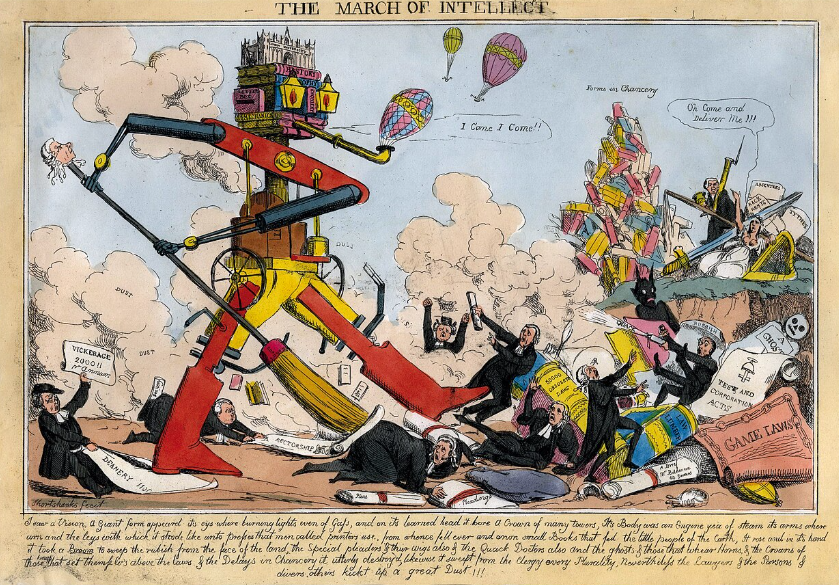
In an 1828 satirical print, a giant strides across the landscape with a steam engine for a body and a stack of books for a head. Gas lamps serve as its eyes; London University crowns its brow. Armed with a broom, it sweeps aside obsolete laws, legal delays, and the privileged figures obstructing its advance.
Note: see a transcription of the text under the illustration below.
Robert Seymour’s The March of Intellect imagines knowledge given a mechanical body: education and industry joined into something powerful enough to overturn the established order. Whether that prospect promised liberation or catastrophe depended, perhaps, on where one stood beneath its feet. As the Grolier Club explains, the print appeared when reformers were using mechanized printing and inexpensive publications to spread learning beyond its traditional confines.
The giant was imaginary. The fascination that animated it was not. In exhibition rooms and traveling shows, audiences were already watching artificial figures write, draw, and apparently defeat human beings at chess. Some were genuine marvels of mechanical craftsmanship. Others concealed a much older source of intelligence.
The Chess Player with a Human Heart
The most notorious of these machines entered the world before the nineteenth century began. First exhibited in 1770, Wolfgang von Kempelen’s Mechanical Turk remained a sensation well into the industrial age.
A turbaned figure sat behind a wooden cabinet, facing a chessboard. Before play began, its exhibitor opened compartments to reveal an impressive arrangement of machinery. Once the doors were closed, the figure moved its arm, lifted pieces, and conducted a game that seemed to demand calculation rather than mere repetition.
Its celebrated opponents included Napoleon Bonaparte, who played against it in 1809. Accounts of their encounter acquired theatrical embellishments, including stories of Napoleon making illegal moves to provoke the machine. The essential deception, however, requires no embellishment: a skilled human player was concealed inside.
The cabinet’s arrangement allowed the operator to shift out of sight during the preliminary inspection. Magnetic indicators beneath the board communicated the opponent’s moves, while mechanical linkages enabled the hidden player to control the figure’s arm. The machinery was real; the independent mechanical mind was not. The history of the Turk’s construction reveals an ingenious apparatus for making human thought appear to originate elsewhere.
Edgar Allan Poe examined the mystery in his 1836 essay Mälzel’s Chess Player, named for the machine’s later owner and exhibitor. He correctly suspected human agency, although several details of his explanation were mistaken. As Thomas Jefferson University’s account notes, his arguments included the erroneous assumption that a genuine chess machine would necessarily win every game.
The Turk was destroyed in a Philadelphia museum fire in 1854. Its long career had demonstrated something more durable than artificial intelligence: how readily an audience could become absorbed in the possibility of it.
The Mechanical Child Who Wrote Poetry
Not every extraordinary automaton concealed a person. Around 1800, the Swiss-born mechanician Henri Maillardet constructed a figure capable of producing four drawings and three poems—two in French and one in English.
Known as the Draughtsman-Writer, it lowered its head over a sheet of paper and guided a pen through elaborate movements. Here, unlike the Turk, the performance genuinely belonged to the mechanism.
Its memory was stored in shaped brass discs called cams. As these turned, metal followers traced their contours, transmitting motion through rods and levers to the writing hand. Each curve and stroke existed first as a physical instruction within the machine.
An important distinction lies beneath the spectacle: the automaton could write out poetry, but it did not compose new poems. It reproduced a repertoire encoded by its makers. Nevertheless, the sight unsettled the boundary between craftsmanship and creativity. A mechanical arm performed an activity associated with education, sensibility, and the private workings of the mind.
Its later history offers an almost Gothic episode of recovered identity. When the damaged machine arrived at Philadelphia’s Franklin Institute in 1928, its origins were misunderstood. Following repairs, it produced its drawings and poems—and, in the border of its final poem, wrote an inscription identifying itself as Maillardet’s automaton.
As the Franklin Institute recounts, the decisive clue came from the machine’s own mechanical memory. Its maker had been forgotten, but the brass retained his name.
When Clockwork Entered the Imagination
The nineteenth-century fascination with automatons inherited much from eighteenth-century watchmaking. The celebrated figures associated with Pierre Jaquet-Droz and his collaborators included a writer, a draughtsman, and a musician. These were not simply dolls accompanied by hidden music: the musician’s fingers actually operated the keys of her instrument. The writer could be configured to produce different short texts, an impressive departure from a single unchanging routine. The Mechanical Art & Design Museum describes the intricate mechanisms behind these performances.
Such figures made the imitation of life both intimate and disquieting. A machine did not need to threaten anyone to disturb them. It only needed to perform a familiar gesture with sufficient conviction.
Writers recognized the unease. E. T. A. Hoffmann’s The Sandman placed an artificial woman at the center of a story about desire, perception, and catastrophic misrecognition. The automaton became more than an engineering curiosity: it offered a way to question whether affection, manners, and apparently spontaneous behavior could themselves be mistaken for mechanical routines. Historian Laura Tradii explores this intersection of automata, social criticism, and the uncanny.
Outside the exhibition room, industrial machinery gave such questions a material urgency. The mechanical writer might be a luxury spectacle, but the possibility of machines performing human work was no longer confined to a cabinet.
The Intelligence Behind the Curtain
It is tempting to treat these automatons as primitive versions of modern artificial intelligence. The comparison is suggestive, but it should not erase their differences. Maillardet’s writer replayed movements stored in brass. The Turk transmitted the decisions of a concealed person. Seymour’s towering machine was a satirical image of knowledge and reform, not a working invention.
Yet together they reveal a remarkably familiar uncertainty. When a machine performs an impressive act, how much do we understand about the process behind it? Whose intelligence, skill, and labor have made the performance possible—and whose have disappeared from view?
The nineteenth century supplied no single answer. It left instead a collection of eloquent objects: a chessboard above a hidden chamber, a mechanical child bent over a poem, a giant crowned with books.
Their mechanisms can be explained. The sense of unease has continued right into our present age.
Text Handwritten under March of Intellect:
“I saw a Vision, A Giant form appeared its eyes where [were] burning lights even of Gass, and on its learned head it bore A Crown of many towers, Its Body was an Engine yea of steam its arms where [were] iron and the legs with which it strode like unto presses that men called printers use, from whence fell ever and anon small Books that fed the little people of the earth, It rose and in its hand it took a Broom to sweep the rubish [rubbish] from the face of the land, the Special pleaders & their wigs also & the Quack Doctors also and the ghosts & those that whear [wear] Horns, & the Crowns of those that set thems’elves above the laws & the Delays in Chancery it utterly destroy’d, likewise it swept from the Clergy every Plurality, Nevertheless the Lawyers & the Parsons & divers others kickt up a great Dust!!!”
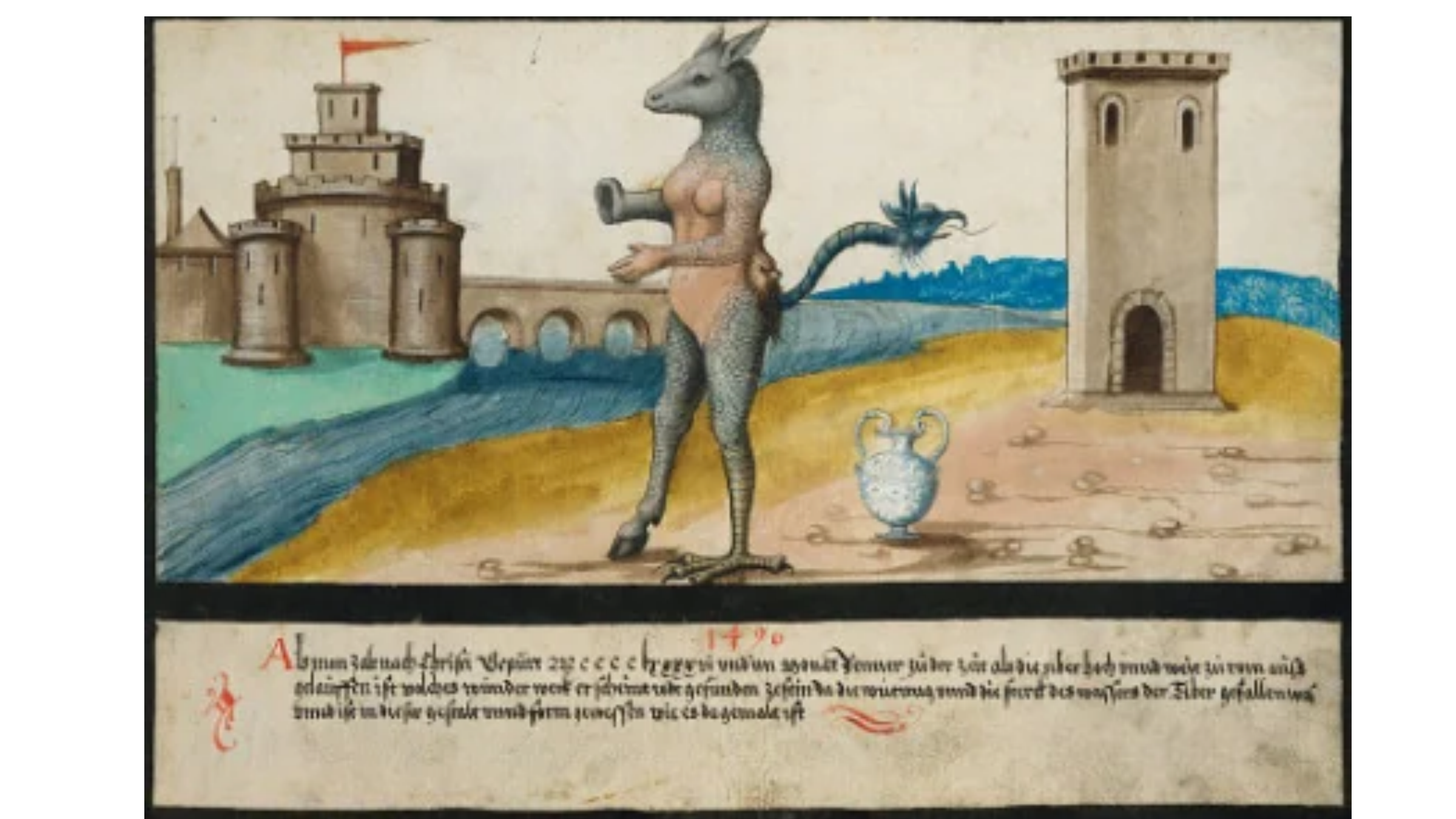
In January 1496, the swollen waters of the Tiber River receded from the low banks of Rome, leaving behind silt, wreckage, and a creature that defied the taxonomy of the known world. According to contemporary witnesses, the carcass possessed the head of an ass, the torso of a woman, a scaled serpentine arm, an elephantine foot, and a scaly tail terminating in the maw of a dragon. Dubbed the “Pope-Ass” (Papstesel), the monstrosity would later be weaponized by Martin Luther and Philip Melanchthon as an apocalyptic emblem of papal corruption. But decades after the creature washed ashore, its likeness was painstakingly drafted in opaque gouache and luminous tempera, cataloged not as fantastical art but as an empirical historical event in one of the most astonishing illuminated manuscripts ever salvaged from the early modern world: the Augsburg Wunderzeichenbuch, or the Augsburg Book of Miracles.
The Resurfacing of an Apocalyptic Relic
For almost five centuries, art historians and codicologists possessed no knowledge of the manuscript’s existence. It had eluded institutional archives, surviving in private obscurity until 2007, when it surfaced quietly at a provincial auction house in Munich, Germany. Discovered in an uncatalogued private estate, the manuscript was swiftly acquired by London antiquarian dealer Daniel Crouch before being purchased by a private collector. In 2013, the German art publisher Taschen produced the first comprehensive facsimile, revealing to the academic world a visual codex unlike anything in the European canon.
Scholars date the creation of the manuscript to approximately 1552 in the Imperial Free City of Augsburg—a wealthy hub of Renaissance banking, printing, and humanist thought dominated by families like the Fuggers and Welsers. At the time of its rediscovery, the manuscript comprised roughly 167 surviving leaves (several folios having been dispersed to public collections such as the National Gallery of Art in Washington, D.C., before the codex’s true provenance was recognized). Yet within its binding, it preserved no colophon, no author’s signature, and no preface dedicating the work to a patron. It arrived in the twenty-first century as a silent, anonymous chronicle of disaster.
Prodigies, Omens, and the Sky in Flames
Created during the tumultuous wake of the Protestant Reformation and the catastrophic religious upheavals that fractured the Holy Roman Empire, the Book of Miracles reflects a sixteenth-century worldview consumed by eschatological dread. To the Renaissance mind, nature was not a neutral, clockwork mechanism; it was a living manuscript written by the hand of the Divine, capable of cracking open to reveal messages of wrath or redemption.
The artists responsible—attributed stylistically to the workshops of prominent Augsburg masters, likely associated with Heinrich Vogtherr the Younger or Hans Burgkmair the Younger—compiled a chronological history of supernatural interventions spanning from the Old Testament through antiquity to their contemporary sixteenth-century doorstep. Biblical catastrophes, such as Noah’s flood and the fall of manna, transition seamlessly into historical anomalies.
Among its pages are
Rains of Blood and Fire: Detailed depictions of crimson deluges falling across medieval German villages, turning snow red and withering crops.
Celestial Portents: Atmospheric parhelia (sundogs), luminous bleeding crosses hovering over night skies, fiery swords suspended in the heavens, and clashing spectral armies battling among the clouds over Vienna.
Chthonic Horrors: Fiery dragons twisting above Swiss mountain passes, massive locust swarms devouring towns, and composite oceanic horrors dredged up from the Baltic.
The Vision of the Apocalypse: The manuscript culminates in literal scenes from the Book of Revelation, illustrating the seven-headed beast rising from the sea, the fall of Babylon, and the casting of the dragon into the abyss.
The Unflinching Eye of Renaissance Observation
What makes the Augsburg manuscript uniquely mesmerizing—and deeply unsettling—is its visual execution. Unlike early medieval bestiaries, which rendered monsters as symbolic, flattened allegories, the Augsburg artists employed the cutting-edge realism of the Northern Renaissance.
They utilized sophisticated linear perspective, delicate architectural rendering of Bavarian and Italian cityscapes, and nuanced naturalism in their landscapes. The dragons, rains of pitch, and deformed chimeras are rendered with the same disciplined, observational precision that Albrecht Dürer applied to a hare or a clump of turf. It is an archive where the impossible is treated with bureaucratic sobriety.
Each double-page spread features a magnificent, near-full-page gouache illustration accompanied below by a brief, matter-of-fact German inscription recording the date, location, and nature of the anomaly, often citing classical or medieval historians such as Livy, Josephus, and the Nuremberg Chronicle. The entries avoid sensationalist sermonizing; they present the omen with the chilling detachment of a case file.
The Lingering Shadow
Why an anonymous Augsburg patron commissioned this monumental, exorbitantly expensive work remains a subject of scholarly fascination. Some historians suggest it was intended as a visual catalog of divine warnings. It’s a talismanic compendium compiled during an era of apocalyptic hysteria when comets and strange births were understood as a dire warning that the terrestrial clock was running out.
Centuries later, the Augsburg Book of Miracles sits as a monument to human vulnerability. It captures an era standing at the threshold of the scientific revolution, attempting to measure, paint, and preserve the inexplicable before the modern rational world drew its curtains over the dark.
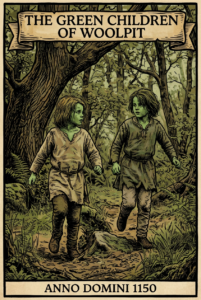
In the agrarian quietude of late twelfth-century Suffolk, the earth yielded something far stranger than the harvest. Near the village of Woolpit, its very name derived from the Old English wulf-pytt, the deep subterranean pits dug to trap the island’s prowling predators, reapers encountered an anomaly at the edge of the cultivated fields. Crawling out from one of these ancient earthworks were two children, a brother and sister. They were not merely lost travelers: their clothing was woven from an unfamiliar, glistening textile, their speech consisted of a fluid, incomprehensible dialect, and their flesh bore a striking, uniform cast of pale green.
The account survives not through cheap broadsheets, but within the sober monastic chronicles of medieval England’s most disciplined minds: Ralph of Coggeshall’s Chronicon Anglicanum and William of Newburgh’s Historia Rerum Anglicarum, both written near the dawn of the thirteenth century during the tumultuous reigns of King Stephen and King Henry II. Neither chronicler was prone to casual fable. William of Newburgh himself recorded his initial skepticism, writing that the event seemed unnatural and improbable, yet was attested by so many venerable witnesses that dismissal became an intellectual failure.
Taken to the hall of the local landowner, Sir Richard de Calne, the children presented a picture of visceral distress. They wept inconsolably and rejected every plate of bread and meat offered to them, visibly starving before their captors. It was only when workers brought freshly harvested green bean stalks into the manor kitchen that the children exhibited frantic recognition, tearing open the raw stalks—not the pods, but the pith of the stalks themselves—in desperate search of sustenance.
For months, the children subsisted almost entirely on this diet. The fragile boy, perpetually sullen and afflicted by a deep melancholia, soon succumbed to illness and was buried in consecrated ground. His sister, however, proved resilient. As her diet adapted to common English bread and her exposure to the midday sun increased, the verdant pigment faded from her skin, leaving the ruddy complexion of a typical mortal maiden. She was baptized into the Christian faith, entered domestic service in de Calne’s household, and slowly mastered the English tongue.
When interrogators finally pressed her to explain their provenance, her answers only deepened the unease. She described a subterranean homeland called the Land of Saint Martin, presumably named after the patron saint of pastoral flocks and monastic twilight, where the inhabitants were all Christian, shaded in the same emerald hue, and lived without the harsh radiance of a sun. Instead, her people inhabited a realm bathed in perpetual, somber dusk, gazing across a broad, luminous river toward a country of light they could never reach. She recounted that while tending their father’s cattle, they heard the sudden, resonant tolling of great church bells echoing from the cavernous dark. Mesmerized by the chimes, they wandered into a yawning fissure, walked through subterranean tunnels, and suddenly broke into the blinding heat and glare of the Suffolk fields, completely unable to retrace their path back into the dark.
For modern historians and pathologists, rationalism offers a tidy diagnosis. The children’s green tint is frequently attributed to hypochromic anemia, historically dubbed “chlorosis” or “green sickness,” a condition induced by extreme malnutrition that lends the skin an uncanny greenish cast and is remedied by an iron-rich diet. Culturally, twelfth-century East Anglia was a landscape scarred by ethnic cleansing. Under Henry II, hundreds of Flemish weavers and mercenaries were massacred at the Battle of Fornham in 1173, not far from Woolpit. It is plausible that the pair were the traumatized orphans of slaughtered Flemish settlers, wandering through the dense wilderness of Thetford Forest, speaking Middle Dutch, which would have been utterly unintelligible to Anglo-Norman ears, and stumbling into wolf traps dressed in Continental linen.
Yet the clinical explanation leaves curious shadows in the margins. It fails to fully extinguish the strangeness recorded by Newburgh and Coggeshall, who knew the Flemish well and were familiar with the ailments of poverty. The girl herself, reported to have grown into an obstinate, spirited woman who eventually married a royal official at King’s Lynn, never altered her testimony. Whether they were displaced casualties of medieval statecraft or emissaries from a realm where the light never rises, the Green Children remain an unclosed folio in the archives of English mystery—a reminder that in the twelfth century, the boundary between history and the abyss was as narrow as a pit dug in the earth.
Woolpit still exists and is a popular tourist destination, largely due to the famous green children.
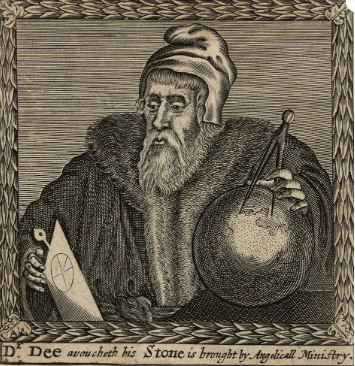
In the twilight decades of the sixteenth century, the sprawling riverside estate at Mortlake housed the largest private library in England. Its custodian, Dr. John Dee, stood as one of the towering intellectual figures of the Elizabethan Renaissance. A brilliant mathematician, cartographer, alchemist, astronomer, and trusted advisor to Queen Elizabeth I, who selected the date of her coronation upon his astrological counsel. Dee was the very archetype of the Renaissance polymath. Yet for all his mastery of terrestrial sciences, Dee’s intellectual ambition refused to stop at the edge of the empirical world. Beyond geometry and navigation lay the ultimate metaphysical pursuit: recovering the divine syntax of creation itself.
Dee operated under the prevailing Hermetic conviction that before the Fall of Man and the fragmentation of tongues at Babel, humanity shared a single, pristine dialect with God. This was the primordial speech of Adam, a language of divine essence in which names and things were identical. To speak a word in this lost tongue was not merely to represent an object, but to command its fundamental nature. Persuaded that centuries of mortal philosophy had reached an impasse, Dee concluded that this linguistic key could only be retrieved through direct revelation from heaven.
Lacking the innate gift of psychic clairvoyance himself, Dee took into his confidence a shadowy, itinerant medium named Edward Kelley. An enigmatic alchemist and convicted forger whose cropped ears bore physical testimony to past deceits, Kelley presented himself as an instrument capable of penetrating the celestial veil. Together, in dim chambers illuminated only by tallow candles, the scholar and the scryer began their nocturnal conferences with the other side.
The Obsidian Mirror
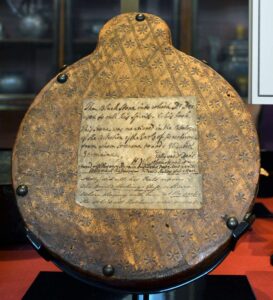
John Dee’s Obsidian Scrying Mirror
Their instrument of communion was a polished Aztec obsidian mirror, an artifact brought back from the New World that Dee believed could serve as a conduit between dimensions. Staring into its glossy, volcanic depths, Kelley claimed to behold the archangel Uriel and other celestial messengers. The transmission process was intricate and laden with dread. The spirits allegedly dictated an entirely new alphabet of twenty-one angular, talismanic glyphs, delivering texts strictly in reverse. According to Kelley, to utter the phrases forward during the transcription would unleash chaotic, reality-altering forces that mortal wards could not contain.
The result of these exhaustive sessions was what modern occultists term the Enochian language, complete with an intricate grammar, distinct syntax, and a series of poetic invocations known as the Angelic Keys. Modern scholars and cryptographers continue to debate its origins: was it an early, remarkably sophisticated synthetic language engineered by Kelley to manipulate a desperate patron, a political Renaissance cipher designed to conceal state intelligence, or a genuine psychological anomaly born of Dee’s singular obsession?
Whatever the truth behind the Mortlake sessions, the legacy of the angelic tongue did not vanish with the Elizabethan court. Three centuries later, the 19th-century occult revivalists of the Hermetic Order of the Golden Dawn resurrected Dee’s notebooks, transforming the Enochian script into the ritual cornerstone of modern ceremonial magic. Today, the obsidian mirror rests quietly beneath the glass cases of the British Museum—cool, dark, and silent, keeping the secrets of two men who tried to transcribe the architecture of heaven.
Explore Further: The Hermetic Order of the Golden Dawn, a Victorian magical society that is still active today in various guises, used the Enochian language extensively in its rituals.
As October wanes and the autumn chill strips the birch woods down to bone, the contemporary imagination turns toward the pageantry of Halloween. Yet behind the paper lanterns and synthetic cobwebs lies an older, harsher reality: the Gaelic festival of Samhain. For the ancient Celts, this liminal night marked the death of the light and the inaugural breath of winter, a volatile threshold where the veil separating this world from the Otherworld dissolved entirely. To study these traditions is to abandon modern, sanitized fairy tales. The folklore of the Celtic fringe—stretching across Ireland, the Scottish Highlands, the remote archipelagos of Orkney, and the valleys of Wales—was not composed to amuse or comfort. It served as a grim taxonomy of peril, delineating the fragile boundaries between mortal sanctuary and an indifferent, predatory wilderness.
Here are 9 of the most iconic and terrifying creatures from this tradition’s folklore. Some of these have been covered in more detail in other posts; see links.
1. The Changeling: Terror in the Cradle
Within the domestic sphere, horror was rarely an external siege; rather, it was an insidious replacement. The tradition of the changeling, or síobhra, struck at the foundational anchor of kinship. Folk memory held that the Fair Folk, covetous of mortal vitality and maternal warmth, slipped past bolted shutters to spirit away infants, leaving behind an uncanny surrogate in the cradle. This counterfeit was often an ancient, spent fae or an enchanted billet of decaying wood imbued with a temporary glamour.
What remained was a creature that devoured the family’s meager rations while offering only endless shrieking and a hollow, ageless gaze. The lore surrounding the changeling functioned as an explanation for sudden failure to thrive or neurological affliction, transforming the sanctuary of the nursery into a site of profound psychological estrangement.
2. The Water Horses: Predation in the Shallows
Where water meets shadow, Gaelic folklore placed its most patient predators. While popular culture often remembers the freshwater Kelpie, Highland oral history preserved a far more lethal entity: the Each-Uisge. Inhabiting deep sea lochs and desolate tarns, this water horse disguised itself as an immaculate stallion grazing beside the tide, inviting weary travelers to mount.
The moment human skin touched its flank, the beast’s hide secreted an unbreakable adhesive. Helpless to dismount, the rider was dragged beneath the surface as the creature plunged into fathomless trenches. By morning, the waters would regurgitate nothing more than the torn entrails of its captive, washing ashore upon the grey shingle.
3. The Sluagh: The Unforgiven Dead
In the Scottish Highlands, the atmosphere itself carried malice in the form of the Sluagh, or the Host of the Unforgiven Dead. These were spirits denied entry to heaven, hell, and the earth itself—individuals whose malice in life permanently barred them from rest. Doomed to drift upon the gale like ragged flocks of starlings or crows, they rode the biting west winds across the moorland.
Folklore maintained that the host possessed an acute sensitivity to the dying, converging upon sickrooms to rip souls from dying flesh before proper rites could be administered. To this day, the architectural preservation of ancient stone crofts recalls this terror, where west-facing windows were kept shuttered and barred whenever an invalid lay near death.
4. The Dullahan: The Inevitable Summons
Along the solitary, rain-slick roads of rural Ireland, nocturnal travel carried the dread of hearing sudden hooves behind you. The Dullahan is folklore’s most relentless herald of mortality. Astride a black courser or driving a coach draped in funerary velvet, this entity carries its own severed head held aloft like a morbid lantern.
Described in oral accounts as bearing the pallor and texture of decaying cheese, the severed head is fixed in a permanent, rictus grimace. Wielding a whip fashioned from a dried human spine, the Dullahan cannot be barred by iron gates or barred doors; when his journey halts outside a dwelling, he speaks a solitary mortal name, and with that single utterance, the named life is extinguished.
5. The Nuckelavee: The Skinless Horror of Orkney
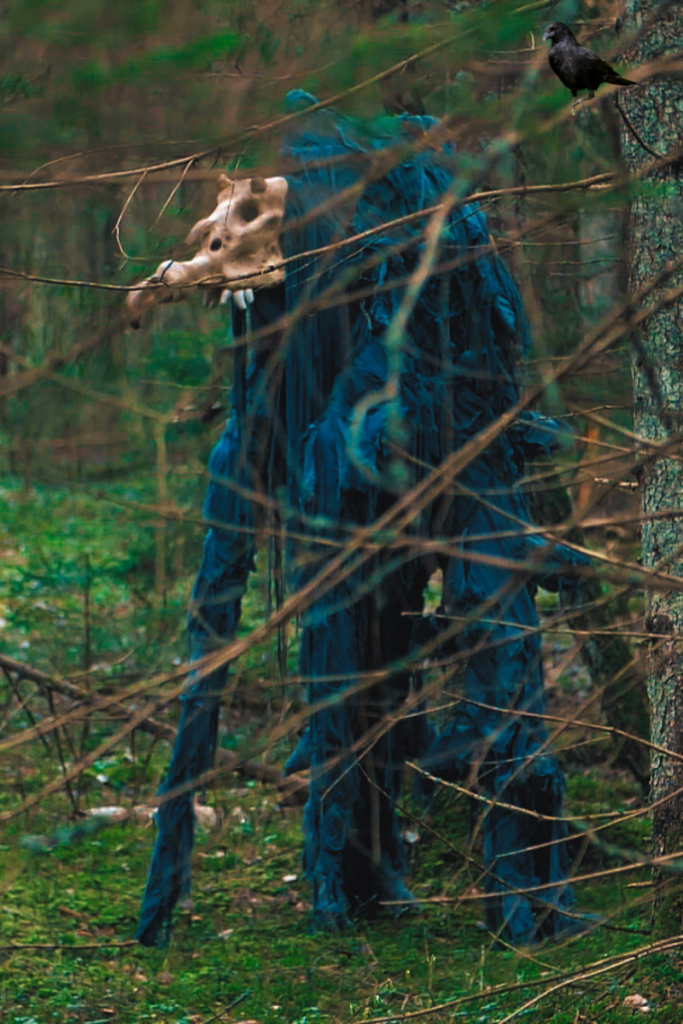
From the storm-battered shores of the Orkney Islands arises perhaps the most grotesque monstrosity in Northern European folklore: the Nuckelavee. Emerging from marine trenches to blight coastal villages, this composite being fuses a horse and an elongated human torso into a single, skinless entity.
Across its exposed, glistening muscles, black venous blood pumps through yellowed conduits. Its arms hang low enough to scrape the ground, and its breath exhales a foul oceanic pestilence capable of withering crops and spreading plague. The only sanctuary for the hunted lay in geography: as a creature of salt water, the Nuckelavee cannot cross fresh, running streams, making every footbridge a desperate line of salvation.
6. The Banshee: The Mourner of Ancient Blood
Sensationalized across centuries into a shrieking ghoul, the Bean Sídhe in authentic Irish tradition commands somber reverence rather than terror. She is an ancestral harbinger, bound exclusively to the island’s ancient lineages. Appearing not to orchestrate violence, she serves as a supernatural witness to the inevitability of death.
Solitary travelers might encounter her at twilight beside a peat bog or stream, clad in burial grave-clothes, combing her silver hair while keening a mournful dirge. Her lamentation is neither curse nor malevolent hex; it is an unyielding reminder that human tenure upon the earth is brief, and that grief inevitably awaits every hearth.
7. Cŵn Annwn: The Hounds of the Underworld
In the mythic underworld of Welsh tradition, known as Annwn, the Wild Hunt swept across the midnight skies led by spectral pack hounds: the Cŵn Annwn. In Celtic aesthetics, their coloring signaled supernatural foreboding, possessing stark white coats offset by ears of dripping crimson. Yet their most terrifying attribute was acoustic dissonance.
Through an unsettling inversion of sound, their baying reverberated loudly across the hills when they were leagues away, yet faded into a muffled, gentle whisper as they closed in upon their prey. To hear their pursuit grow quiet on the night air meant that their teeth were already at your heels. For more about this, read one of the many versions of the Mabinogion that are out there.
8. The Leanan Sídhe: The Parasitic Muse
For scholars, scribes, and artisans, danger lurked not in grotesque beasts, but in the seductive grace of the Leanan Sídhe. The “Fairy Mistress” presented herself as a patron of unbearable beauty, offering mortal poets incandescent artistic genius and profound renown. Yet this barter was inherently parasitic. In exchange for visionary inspiration, she siphoned the vital spirit of her consort.
Those who accepted her communion burned with brilliant brilliance for a few feverish seasons, only to deteriorate rapidly into delirium, wasting away into an untimely grave. She was the personification of artistic obsession, demanding absolute ruin in exchange for immortality on the page.
9. The Fomors: The Primordial Chaos
Before gods or humankind staked their claim upon Ireland, the landscape belonged to the Fomors, primordial titans embodying winter, famine, and oceanic devastation. Depicted in medieval texts with asymmetric anatomies—towering statures, single limbs, animal visages, or lone cyclopean eyes—they represented an untamable cosmos hostile to human settlement.
Ruled by entities such as Balor of the Evil Eye, whose poisonous gaze could incinerate armies and scorch the soil barren, the Fomors were the personification of elemental brutality. To survive in the Celtic world was to perpetually wage war against the encroaching dark, carving out fragile pockets of order against forces that were here long before humanity arrived, and will remain long after we are gone.
When the Candles Burn Low
As Halloween approaches, these stories offer something less comfortable than seasonal fright. They return us to a landscape in which a quiet shore, an unfamiliar rider, or a sound beyond the shutters might demand our attention—and our caution. Their power lies not only in what waits in the darkness, but in how little separates it from the ordinary world.
Perhaps that is why we still return to them when the evenings shorten. We may no longer bar the western windows or search the water for a horse’s reflection, but the old unease survives. Beyond the warm circle of the hearth, the night remains very large.
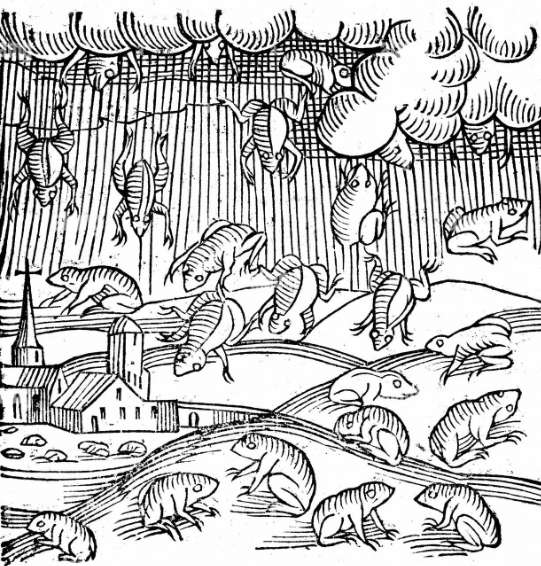
Woodcut illustration of frog rain from Conrad Lycosthenes’ Prodigiorum ac ostentorum chronicon (1557), an account of wonders and strange phenomena
Some books promise to explain the world. Charles Fort’s The Book of the Damned, published in 1919, is more interested in disturbing our confidence that it has been explained.
Its pages gather reports of falling frogs, strangely colored rains, mysterious disappearances, and baffling objects in the sky. These are not presented here as established supernatural events. They are accounts Fort collected—fragments of testimony whose reliability and interpretation remain separate questions.
Yet their appeal is difficult to resist. For readers drawn to obscure archives and the uneasy border between scholarship and obsession, Fort offers a peculiar invitation: enter the library, examine what has been discarded, and leave certainty at the door.
A Collector of Intellectual Outcasts
The “damned” of Fort’s title are not souls condemned to an infernal afterlife. They are observations excluded from accepted explanations: reports judged mistaken, impossible, irrelevant, or otherwise unfit for the official picture of reality.
As historian Joshua Blu Buhs recounts in his essay for The Public Domain Review, Fort began as a journalist and fiction writer. Financial inheritances eventually allowed him to devote his days to library research. He accumulated tens of thousands of notes, organizing them into roughly thirteen hundred categories.
There is something almost Gothic about the undertaking. Rather than discovering a forbidden manuscript, Fort assembled his own forbidden archive from the ordinary materials of print culture.
His central suspicion was that systems of knowledge achieve their apparent completeness partly through exclusion. What happens, he asked, to the awkward observation that refuses to fit?
That is a worthwhile question. It is not, by itself, evidence that any particular extraordinary report is true.
Frogs, Blood, and a Sea Above the Clouds
Among Fort’s most memorable materials were accounts of things falling from the sky: frogs, fish, and substances described as blood. Where another writer might arrange these into a sober catalogue, Fort surrounded them with extravagant possibilities.
Perhaps, he suggested, there existed a “Super-Sargasso Sea” above the earth—a reservoir where displaced objects accumulated before falling back. Perhaps reports of blood rain suggested a living universe capable of bleeding. Perhaps humanity occupied a position far less independent than it imagined.
“I think we’re property,” he wrote.
The fascination lies partly in the uncertainty of his performance. Is he proposing a cosmology, mocking the confidence of other cosmologies, or doing both at once?
Buhs’s account emphasizes this slipperiness. Fort could devise an explanation and then undermine the very idea of explaining. His speculative worlds are best approached as provocations, not discoveries. They make the familiar strange without necessarily making the strange credible.
More Than a Cabinet of Curiosities
Beneath the anomalies lay a philosophical ambition. Fort was drawn to monism: the idea that reality forms an all-inclusive whole, with apparently separate things existing as parts of it.
For him, scientific classification risked cutting that continuity into artificial compartments. His objection was not simply that researchers had overlooked a few curious events. He questioned the boundaries by which certain observations became acceptable knowledge and others became intellectual refuse.
This gives The Book of the Damned more substance than a collection of spooky anecdotes. It is also an argument about authority.
But the argument has limits. A method that distinguishes reliable observations from unreliable ones is not necessarily suppressing mystery. It may be doing precisely what responsible inquiry requires. Reports can be sincere and still mistaken; an unexplained account need not demand an extraordinary cause.
Fort’s challenge is strongest when it unsettles complacency. It is weaker when suspicion of an explanation takes the place of evidence against it.
The Pleasure (and Problems) of Fort
As a literary presence, Fort is anything but restrained. Buhs describes a book that interweaves anomalous reports with attacks on established scientific ideas, producing a sometimes bewildering accumulation of material.
Readers looking for orderly arguments or definitive answers may find this frustrating. Those who enjoy eccentric intellectual performances may find the disorder inseparable from the appeal.
His humor matters. It prevents the book from settling comfortably into the solemnity of a revealed doctrine, even when his ambitions approach one. The result occupies an unstable space between philosophical speculation, satire, and the literature of the uncanny.
For a dark academia reader, that instability is the attraction: scholarship conducted at the edge of its own shadow.
Keeping the Question Open
An agnostic reading of Fort requires neither belief nor dismissal. We can appreciate his imagination without accepting his hypotheses, and examine neglected reports without assuming neglect makes them true.
His enduring question is not whether frogs fell from an invisible celestial ocean. It is how we decide what deserves investigation—and whether our confidence sometimes outruns our evidence.
The unexplained is not proof of the supernatural. Nor must every unresolved account become an embarrassment hastily swept aside.
Fort’s archive leaves us with something quieter than revelation: a desk covered in contradictory reports, a lamp burning into the night, and the possibility that intellectual humility begins where the urge to finish the story ends.
To understand the isolation of Appalachia, one must first confront its impossible antiquity. Geologists tell us that the Central Appalachian chain was once as towering as the Himalayas, grinding into existence hundreds of millions of years ago—predating complex animal life, continental drift, and the first sprouting of deciduous forests. When fog settles over the blue ridges and hollows, it cloaks a topography so worn by time that its shadows feel sentient. In the quiet recesses of archival research, between yellowed regional monographs and handwritten field journals, one uncovers a landscape defined not merely by botany and topography, but by an architecture of unspoken taboos.
Among these mountain customs, none commands a more visceral, lingering dread than the warning whispered across timber porches: If you hear whistling in the woods after sundown, never whistle back.
The Migration of Dread: The Celtic Mimic in Ancient Stone
When eighteenth-century waves of Ulster Scots and Gaelic settlers drifted into the Southern valleys, they brought with them a library of ancient anxieties. In their ancestral homes, the boundaries between the living world and the hidden folk—the aos sí or the restless dead—were porous, fraught with the danger of mimicry and trickster logic. Creatures like the púca and the sluagh were infamous for using familiar sounds, stolen voices, and avian cries to entice travelers off well-trodden paths into bogs and lochs.
Upon crossing the Atlantic, these European fears found a vast, primeval theater. The hollows were darker than the highlands, the canopy far denser, and the indigenous lore of the Cherokee already recognized spirits that walked between the seen and unseen realms. The settlers’ fear of voice-stealing fae melted seamlessly into indigenous cautions regarding woodland mimics and deceptive spirits.
The Appalachian whistle, therefore, became an auditory lure. The entities that stalk the treeline are rarely described as hunting by sight; in a forest choked by rhododendron hells and limestone karst caves, vision is an unreliable sense. Instead, they hunt through acoustic resonance and psychological compliance. A lonely cadence floating on the night air is not an ambient melody, but an echolocation probe. It tests the perimeter to confirm if anyone is awake, solitary, and foolhardy enough to acknowledge it. To answer is to give away your position, your coordinates, and your consent. And as the old hill folk warn, once you return that note, the next whistle will not be distant—it will come from the brush just beyond your porch light.
Other Taboos of the Hollows: Rules for Navigating the Treeline
The prohibition against whistling is merely one component of a broader codex of Appalachian self-preservation. When scouring historical folk collections, one notices a recurring pattern of sensory discipline designed to maintain boundary lines between human hearths and wild terrain.
No, if you see something in the trees, look away. There exists a stern mountain principle that visual acknowledgment grants power to whatever lurks beyond the light. Staring into the pitch-black canopy is regarded as an invitation, a mutual recognition between observer and observed. Old timers caution that if an apparition or an uncanny shape catches your peripheral vision, you keep walking toward the threshold without turning your head.
Never answer your own name call. Much like the mimic-lore of the British Isles, a frequent legend in the hollows describes hearing the unmistakable voice of a spouse, a sibling, or a child drifting from the forest fringe late at night. The voice may sound panicked, pleading, or curiously flat. Mountain discipline demands you verify where your kin are inside the cabin before stepping into the fog. To answer a voice that lacks a verifiable body is to step directly into an auditory trap.
The threshold protections. Long before modern cryptozoology popularized creatures like the Wampus Cat or the Not-Deer, rural mountain households relied on domestic apotropaic magic. Salt was cast across windowsills, porch ceilings were coated in pale “haint blue” paint to trick malevolent spirits into thinking the wood was water or open sky, and iron horseshoes were nailed over stable doors. These rituals were quiet acts of deterrence, built on the premise that natural thresholds must be fortified against an encroaching wild.
The Scholarly Allure of Appalachian Horror
For students of literature and folklore, Appalachia remains an extraordinary study in cultural survival. The horror rooted in these ridges is not loud or theatrical; it is atmospheric, polite, and deeply psychological. It relies on the chilling truth that humans are transient latecomers to a primordial earth, inhabiting narrow clearings carved out of an indifferent wilderness.
When the night wind curls down off the summit and filters through the hemlocks, carrying a soft, warbling tone that sounds all too human, the ancient instinct stirs. You do not investigate. You do not pause to decipher the melody. You simply pull the shutters tight, latch the deadbolt, and keep your breath quiet until dawn.
Before glowing orbs, alien theories, and midnight pranksters with planks of wood, England had another explanation for strange formations in its fields: the Devil had been at work.
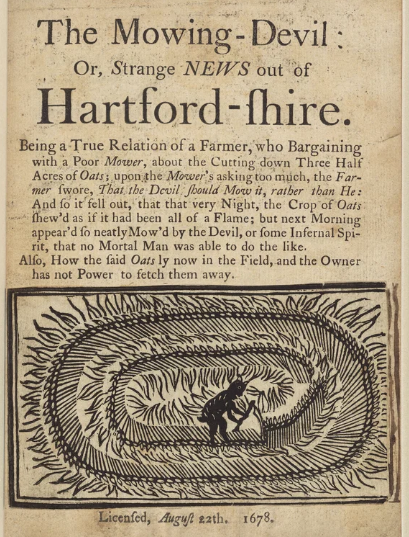
In August 1678, an anonymous pamphlet appeared with the wonderfully ominous title The Mowing-Devil: Or, Strange News out of Hartford-shire. It tells the story of a farmer in Hertfordshire whose ripe oat field became the setting for a dispute, a curse, and an alleged overnight visitation from something infernal.
It is now often called an early account of a crop circle. But like so many enduring mysteries, the real story is stranger and more revealing than the label suggests.
The tale begins not with lights in the sky, but with a wage argument.
According to the pamphlet, a “rich industrious farmer” needed three and a half acres of oats harvested. He approached a poor local mower to negotiate the work. The laborer named a price the farmer considered too high; the farmer offered much less. Sharp words followed. Even when the mower reportedly returned and offered to accept a lower wage, the farmer’s temper had hardened. He declared that “the Devil himself should mow his oats” before the man would be hired.
It is the sort of reckless phrase people still say in frustration, though perhaps with less theological weight than it carried in seventeenth-century England.
That night, passersby allegedly saw the oat field burning—or at least appearing to burn. By morning, the flames had vanished. In their place lay an unnervingly transformed field: the oats had been cut down in what the pamphlet called round circles, each stalk arranged with a precision no ordinary person could match. The farmer, terrified by what he had invited, supposedly refused to take the crop away.
The pamphlet’s woodcut is the detail that has captivated modern imaginations. It depicts a small horned devil wielding a scythe amid a swirling, circular arrangement of oats. When crop-circle fascination surged in the late twentieth century, the image was rediscovered and promoted as perhaps the earliest visual record of the phenomenon. The resemblance is certainly irresistible: a strange overnight formation in an English grain field, arranged in circles, blamed on a nonhuman force.
But the comparison has an important flaw. Modern crop circles are typically made from stalks bent or flattened into patterns. The Mowing-Devil story describes oats that were cut down. The central marvel is not that the crop was pressed into elaborate symbols, but that it had apparently been mown with impossible neatness. The pamphlet insists that the Devil had “cut them in round circles” and placed every straw with an exactness that would have taken a human “above an age” to accomplish.
So, rather than a direct ancestor of the familiar flattened circles seen in modern fields, the Mowing Devil is better understood as an early modern tale of supernatural harvest. Its connection to crop circles lives largely in its image and in our continuing desire to find eerie patterns in old stories.
The original pamphlet was licensed on August 22, 1678, and was written in the style of “strange news,” a popular early form of sensational print that mixed wonders, moral lessons, religious anxieties, and alleged eyewitness testimony. It presents itself as a true account but gives no farmer’s name and no precise location within Hertfordshire. That ambiguity makes the incident impossible to independently verify.
Its true purpose may not have been to document an agricultural mystery at all.
At its heart, the story is a moral fable about wealth, labor, and the consequences of exploiting workers. The farmer is repeatedly described as rich; the mower, as poor. The writer takes pains to portray the laborer’s requested payment as an understandable attempt to earn a living through “the sweat of his brows and marrow of his bones.” In contrast, the farmer’s refusal to pay a fair wage—and his angry invocation of the Devil—became the sins that summoned disaster.
The Devil, in this version of rural justice, is less an alien visitor than a grimly efficient laborer. He completes the harvest, but he does so in a manner that renders it useless to its owner. The crop lies in the field; the frightened farmer cannot bring himself to touch it. It is a supernatural punishment tailored perfectly to greed.
There are, of course, fewer spectral possibilities. The text’s claim that the field seemed to be on fire may point toward a real blaze, embellished into a moral tale. It is also possible that the story was invented entirely as cheap, entertaining print. Another possibility is far more earthly: a resentful laborer, or maybe a sympathetic neighbor, may have damaged or cut the field after the wage dispute, leaving the supernatural explanation to circulate afterward.
We’ll never know for sure after all this time. What remains is a small woodcut, a field of oats, and a warning that has survived more than three centuries.
The Mowing Devil may not be proof that crop circles existed in seventeenth-century England. But it is a compelling ancestor to the modern mystery: an image of patterned crops, unexplained labor, and a community confronting something it can’t explain. Long before people looked to the skies for answers, they looked at the darkened field beyond the cottage window and imagined a scythe moving through the grain.

 In the agrarian quietude of late twelfth-century Suffolk, the earth yielded something far stranger than the harvest. Near the village of Woolpit, its very name derived from the Old English wulf-pytt, the deep subterranean pits dug to trap the island’s prowling predators, reapers encountered an anomaly at the edge of the cultivated fields. Crawling out from one of these ancient earthworks were two children, a brother and sister. They were not merely lost travelers: their clothing was woven from an unfamiliar, glistening textile, their speech consisted of a fluid, incomprehensible dialect, and their flesh bore a striking, uniform cast of pale green.