
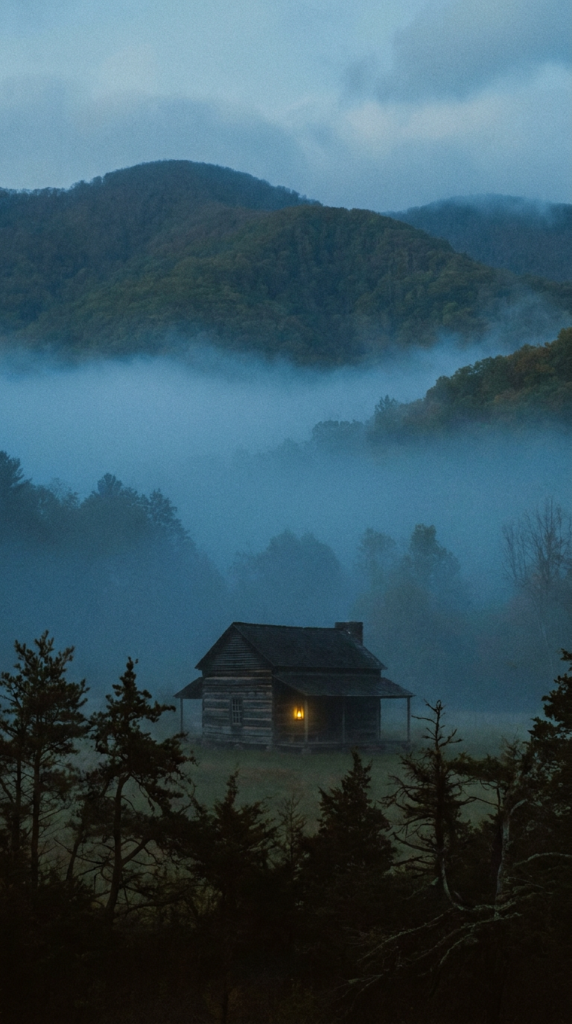
To understand the isolation of Appalachia, one must first confront its impossible antiquity. Geologists tell us that the Central Appalachian chain was once as towering as the Himalayas, grinding into existence hundreds of millions of years ago—predating complex animal life, continental drift, and the first sprouting of deciduous forests. When fog settles over the blue ridges and hollows, it cloaks a topography so worn by time that its shadows feel sentient. In the quiet recesses of archival research, between yellowed regional monographs and handwritten field journals, one uncovers a landscape defined not merely by botany and topography, but by an architecture of unspoken taboos.
Among these mountain customs, none commands a more visceral, lingering dread than the warning whispered across timber porches: If you hear whistling in the woods after sundown, never whistle back.
The Migration of Dread: The Celtic Mimic in Ancient Stone
When eighteenth-century waves of Ulster Scots and Gaelic settlers drifted into the Southern valleys, they brought with them a library of ancient anxieties. In their ancestral homes, the boundaries between the living world and the hidden folk—the aos sí or the restless dead—were porous, fraught with the danger of mimicry and trickster logic. Creatures like the púca and the sluagh were infamous for using familiar sounds, stolen voices, and avian cries to entice travelers off well-trodden paths into bogs and lochs.
Upon crossing the Atlantic, these European fears found a vast, primeval theater. The hollows were darker than the highlands, the canopy far denser, and the indigenous lore of the Cherokee already recognized spirits that walked between the seen and unseen realms. The settlers’ fear of voice-stealing fae melted seamlessly into indigenous cautions regarding woodland mimics and deceptive spirits.
The Appalachian whistle, therefore, became an auditory lure. The entities that stalk the treeline are rarely described as hunting by sight; in a forest choked by rhododendron hells and limestone karst caves, vision is an unreliable sense. Instead, they hunt through acoustic resonance and psychological compliance. A lonely cadence floating on the night air is not an ambient melody, but an echolocation probe. It tests the perimeter to confirm if anyone is awake, solitary, and foolhardy enough to acknowledge it. To answer is to give away your position, your coordinates, and your consent. And as the old hill folk warn, once you return that note, the next whistle will not be distant—it will come from the brush just beyond your porch light.
Other Taboos of the Hollows: Rules for Navigating the Treeline
The prohibition against whistling is merely one component of a broader codex of Appalachian self-preservation. When scouring historical folk collections, one notices a recurring pattern of sensory discipline designed to maintain boundary lines between human hearths and wild terrain.
No, if you see something in the trees, look away. There exists a stern mountain principle that visual acknowledgment grants power to whatever lurks beyond the light. Staring into the pitch-black canopy is regarded as an invitation, a mutual recognition between observer and observed. Old timers caution that if an apparition or an uncanny shape catches your peripheral vision, you keep walking toward the threshold without turning your head.
Never answer your own name call. Much like the mimic-lore of the British Isles, a frequent legend in the hollows describes hearing the unmistakable voice of a spouse, a sibling, or a child drifting from the forest fringe late at night. The voice may sound panicked, pleading, or curiously flat. Mountain discipline demands you verify where your kin are inside the cabin before stepping into the fog. To answer a voice that lacks a verifiable body is to step directly into an auditory trap.
The threshold protections. Long before modern cryptozoology popularized creatures like the Wampus Cat or the Not-Deer, rural mountain households relied on domestic apotropaic magic. Salt was cast across windowsills, porch ceilings were coated in pale “haint blue” paint to trick malevolent spirits into thinking the wood was water or open sky, and iron horseshoes were nailed over stable doors. These rituals were quiet acts of deterrence, built on the premise that natural thresholds must be fortified against an encroaching wild.
The Scholarly Allure of Appalachian Horror
For students of literature and folklore, Appalachia remains an extraordinary study in cultural survival. The horror rooted in these ridges is not loud or theatrical; it is atmospheric, polite, and deeply psychological. It relies on the chilling truth that humans are transient latecomers to a primordial earth, inhabiting narrow clearings carved out of an indifferent wilderness.
When the night wind curls down off the summit and filters through the hemlocks, carrying a soft, warbling tone that sounds all too human, the ancient instinct stirs. You do not investigate. You do not pause to decipher the melody. You simply pull the shutters tight, latch the deadbolt, and keep your breath quiet until dawn.
Leave a Reply