Some books promise to explain the world. Charles Fort’s The Book of the Damned, published in 1919, is more interested in disturbing our confidence that it has been explained.
Its pages gather reports of falling frogs, strangely colored rains, mysterious disappearances, and baffling objects in the sky. These are not presented here as established supernatural events. They are accounts Fort collected—fragments of testimony whose reliability and interpretation remain separate questions.
Yet their appeal is difficult to resist. For readers drawn to obscure archives and the uneasy border between scholarship and obsession, Fort offers a peculiar invitation: enter the library, examine what has been discarded, and leave certainty at the door.
A Collector of Intellectual Outcasts
The “damned” of Fort’s title are not souls condemned to an infernal afterlife. They are observations excluded from accepted explanations: reports judged mistaken, impossible, irrelevant, or otherwise unfit for the official picture of reality.
As historian Joshua Blu Buhs recounts in his essay for The Public Domain Review, Fort began as a journalist and fiction writer. Financial inheritances eventually allowed him to devote his days to library research. He accumulated tens of thousands of notes, organizing them into roughly thirteen hundred categories.
There is something almost Gothic about the undertaking. Rather than discovering a forbidden manuscript, Fort assembled his own forbidden archive from the ordinary materials of print culture.
His central suspicion was that systems of knowledge achieve their apparent completeness partly through exclusion. What happens, he asked, to the awkward observation that refuses to fit?
That is a worthwhile question. It is not, by itself, evidence that any particular extraordinary report is true.
Frogs, Blood, and a Sea Above the Clouds
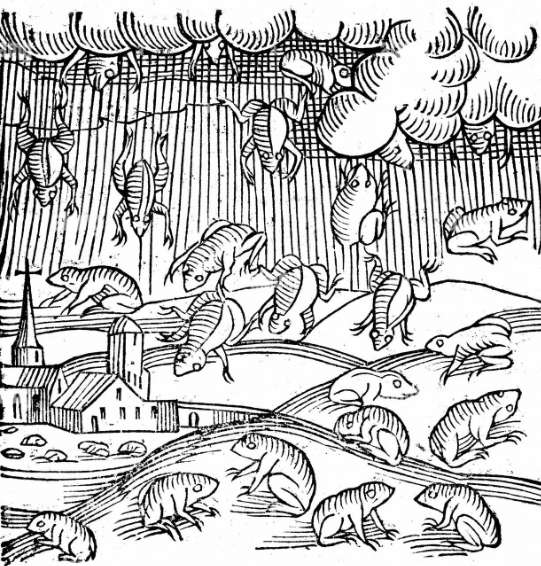
Among Fort’s most memorable materials were accounts of things falling from the sky: frogs, fish, and substances described as blood. Where another writer might arrange these into a sober catalogue, Fort surrounded them with extravagant possibilities.
Perhaps, he suggested, there existed a “Super-Sargasso Sea” above the earth—a reservoir where displaced objects accumulated before falling back. Perhaps reports of blood rain suggested a living universe capable of bleeding. Perhaps humanity occupied a position far less independent than it imagined.
“I think we’re property,” he wrote.
The fascination lies partly in the uncertainty of his performance. Is he proposing a cosmology, mocking the confidence of other cosmologies, or doing both at once?
Buhs’s account emphasizes this slipperiness. Fort could devise an explanation and then undermine the very idea of explaining. His speculative worlds are best approached as provocations, not discoveries. They make the familiar strange without necessarily making the strange credible.
More Than a Cabinet of Curiosities
Beneath the anomalies lay a philosophical ambition. Fort was drawn to monism: the idea that reality forms an all-inclusive whole, with apparently separate things existing as parts of it.
For him, scientific classification risked cutting that continuity into artificial compartments. His objection was not simply that researchers had overlooked a few curious events. He questioned the boundaries by which certain observations became acceptable knowledge and others became intellectual refuse.
This gives The Book of the Damned more substance than a collection of spooky anecdotes. It is also an argument about authority.
But the argument has limits. A method that distinguishes reliable observations from unreliable ones is not necessarily suppressing mystery. It may be doing precisely what responsible inquiry requires. Reports can be sincere and still mistaken; an unexplained account need not demand an extraordinary cause.
Fort’s challenge is strongest when it unsettles complacency. It is weaker when suspicion of an explanation takes the place of evidence against it.
The Pleasure (and Problems) of Fort
As a literary presence, Fort is anything but restrained. Buhs describes a book that interweaves anomalous reports with attacks on established scientific ideas, producing a sometimes bewildering accumulation of material.
Readers looking for orderly arguments or definitive answers may find this frustrating. Those who enjoy eccentric intellectual performances may find the disorder inseparable from the appeal.
His humor matters. It prevents the book from settling comfortably into the solemnity of a revealed doctrine, even when his ambitions approach one. The result occupies an unstable space between philosophical speculation, satire, and the literature of the uncanny.
For a dark academia reader, that instability is the attraction: scholarship conducted at the edge of its own shadow.
Keeping the Question Open
An agnostic reading of Fort requires neither belief nor dismissal. We can appreciate his imagination without accepting his hypotheses, and examine neglected reports without assuming neglect makes them true.
His enduring question is not whether frogs fell from an invisible celestial ocean. It is how we decide what deserves investigation—and whether our confidence sometimes outruns our evidence.
The unexplained is not proof of the supernatural. Nor must every unresolved account become an embarrassment hastily swept aside.
Fort’s archive leaves us with something quieter than revelation: a desk covered in contradictory reports, a lamp burning into the night, and the possibility that intellectual humility begins where the urge to finish the story ends.
Did you know that Charles Fort had a major influence on the 1999 film, Magnolia, directed by Paul Thomas Anderson?
Source: Joshua Blu Buhs, “Strange Gods: Charles Fort’s Book of the Damned (1919)”, The Public Domain Review.
If you like to explore strange phenomena of history, you might be interested in The Devil’s Footprints in Devon
Leave a Reply