
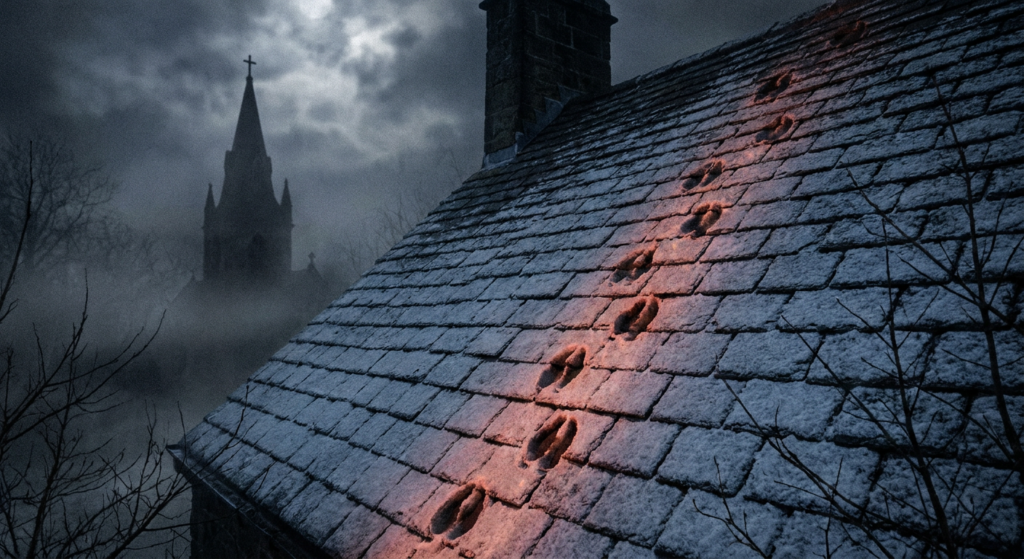
There is a distinct, unsettling beauty to an English winter morning when the world is smothered in fresh, undisturbed snow. It offers a pristine quietude—a blank slate where every footstep, paw print, and fallen leaf leaves behind a crisp, undeniable record of passage. Yet on the morning of February 8, 1855, the residents of Devon woke up to discover that something utterly unnatural had traversed their frozen countryside under the cover of darkness.
The preceding evening had been bitterly cold, bringing a heavy snowfall that dusted thirty different hamlets, towns, and villages across the southern county, stretching from the coast of Exmouth inland toward Dawlish and Totnes. When church bells chimed to signal dawn, early risers ventured outside with brass keys and coal buckets, only to halt in their tracks. Imprinted into the crisp crust of white was a singular, relentless trail that defied all rational understanding.
It soon became known to history as the Devil’s Footprints of Devon.
What confronted the Victorian townsfolk was not the chaotic pacing of a stray beast or the wanderings of an eccentric neighbor. The prints were neat, sunken horseshoe-like impressions—roughly four inches long and nearly three inches wide—bearing the distinctive shape of a small, cloven hoof. Most unnervingly, they were arranged in a strict, unswerving single file, one directly behind the other, spaced at uniform intervals of eight inches like the measured cadence of an upright strider.
As villagers followed the trail, the phenomenon escalated from a curious oddity into pure gothic horror. The unbroken line of impressions spanned nearly one hundred miles across the county, moving with impossible indifference to physical terrain. The hoof prints marched directly across frozen fields, scrambled up vertical fourteen-foot stone walls without disturbing the snow atop the coping stones, and strolled casually across snow-dusted haystack mounds.
Most chilling of all was the creature’s penchant for elevation. In several villages, the solitary line of prints ascended exterior walls and paced directly across high, pitched thatched roofs, circling church towers before dropping neatly down to the earth on the other side without breaking stride. In enclosed courtyard gardens surrounded by locked iron gates, the cloven marks trod right up to bolted cottage doors, stopped, vanished entirely, and resumed on the opposite threshold as if stone, mortar, and timber offered no barrier at all.
Panic spread quickly through the superstitious Victorian hamlets. Terrified families locked their shutters, church attendance surged to capacity, and groups of farmers armed themselves with pitchforks and shotguns to scour the dense woodlands for whatever had circled their homes in the night. The national press soon seized upon the sensation, with publications like the Illustrated London News printing eyewitness diagrams and letters from bewildered naturalists and clergymen.
Skeptics and armchair scholars immediately scrambled to offer sensible Victorian rationales. Some argued that a menagerie of animals must have broken loose, suggesting an escaped kangaroo or badgers bounding in a specific rhythm. Others blamed experimental weather balloons trailing iron guide-ropes, or migrating wood mice whose scurrying tracks had melted together in the midday sun.
Yet none of these neat explanations withstands basic physical logic. No animal known to science, neither rodent, marsupial, nor domestic beast, could traverse a hundred miles of rugged moorland, frozen estuaries, and high slate rooftops in the span of an eight-hour winter night, all while maintaining an unswerving single-file cadence through waist-high obstacles. Furthermore, a dragging balloon rope would have left sweeping ruts rather than crisp, separated hoof cavities pressed an inch deep into virgin snow.
More than a century and a half later, the strange incident remains one of the Victorian era’s most confounding cold cases. We like to imagine the nineteenth century as an age defined by the triumph of cold, industrial logic, a time when steam engines, encyclopedias, and gas lamps systematically chased away the old superstitions of the dark. But every so often, the physical world produces an enigma that refuses to fit cleanly into a textbook or ledger.
Whatever stepped lightly across the rooftops of Devon in the silent hours before dawn, it left behind an enduring question stamped neatly into the winter frost: what kind of shadow walks across locked gardens, ignores the laws of gravity, and leaves humanity clutching pitchforks at the foot of their beds?
Leave a Reply