
Category: folklore

  • The Twilight Strangers: The Enigma of the Green Children of Woolpit

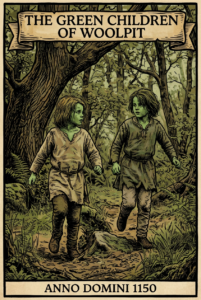
    Depiction of the Green Children of WoolpitIn the agrarian quietude of late twelfth-century Suffolk, the earth yielded something far stranger than the harvest. Near the village of Woolpit, its very name derived from the Old English wulf-pytt, the deep subterranean pits dug to trap the island’s prowling predators, reapers encountered an anomaly at the edge of the cultivated fields. Crawling out from one of these ancient earthworks were two children, a brother and sister. They were not merely lost travelers: their clothing was woven from an unfamiliar, glistening textile, their speech consisted of a fluid, incomprehensible dialect, and their flesh bore a striking, uniform cast of pale green.

    The account survives not through cheap broadsheets, but within the sober monastic chronicles of medieval England’s most disciplined minds: Ralph of Coggeshall’s Chronicon Anglicanum and William of Newburgh’s Historia Rerum Anglicarum, both written near the dawn of the thirteenth century during the tumultuous reigns of King Stephen and King Henry II. Neither chronicler was prone to casual fable. William of Newburgh himself recorded his initial skepticism, writing that the event seemed unnatural and improbable, yet was attested by so many venerable witnesses that dismissal became an intellectual failure.

    Taken to the hall of the local landowner, Sir Richard de Calne, the children presented a picture of visceral distress. They wept inconsolably and rejected every plate of bread and meat offered to them, visibly starving before their captors. It was only when workers brought freshly harvested green bean stalks into the manor kitchen that the children exhibited frantic recognition, tearing open the raw stalks—not the pods, but the pith of the stalks themselves—in desperate search of sustenance.

    For months, the children subsisted almost entirely on this diet. The fragile boy, perpetually sullen and afflicted by a deep melancholia, soon succumbed to illness and was buried in consecrated ground. His sister, however, proved resilient. As her diet adapted to common English bread and her exposure to the midday sun increased, the verdant pigment faded from her skin, leaving the ruddy complexion of a typical mortal maiden. She was baptized into the Christian faith, entered domestic service in de Calne’s household, and slowly mastered the English tongue.

    When interrogators finally pressed her to explain their provenance, her answers only deepened the unease. She described a subterranean homeland called the Land of Saint Martin, presumably named after the patron saint of pastoral flocks and monastic twilight, where the inhabitants were all Christian, shaded in the same emerald hue, and lived without the harsh radiance of a sun. Instead, her people inhabited a realm bathed in perpetual, somber dusk, gazing across a broad, luminous river toward a country of light they could never reach. She recounted that while tending their father’s cattle, they heard the sudden, resonant tolling of great church bells echoing from the cavernous dark. Mesmerized by the chimes, they wandered into a yawning fissure, walked through subterranean tunnels, and suddenly broke into the blinding heat and glare of the Suffolk fields, completely unable to retrace their path back into the dark.

    For modern historians and pathologists, rationalism offers a tidy diagnosis. The children’s green tint is frequently attributed to hypochromic anemia, historically dubbed “chlorosis” or “green sickness,” a condition induced by extreme malnutrition that lends the skin an uncanny greenish cast and is remedied by an iron-rich diet. Culturally, twelfth-century East Anglia was a landscape scarred by ethnic cleansing. Under Henry II, hundreds of Flemish weavers and mercenaries were massacred at the Battle of Fornham in 1173, not far from Woolpit. It is plausible that the pair were the traumatized orphans of slaughtered Flemish settlers, wandering through the dense wilderness of Thetford Forest, speaking Middle Dutch, which would have been utterly unintelligible to Anglo-Norman ears, and stumbling into wolf traps dressed in Continental linen.

    Yet the clinical explanation leaves curious shadows in the margins. It fails to fully extinguish the strangeness recorded by Newburgh and Coggeshall, who knew the Flemish well and were familiar with the ailments of poverty. The girl herself, reported to have grown into an obstinate, spirited woman who eventually married a royal official at King’s Lynn, never altered her testimony. Whether they were displaced casualties of medieval statecraft or emissaries from a realm where the light never rises, the Green Children remain an unclosed folio in the archives of English mystery—a reminder that in the twelfth century, the boundary between history and the abyss was as narrow as a pit dug in the earth.

    Woolpit still exists and is a popular tourist destination, largely due to the famous green children.
  • The 9 Scariest Creatures From Celtic Lore

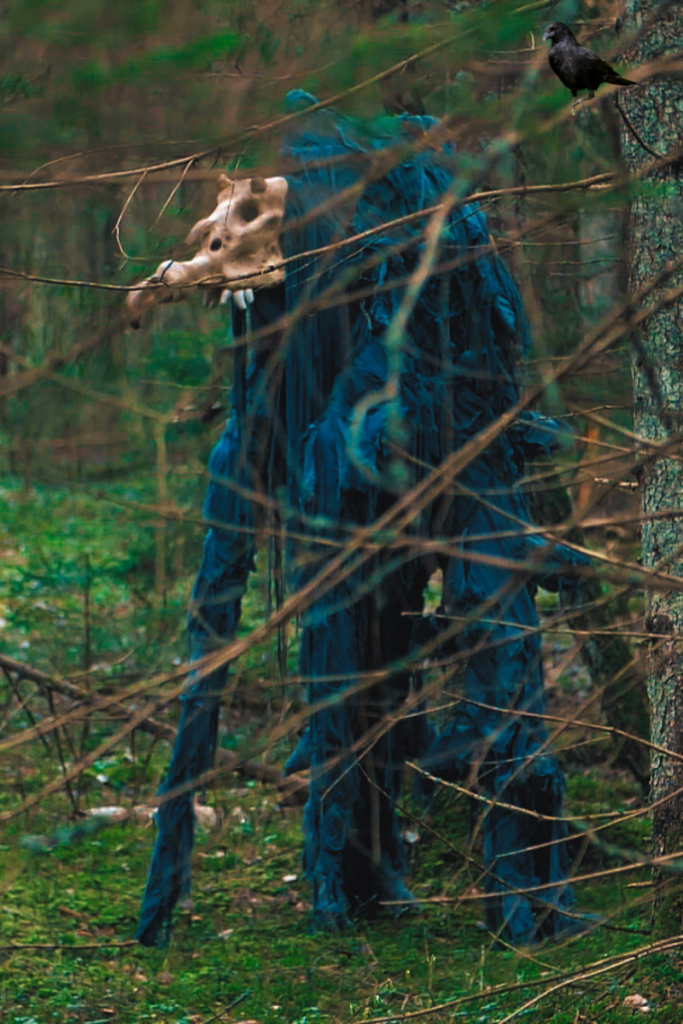
    A creature with a skull head walks in the woods.

    As October wanes and the autumn chill strips the birch woods down to bone, the contemporary imagination turns toward the pageantry of Halloween. Yet behind the paper lanterns and synthetic cobwebs lies an older, harsher reality: the Gaelic festival of Samhain. For the ancient Celts, this liminal night marked the death of the light and the inaugural breath of winter, a volatile threshold where the veil separating this world from the Otherworld dissolved entirely. To study these traditions is to abandon modern, sanitized fairy tales. The folklore of the Celtic fringe—stretching across Ireland, the Scottish Highlands, the remote archipelagos of Orkney, and the valleys of Wales—was not composed to amuse or comfort. It served as a grim taxonomy of peril, delineating the fragile boundaries between mortal sanctuary and an indifferent, predatory wilderness.

    Here are 9 of the most iconic and terrifying creatures from this tradition’s folklore.  Some of these have been covered in more detail in other posts; see links.

    1. The Changeling: Terror in the Cradle

    Within the domestic sphere, horror was rarely an external siege; rather, it was an insidious replacement. The tradition of the changeling, or síobhra, struck at the foundational anchor of kinship. Folk memory held that the Fair Folk, covetous of mortal vitality and maternal warmth, slipped past bolted shutters to spirit away infants, leaving behind an uncanny surrogate in the cradle. This counterfeit was often an ancient, spent fae or an enchanted billet of decaying wood imbued with a temporary glamour.

    What remained was a creature that devoured the family’s meager rations while offering only endless shrieking and a hollow, ageless gaze. The lore surrounding the changeling functioned as an explanation for sudden failure to thrive or neurological affliction, transforming the sanctuary of the nursery into a site of profound psychological estrangement.

    2. The Water Horses: Predation in the Shallows

    Where water meets shadow, Gaelic folklore placed its most patient predators. While popular culture often remembers the freshwater Kelpie, Highland oral history preserved a far more lethal entity: the Each-Uisge. Inhabiting deep sea lochs and desolate tarns, this water horse disguised itself as an immaculate stallion grazing beside the tide, inviting weary travelers to mount.

    The moment human skin touched its flank, the beast’s hide secreted an unbreakable adhesive. Helpless to dismount, the rider was dragged beneath the surface as the creature plunged into fathomless trenches. By morning, the waters would regurgitate nothing more than the torn entrails of its captive, washing ashore upon the grey shingle.

    3. The Sluagh: The Unforgiven Dead

    In the Scottish Highlands, the atmosphere itself carried malice in the form of the Sluagh, or the Host of the Unforgiven Dead. These were spirits denied entry to heaven, hell, and the earth itself—individuals whose malice in life permanently barred them from rest. Doomed to drift upon the gale like ragged flocks of starlings or crows, they rode the biting west winds across the moorland.

    Folklore maintained that the host possessed an acute sensitivity to the dying, converging upon sickrooms to rip souls from dying flesh before proper rites could be administered. To this day, the architectural preservation of ancient stone crofts recalls this terror, where west-facing windows were kept shuttered and barred whenever an invalid lay near death.

    4. The Dullahan: The Inevitable Summons

    Along the solitary, rain-slick roads of rural Ireland, nocturnal travel carried the dread of hearing sudden hooves behind you. The Dullahan is folklore’s most relentless herald of mortality. Astride a black courser or driving a coach draped in funerary velvet, this entity carries its own severed head held aloft like a morbid lantern.

    Described in oral accounts as bearing the pallor and texture of decaying cheese, the severed head is fixed in a permanent, rictus grimace. Wielding a whip fashioned from a dried human spine, the Dullahan cannot be barred by iron gates or barred doors; when his journey halts outside a dwelling, he speaks a solitary mortal name, and with that single utterance, the named life is extinguished.

    5. The Nuckelavee: The Skinless Horror of Orkney

    From the storm-battered shores of the Orkney Islands arises perhaps the most grotesque monstrosity in Northern European folklore: the Nuckelavee. Emerging from marine trenches to blight coastal villages, this composite being fuses a horse and an elongated human torso into a single, skinless entity.

    Across its exposed, glistening muscles, black venous blood pumps through yellowed conduits. Its arms hang low enough to scrape the ground, and its breath exhales a foul oceanic pestilence capable of withering crops and spreading plague. The only sanctuary for the hunted lay in geography: as a creature of salt water, the Nuckelavee cannot cross fresh, running streams, making every footbridge a desperate line of salvation.

    6. The Banshee: The Mourner of Ancient Blood

    Sensationalized across centuries into a shrieking ghoul, the Bean Sídhe in authentic Irish tradition commands somber reverence rather than terror. She is an ancestral harbinger, bound exclusively to the island’s ancient lineages. Appearing not to orchestrate violence, she serves as a supernatural witness to the inevitability of death.

    Solitary travelers might encounter her at twilight beside a peat bog or stream, clad in burial grave-clothes, combing her silver hair while keening a mournful dirge. Her lamentation is neither curse nor malevolent hex; it is an unyielding reminder that human tenure upon the earth is brief, and that grief inevitably awaits every hearth.

    7. Cŵn Annwn: The Hounds of the Underworld

    In the mythic underworld of Welsh tradition, known as Annwn, the Wild Hunt swept across the midnight skies led by spectral pack hounds: the Cŵn Annwn. In Celtic aesthetics, their coloring signaled supernatural foreboding, possessing stark white coats offset by ears of dripping crimson. Yet their most terrifying attribute was acoustic dissonance.

    Through an unsettling inversion of sound, their baying reverberated loudly across the hills when they were leagues away, yet faded into a muffled, gentle whisper as they closed in upon their prey. To hear their pursuit grow quiet on the night air meant that their teeth were already at your heels. For more about this, read one of the many versions of the Mabinogion that are out there.

    8. The Leanan Sídhe: The Parasitic Muse

    For scholars, scribes, and artisans, danger lurked not in grotesque beasts, but in the seductive grace of the Leanan Sídhe. The “Fairy Mistress” presented herself as a patron of unbearable beauty, offering mortal poets incandescent artistic genius and profound renown. Yet this barter was inherently parasitic. In exchange for visionary inspiration, she siphoned the vital spirit of her consort.

    Those who accepted her communion burned with brilliant brilliance for a few feverish seasons, only to deteriorate rapidly into delirium, wasting away into an untimely grave. She was the personification of artistic obsession, demanding absolute ruin in exchange for immortality on the page.

    9. The Fomors: The Primordial Chaos

    Before gods or humankind staked their claim upon Ireland, the landscape belonged to the Fomors, primordial titans embodying winter, famine, and oceanic devastation. Depicted in medieval texts with asymmetric anatomies—towering statures, single limbs, animal visages, or lone cyclopean eyes—they represented an untamable cosmos hostile to human settlement.

    Ruled by entities such as Balor of the Evil Eye, whose poisonous gaze could incinerate armies and scorch the soil barren, the Fomors were the personification of elemental brutality. To survive in the Celtic world was to perpetually wage war against the encroaching dark, carving out fragile pockets of order against forces that were here long before humanity arrived, and will remain long after we are gone.

    When the Candles Burn Low

    As Halloween approaches, these stories offer something less comfortable than seasonal fright. They return us to a landscape in which a quiet shore, an unfamiliar rider, or a sound beyond the shutters might demand our attention—and our caution. Their power lies not only in what waits in the darkness, but in how little separates it from the ordinary world.

    Perhaps that is why we still return to them when the evenings shorten. We may no longer bar the western windows or search the water for a horse’s reflection, but the old unease survives. Beyond the warm circle of the hearth, the night remains very large.


  • Never Whistle Back: Origins of Appalachian Folklore

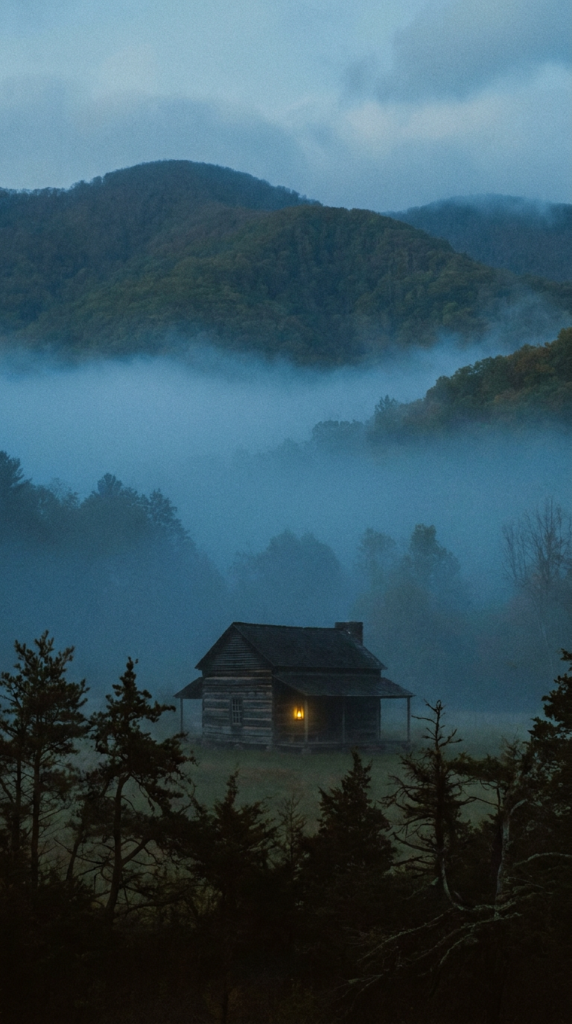
    An eerie old cabin in the Appalachian mountains.


    To understand the isolation of Appalachia, one must first confront its impossible antiquity. Geologists tell us that the Central Appalachian chain was once as towering as the Himalayas, grinding into existence hundreds of millions of years ago—predating complex animal life, continental drift, and the first sprouting of deciduous forests. When fog settles over the blue ridges and hollows, it cloaks a topography so worn by time that its shadows feel sentient. In the quiet recesses of archival research, between yellowed regional monographs and handwritten field journals, one uncovers a landscape defined not merely by botany and topography, but by an architecture of unspoken taboos.

    Among these mountain customs, none commands a more visceral, lingering dread than the warning whispered across timber porches: If you hear whistling in the woods after sundown, never whistle back.

    The Migration of Dread: The Celtic Mimic in Ancient Stone

    When eighteenth-century waves of Ulster Scots and Gaelic settlers drifted into the Southern valleys, they brought with them a library of ancient anxieties. In their ancestral homes, the boundaries between the living world and the hidden folk—the aos sí or the restless dead—were porous, fraught with the danger of mimicry and trickster logic. Creatures like the púca and the sluagh were infamous for using familiar sounds, stolen voices, and avian cries to entice travelers off well-trodden paths into bogs and lochs.

    Upon crossing the Atlantic, these European fears found a vast, primeval theater. The hollows were darker than the highlands, the canopy far denser, and the indigenous lore of the Cherokee already recognized spirits that walked between the seen and unseen realms. The settlers’ fear of voice-stealing fae melted seamlessly into indigenous cautions regarding woodland mimics and deceptive spirits.

    The Appalachian whistle, therefore, became an auditory lure. The entities that stalk the treeline are rarely described as hunting by sight; in a forest choked by rhododendron hells and limestone karst caves, vision is an unreliable sense. Instead, they hunt through acoustic resonance and psychological compliance. A lonely cadence floating on the night air is not an ambient melody, but an echolocation probe. It tests the perimeter to confirm if anyone is awake, solitary, and foolhardy enough to acknowledge it. To answer is to give away your position, your coordinates, and your consent. And as the old hill folk warn, once you return that note, the next whistle will not be distant—it will come from the brush just beyond your porch light.

    Other Taboos of the Hollows: Rules for Navigating the Treeline

    The prohibition against whistling is merely one component of a broader codex of Appalachian self-preservation. When scouring historical folk collections, one notices a recurring pattern of sensory discipline designed to maintain boundary lines between human hearths and wild terrain.

    No, if you see something in the trees, look away. There exists a stern mountain principle that visual acknowledgment grants power to whatever lurks beyond the light. Staring into the pitch-black canopy is regarded as an invitation, a mutual recognition between observer and observed. Old timers caution that if an apparition or an uncanny shape catches your peripheral vision, you keep walking toward the threshold without turning your head.

    Never answer your own name call. Much like the mimic-lore of the British Isles, a frequent legend in the hollows describes hearing the unmistakable voice of a spouse, a sibling, or a child drifting from the forest fringe late at night. The voice may sound panicked, pleading, or curiously flat. Mountain discipline demands you verify where your kin are inside the cabin before stepping into the fog. To answer a voice that lacks a verifiable body is to step directly into an auditory trap.

    The threshold protections. Long before modern cryptozoology popularized creatures like the Wampus Cat or the Not-Deer, rural mountain households relied on domestic apotropaic magic. Salt was cast across windowsills, porch ceilings were coated in pale “haint blue” paint to trick malevolent spirits into thinking the wood was water or open sky, and iron horseshoes were nailed over stable doors. These rituals were quiet acts of deterrence, built on the premise that natural thresholds must be fortified against an encroaching wild.

    The Scholarly Allure of Appalachian Horror

    For students of literature and folklore, Appalachia remains an extraordinary study in cultural survival. The horror rooted in these ridges is not loud or theatrical; it is atmospheric, polite, and deeply psychological. It relies on the chilling truth that humans are transient latecomers to a primordial earth, inhabiting narrow clearings carved out of an indifferent wilderness.

    When the night wind curls down off the summit and filters through the hemlocks, carrying a soft, warbling tone that sounds all too human, the ancient instinct stirs. You do not investigate. You do not pause to decipher the melody. You simply pull the shutters tight, latch the deadbolt, and keep your breath quiet until dawn.

    Have you seen: The Mowing Devil of 1678: the First Crop Circle?