Author: wdo2b

  • Ogham: The Druid’s Cipher

    Archivist’s Note: This briefing contains affiliate links. If you acquire an artifact through these links, the Archive may earn a small commission at no extra cost to you, which helps keep the candles lit.

    Druids carving symbols on a tree.

    If you want to destroy a civilization, you burn its books. But how do you erase a culture that refuses to write anything down?

    When Julius Caesar marched his legions into Gaul and Britain, he encountered the Druids, who were the intellectual and spiritual elite of the Celtic world. They were philosophers, judges, astronomers, and magicians. Yet, despite their vast knowledge, Caesar noted something that baffled the bureaucratic Roman mind: the Druids strictly forbade the writing of their sacred lore.

    This wasn’t out of ignorance; they were fully capable of using Greek and Latin alphabets for mundane trade and taxes. The ban on writing was a deliberate, fiercely guarded security measure. To write a spell, a genealogy, or a piece of tactical knowledge on parchment was to risk it falling into the hands of the uninitiated. Furthermore, they believed that relying on written text weakened the mind. A true Druid was a living library, required to memorize tens of thousands of verses over a grueling twenty-year apprenticeship.

    But oral history has a fatal flaw: it bleeds out on the battlefield. As the Roman Empire expanded, bringing with it the Latin alphabet and the sword, the living libraries of the Celtic world were systematically hunted down. The Druids realized that memory was no longer enough to protect their culture. They needed a way to record their knowledge—but they needed to do it in a way their conquerors couldn’t understand.

    They didn’t need a new language. They needed a cipher.

    The Edge of the Blade

    Enter Ogham (pronounced OH-am). Emerging in the early centuries AD, just as Latin was suffocating the native tongues of Europe, Ogham is one of the most unusual writing systems ever devised.

    If you look at a piece of Roman parchment, the ink sits flat on the page. Ogham, however, is inherently tactile. It was not originally designed for the quill and vellum; it was designed for the chisel, the knife, and the edge of a stone.

    The alphabet consists of a series of simple, straight notches intersecting a central, vertical line—known as the flesc (stem). Imagine the sharp corner of a standing stone, or the edge of a wooden staff. The carver would cut horizontal or diagonal strokes across that edge. One notch to the right meant one letter; two notches to the left meant another; three notches cutting straight through the middle meant something else entirely.

    To a Roman soldier or a Latin-speaking missionary, a piece of wood covered in Ogham didn’t look like a document. It looked like tally marks, decorative borders, or the random scarring of a blade. It was hidden in plain sight.

    But to an initiated Celt, running their fingers along the edge of that wood in the dark, it was a highly sophisticated phonetic code. It was used to mark territories, record genealogies, and, according to myth, cast silent magic. It was a rebellion carved into the very landscape—a secret alphabet that allowed the ghosts of the Druids to speak right under the noses of the empire.

    The Monastic Rosetta Stone

    As centuries passed, the Druids faded into myth, and the wild Celtic forests were slowly replaced by the stone walls of Christian monasteries. The original purpose of Ogham—as a covert rebellion against the Romans—was no longer necessary. Yet, the Irish monks who now held the monopoly on literacy refused to let the cipher of their ancestors die.

    They brought the outdoor alphabet indoors. They took a script meant for the harsh edge of a stone and forced it onto the flat, unforgiving surface of animal vellum.

    The ultimate culmination of this preservation effort is found in a massive, 14th-century manuscript known as the Book of Ballymote. Compiled by scribes in County Sligo, this heavy, leather-bound tome is a treasure trove of Irish history, genealogy, and mythology. But for our purposes, its most important pages contain the In Lebor Ogaim—The Ogham Tract.

    The Ogham Tract acts as the Rosetta Stone for the Celtic world. Without it, the notches on the standing stones dotting the Irish countryside would be unreadable today. The manuscript not only provides the key to translating the standard Ogham alphabet into Latin letters, but it also reveals the sheer, obsessive complexity of the cipher. The scribes recorded over a hundred secret, cryptographic variations of Ogham used by scholars and poets. There was “Bird Ogham,” “Color Ogham,” and “Fortress Ogham,” where the letters were swapped out for specific categories of words to further confuse the uninitiated.

    Through the iron gall ink of the Book of Ballymote, we see that Ogham wasn’t just a primitive alphabet; it was a Playground for the ancient mind, a puzzle box preserved on parchment.

    The Tree Alphabet and the Modern Revival
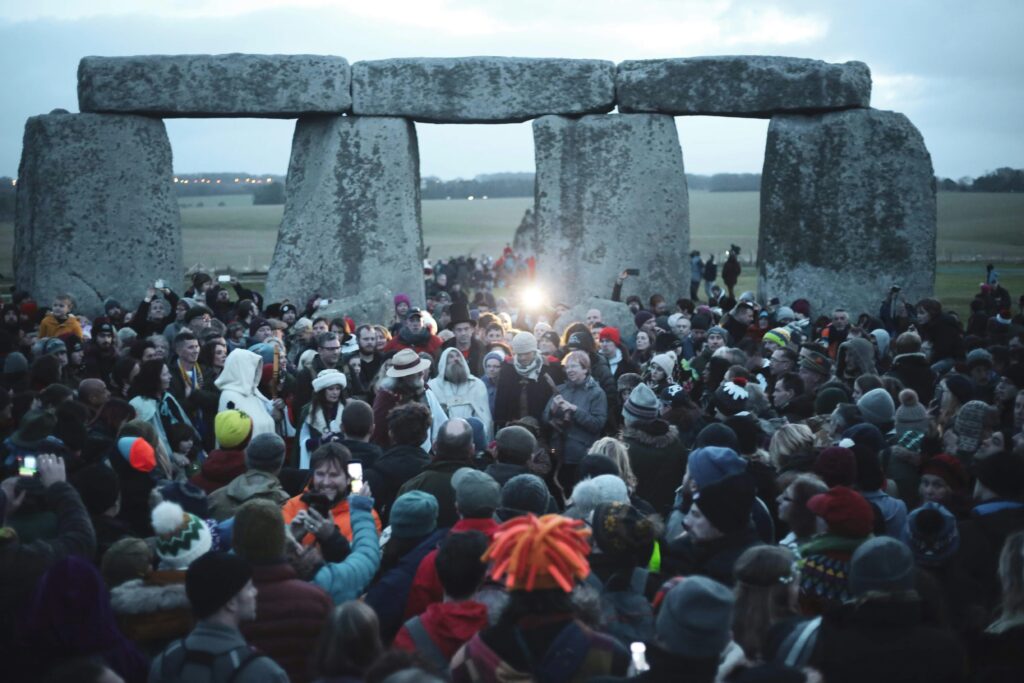
    Winter Solstice celebration at Stonehenge
    Photo by Dyana Wing So on Unsplash

    Ogham might have remained a dusty academic curiosity locked in medieval manuscripts if not for a 20th-century poet who saw the magic hidden within the notches.

    In 1948, the British poet and scholar Robert Graves published The White Goddess, a dense, highly complex, and deeply poetic exploration of ancient mythology. Graves became fascinated by a specific detail found in the old Ogham tracts: the names of the letters themselves.

    In Ogham, the letter ‘B’ is Beith, which translates to Birch. The letter ‘D’ is Dair, meaning Oak. ‘C’ is Coll, meaning Hazel. Graves popularized the theory that Ogham was fundamentally a “Tree Alphabet.” He proposed that the Druids had created a system where the alphabet doubled as a taxonomy of the forest and a mystical calendar, with each tree representing different seasons, lunar cycles, and spiritual concepts. Oak stood for strength and doors; Birch stood for beginnings and purification.

    While modern historians and linguists fiercely debate the historical accuracy of Graves’s more elaborate theories, the cultural impact of The White Goddess was seismic. Graves took a dead cipher and breathed life back into it.

    His poetic vision of the tree alphabet became the foundational text for the modern Celtic revival. It sparked the imaginations of neo-Pagans, artists, and fantasy authors. Today, if you walk into a new age shop, you will find Ogham carved into wooden staves for divination, or printed on tarot-style oracle decks. It has become a staple of modern fantasy literature, representing a deep, earthy magic that predates the written word.

    The druids may have refused to write their secrets down, but their cipher survived. It evolved from a blade carving on a misty battlefield, to ink on medieval vellum, to a modern symbol of our enduring connection to the natural world.
  • The Book of Kells: Early Inspiration For Celtic Art

    Archivist’s Note: This briefing contains affiliate links. If you acquire an artifact through these links, the Archive may earn a small commission at no extra cost to you, which helps keep the candles lit.

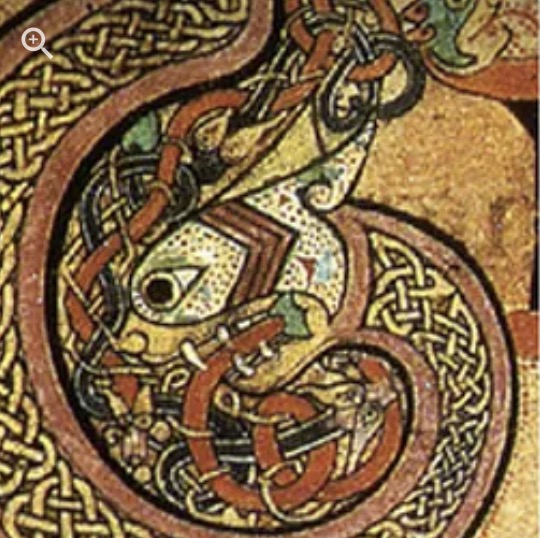
    Book of Kells image
    Screenshot

    In the year 806 AD, the sky over the Scottish island of Iona darkened with the sails of Viking longships. When the raid was over, 68 monks lay dead. The survivors fled across the sea to Ireland, seeking sanctuary in the Abbey of Kells.

    They left behind their homes, their safety, and their silver. But they carried one object with them—a book so valuable, so painstakingly crafted, that it was worth dying to protect.

    This wasn’t just a copy of the Gospels. It was a masterpiece of obsession. Today, we call it the Book of Kells. It’s one of the most famous illuminated manuscripts ever created. It also served to inspire thousands of artists who continued the tradition of traditional Celtic iconography.

    The Architecture of a Masterpiece

    To understand the Book of Kells, you have to forget everything you know about modern publishing. This book wasn’t printed; it was grown, hunted, and mined.

    The pages themselves, all 680 of them, are made of vellum, requiring the skins of an estimated 185 calves. But the true magic lies in the ink. The monks didn’t just use local pigments. They used crushed lapis lazuli brought all the way from the mountains of Afghanistan, bright red lead, and iron gall ink that literally bites into the vellum as it dries.

    But the materials are only half the story. The real mystery is what they chose to draw with them.

    Zoomorphic Illusions: The Beasts in the Ink

    When you look at the Book of Kells, your eyes are immediately drawn to the massive, labyrinthine Celtic knots. The geometry is so complex, so impossibly tight, that some historians have joked it must have been drawn by angels.

    But look closer, and the geometry begins to move.

    The Book of Kells is famous for its “zoomorphic” imagery—art where animals and mythical beasts are twisted, stretched, and knotted together to form patterns and letters. A capital letter is more than just a letter; it’s also a serpent swallowing its own tail. A border isn’t just a line; it is a tangled mass of elongated hounds, birds, and lions, biting and gripping one another in an eternal, silent struggle.

    Why would monks fill a sacred text with such chaotic, almost pagan imagery?

    Because they were Irish and Scottish scribes, and the old world was still in their blood. They took the ancient Celtic tradition of knotwork—symbols of eternity and the interconnectedness of life—and fused it with their new faith. They drew peacocks (a symbol of immortality), snakes (representing resurrection through the shedding of skin), and mythical beasts that seem to defy categorization entirely.

    A Living Legacy

    The monks of Iona and Kells created a beautiful, decorative book that’s still admired centuries later. Beyond this, they codified an entire visual language.

    Consider Celtic art today and you’ll see elements like the intricate knotwork on a silver ring, all kinds of zoomorphic tattoos, the fantasy illustrations of dragons and wolves woven into endless loops. Many are the direct descendants of the Book of Kells (though artists, naturally, have all kinds of influences). Those anonymous scribes, working by candlelight while the world outside descended into the Dark Ages, created an aesthetic that has survived for over a thousand years.

    It is a reminder that sometimes, the most enduring way to protect a secret is to hide it in plain sight, tangled in the ink.

    The Book of Kells Today: The Road to Dublin

    The fact that we can still look at these monsters today is nothing short of a miracle. The Book of Kells had to survive the Vikings and, subsequently, all kinds of political chaos.

    In the year 1006, the manuscript was stolen from the church at Kells in the dead of night. It was missing for months, eventually found buried under a pile of dirt. Its jewel-encrusted gold cover had been violently ripped off and lost to history, but the vellum pages miraculously survived the damp Irish soil.

    Centuries later, during the brutal Cromwellian campaigns of the 1650s, the church at Kells was occupied by cavalry. To save the book from being trampled or burned by soldiers, it was secretly smuggled out of the ruins and sent to Dublin for safekeeping. In 1661, it was presented to Trinity College. It has rested there ever since, safely locked away in the shadowy alcoves of the Long Room library.

    If you want to experience this historic wonder for yourself and aren’t near Trinity College in Dublin right now, you can find some beautiful illustrated reprints.

  • The Lost Art of the Celestial Chart

    Archivist’s Note: This briefing contains affiliate links. If you acquire an artifact through these links, the Archive may earn a small commission at no extra cost to you, which helps keep the candles lit.

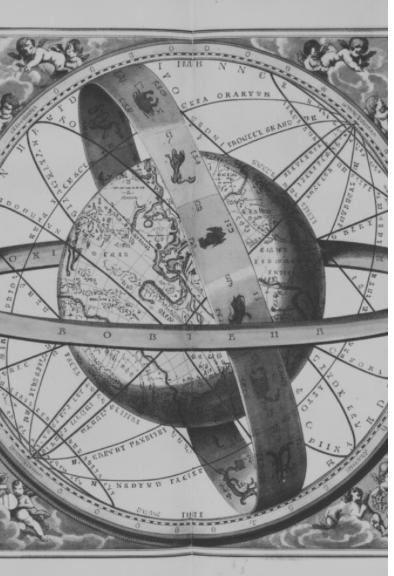
    Celestial map from Andreas Cellarius's Harmonia Macrocosmica atlas.

    In 1660, the night sky was more than pretty scenery; it was a living theater and the realm where gods, heroes, and monsters dwelt.

    There were no streetlights, no glowing screens, no light pollution softening the dark. When the sun went down, the heavens blazed to life—thousands upon thousands of stars stitched across an ink-black sky. For sailors navigating unknown seas and travelers crossing unmarked land, those stars weren’t poetic. They were essential. But they were also overwhelming. How do you memorize infinity?

    The answer, it turns out, was storytelling.

    Before astronomy became a discipline of data tables and telescope imagery, it was something closer to myth-making. Early celestial charts didn’t just plot coordinates. They populated the sky. That cluster of stars wasn’t merely a pattern—it was Orion, the hunter, forever pursuing the Pleiades. A curl of faint light became the tail of Scorpius. The art wasn’t decorative; it was mnemonic. Pictures helped observers remember what they were seeing. “That’s not just three stars,” a teacher might say. “That’s Orion’s Belt.” The sky became a cast of characters.

    In this era—the sky before science as we know it—magic and measurement shared the same page.

    The Most Famous Celestial Atlas of All Time

    Enter Andreas Cellarius.

    In 1660, the Dutch-German cartographer published Harmonia Macrocosmica, a celestial atlas that many consider the most beautiful ever created. If modern star charts are spreadsheets in the dark, Cellarius’s maps are theater. His pages glow with deep, velvety blues and luminous golds.

    Constellations are more than just patterns noticed by people with vivid imaginations. They are grand figures sweeping across the heavens: heroes brandishing swords, sea monsters coiling between stars, zodiac figures marching along the ecliptic. Ornate borders frame the skies, filled with cherubs, classical scholars, and elaborate cartouches. It is science wrapped in spectacle.

    Cellarius was working at a turning point. The 17th century was alive with astronomical revolution. It was the time of Copernicus, Galileo, and Kepler. The cosmos was being redrawn in radical ways. Yet Harmonia Macrocosmica still held onto the old visual language of myth. It mapped both competing models of the universe—the Earth-centered and the Sun-centered—without choosing sides too forcefully. In its pages, astronomy hadn’t yet shed its poetic skin.

    That’s why the atlas feels so alive. It belongs to a moment when observing the sky was not just technical; it was existential. The stars were navigational tools, religious symbols, astrological omens, and scientific data all at once.

    Today, our star maps look very different. Open a modern astronomy app and you’ll see clean lines, minimal design, precise labels. Efficient. Accurate. A triumph of clarity. But also, perhaps, a little sterile.

    The Fascination With Celestial Charts Persists Today

    Our fascination hasn’t faded.

    We may no longer steer ships by Orion or consult the heavens for prophecy, but we still decorate our walls with vintage star charts. We hang zodiac prints in our bedrooms. We stick glow-in-the-dark stars to our children’s ceilings. In cities where the real constellations are washed out by sodium lamps and LED glare, we recreate them indoors. It’s an act of quiet longing.

    Why?

    Because ancient celestial charts remind us that the sky once felt personal. The stars were not just hydrogen spheres millions of light-years away —they were hunters, queens, dragons, and bears. They were stories we could hold onto in the dark.

    In an age where we can barely see the Milky Way from our backyards, we still crave that sense of cosmic drama. We want the sky to mean something.

    The lost art of the celestial chart shows us that before science became specialized, it was beautiful. Before it became all about data and abstract theories, it was narrative. And perhaps that’s why these old maps endure, not just as historical artifacts, but as reminders that the universe has always been more than a set of coordinates.


  • The Seal of Silence: Why the Signet Ring was the Original Encryption

    Archivist’s Note: This briefing contains affiliate links. If you acquire an artifact through these links, the Archive may earn a small commission at no extra cost to you, which helps keep the candles lit.


    Old signet ring on table with candle.

    In a world of digital passwords and biometric scans, we have forgotten the weight of a physical secret. But in the 19th century, security was a matter of heat, pressure, and a single, unique mark of gold. To break a wax seal was a serious breach of privacy and a violation of some of that age’s most sacred values.

    The Ritual of the Script

    Before a letter was ever read, it was “authorized.” The sender would melt a stick of deep red or black wax over a flickering candle, letting the molten pool settle onto the parchment. Then came the moment of identity: the press of the seal. Whether it was a heavy brass desk seal or a gold signet ring worn on the hand, that impression was a legal signature. In an era where literacy was not universal, your mark was your bond.

    The Wearable Signature: Desk Seals vs. Signet Rings

    There is a distinct evolution in the tools of the Archive. A desk seal, often crafted with an ivory or wooden handle, was a stationary tool of the home office, a scholar’s instrument. But the Signet Ring was a wearable signature. It allowed the traveler, the soldier, or the diplomat to carry their identity with them.

    These rings were often carved in intaglio—the image was sunken into a stone like bloodstone or carnelian, and always in reverse. To see the true face of the ring, you had to press it into the wax. It was a mirror image of the soul, revealed only in the act of sealing a secret.

    The Sherlockian Connection

    The stakes were high. A signet ring was so tied to an individual’s power that it was often destroyed upon their death to prevent forgeries. In the world of Sherlock Holmes or Agatha Christie, a tampered seal was the first clue to a deeper conspiracy. If the wax was cracked or the impression was off by even a fraction of a millimeter, the game was afoot.

    The Modern Return to the Tactile

    Why do we still crave the click of a brass seal today? Perhaps because some messages are too important to be digitized. When you seal a letter with wax, you are telling the recipient that the contents are for their eyes only. You are reclaiming a moment of deliberate stillness in a world of digital noise.

    The Analyst’s Acquisitions Desk

    If you are looking to begin your own ritual of the script, the Archive has curated a selection of authentic artifacts and tools:

    Browse Antique Signet Rings  Wearable history and heraldic identity.

    Browse Vintage Desk Seals  The stationary tools of the 19th-century scholar.

    Aquire Sealing Wax & Supplies  Everything needed to secure your own secrets.


  • The Ancient Library of Alexandria: Clues to Ancient Technology and Lost Civilizations

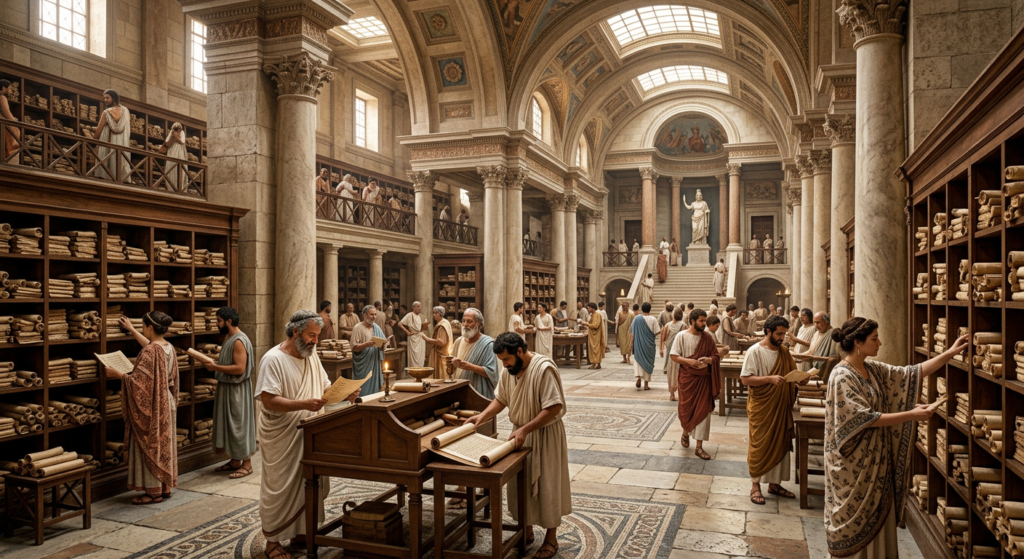
    Ancient Library of Alexandria

    We are taught to view the destruction of the Great Library as a tragedy of art and philosophy, leading to a cultural dark age brought on by fire and hubris. History books tell us to mourn the lost plays of Sophocles, the missing dialogues of Aristotle, and the vanished verses of Sappho. However, the tragedy of Alexandria wasn’t only the loss of our poetry. It was also the severing of our technological timeline.

    Look past the marble statues and the philosophical debates, and you will find a different kind of archive. The Library of Alexandria was the ancient world’s premier research and development laboratory. In addition to literature, it was a repository of schematics, diagrams, and the tactile, mechanical blueprints of a future that has faded into obscurity. Aside from losing history, we lost our science fiction –and, according to some theories, incredibly advanced technology. We lost blueprints for machines that could have propelled humanity into an industrial revolution almost 2,000 years before the Victorian era.

    The Archive at the Center of the Ancient World

    Before we sift through the ashes, we must understand the monument that burned. Founded in the 3rd century BC under the Ptolemaic dynasty, the Great Library was a royal obsession. The mandate given to its scholars was simple but terrifying in its scope: collect all the knowledge in the world.

    One thing many people don’t realize is that the Library had an imperialistic quality. You have to remember the historical context; we aren’t talking about a modern democracy but an ancient monarchy. The librarians of Alexandria were ruthless acquirers. They didn’t just ask politely for donations. By royal decree, any ship docking in the city’s harbor was searched. If a manuscript or scroll was found, it was confiscated and copied by scribes. The copy was handed back to the ship’s captain; the original was locked away in the Library’s vaults.

    At its height, the archive held hundreds of thousands of papyrus scrolls, encompassing the collective memory of the Mediterranean, the Middle East, and beyond.

    A Gradual Destruction

    While popular legend blames a single, apocalyptic fire set by Julius Caesar in 48 BC (and, later, by Muslim invaders) the truth is a slower, more agonizing death by a thousand cuts. There were centuries of sieges, riots, and bureaucratic neglect. The end result was that the world’s greatest concentration of human intellect was erased from the map.

    Engineers and Futurists of the Ancient World

    To understand what burned, we must examine the fragments that survived.  The ancient world was not a primitive landscape of stone and superstition; it was a realm of bronze gears, hydraulic valves, and programmable automata.

    Consider Hero of Alexandria. Walking the halls of the Great Library in the first century AD, Hero was a mathematician and a visionary engineer. Many of his ideas weren’t implemented for over a millennium after his death. Among his surviving texts are the schematics for the aeolipile –the world’s first recorded steam engine.

    Picture it: a brass sphere spinning violently on its axis, powered entirely by pressurized steam, centuries before the coal-choked skies of industrial age London. Hero also designed wind-powered organs, automated theatrical props that operated on complex pulley systems, and even the world’s first vending machine. These were not mere fanciful works of art; they were the prototypes of a mechanized society, meticulously drafted on papyrus scrolls that were housed within the Library’s walls.

    The World’s First Computer

    Then, there is the Antikythera mechanism. Recovered from a shipwreck off the coast of a Greek island, this corroded lump of bronze and wood was initially dismissed by historians. But under the penetrating gaze of modern X-rays, it revealed itself to be an analog computer of staggering complexity. Dating back to the 2nd century BC, its interlocking gear trains tracked the cycles of the solar system, predicted eclipses, and calculated the irregular orbit of the moon with a precision that wouldn’t be seen again until the development of Swiss clockmaking in the 14th century.

    The Antikythera mechanism proves that the theoretical physics and advanced mathematics stored in Alexandria were actively being translated into high-tech hardware. If a device of this magnitude were lost to the bottom of the sea, we must ask ourselves: What other impossible machines were cataloged in the Great Library? What other blueprints were reduced to cinders before they could be built?

    The Forbidden Histories

    If the Library held the blueprints for tomorrow, it also guarded the forbidden maps of antiquity. When you gather all the knowledge of the known world into one place, you inevitably collect the ghosts of civilizations that came before. This is where history, speculation, and even conspiracy theories merge.

    We know that the Library housed the exhaustive works of historians like Manetho, an Egyptian priest, and Berossus, a Babylonian astronomer. Both wrote sweeping, multi-volume histories of their respective cultures, detailing chronologies of kings and cataclysms that stretched back tens of thousands of years —long before the conventionally-dated dawn of human civilization. Today, their original scrolls are entirely lost, surviving only as fragmented quotes in the texts of later, often skeptical, writers.

    Perhaps the most tantalizing speculation surrounds the original source material for the world’s most famous lost empire. The most widely known accounts of Atlantis were recorded by Plato. His accounts, though often dismissed as myth, weren’t created in a vacuum. He claimed the story was passed down from the Greek statesman Solon, who had translated it directly from the sacred pillars of Egyptian priests at Sais. Given the Ptolemaic dynasty’s obsession with hoarding Egyptian records, it is certainly plausible that the original, unfiltered accounts of Atlantis, not as a philosophical allegory, but as a geographical and historical reality, rested on the shelves of Alexandria.

    Today, you can find countless books, documentaries, and websites on topics such as alternative or “forbidden” history, with theories ranging from aliens to angels that explain lost wonders. The Library, meanwhile, serves as a tenuous bridge between recorded history and wild speculation.

    What if the Library contained the true, unredacted history of humanity? Accounts of antediluvian empires, maps of sunken continents, and the records of a species that had risen to technological heights and fallen back into the mud long before the first pharaoh took the throne.

    New Discoveries

    Perhaps not all of this fascinating history was erased. In fact, archeologists are uncovering artifacts all the time, including remnants of Pharos, the Lighthouse of Alexandria. This can give us hope that more evidence from the Library may still be found.

    For over a millennium, the ruins were thought to be lost forever. But recent underwater archaeological expeditions have begun to pull the ancient city back from the abyss. Divers navigating the murky harbor floor have discovered colossal sphinxes, submerged temples, and massive granite blocks belonging to the Pharos—the Great Lighthouse of Alexandria. The Lighthouse itself was a marvel of ancient high-tech engineering, reportedly utilizing a massive, mysterious mirror system to project light for miles, or, as some darker legends claim, to focus the sun’s rays and burn enemy ships.

    The ramifications of these underwater discoveries are staggering. If the monumental architecture of the Ptolemies survived beneath the waves, what else lies buried in the silt? Could there be sealed, water-tight vaults? Bronze mechanisms encased in coral? The discovery of the sunken city proves that Alexandria’s secrets weren’t entirely vaporized into ash; some were swallowed by the sea. And the sea is slowly starting to yield its ghosts.

  • The Timeless Power of the Pen: Why Handwriting Still Matters in the Digital Age

    Archivist’s Note: This briefing contains affiliate links. If you acquire an artifact through these links, the Archive may earn a small commission at no extra cost to you, which helps keep the candles lit.

    Person writing with a pen in a notebook. Since the dawn of recorded history, humans have sought ways to leave their mark. From the earliest cuneiform etched into clay to the elegant calligraphy of the Renaissance, the act of writing by hand has been the primary vehicle for human thought, history, and emotion. While the 21st century has ushered in an era of unprecedented digital efficiency, the humble pen remains one of our most powerful cognitive and creative tools. Far from being an obsolete relic, handwriting offers unique neurological and personal benefits that keyboards simply cannot replicate.
    The Neurological Symphony of Writing

    Recent scientific research has begun to quantify what many writers have long felt: writing by hand engages the brain in a fundamentally different way than typing. As NPR reports, neuroscientists have found that handwriting is one of the most complex motor skills the human brain can perform. Unlike the uniform, repetitive motion of pressing keys, handwriting requires a sophisticated coordination between the motor and visual systems.

    When you write by hand, your brain must continuously monitor the pressure of your fingers and the precise movement required to form each unique letter. This complexity causes different parts of the brain to “sync up.” Brain imaging studies show that handwriting activates areas involved in motor processing and visual information, which in turn fire at frequencies associated with learning and memory formation.

    For students and professionals alike, this means that taking notes by hand isn’t just a slower way to record information; it’s also a more effective way to process and retain it. The physical act of forming letters creates “neural hooks” that help the brain retrieve information later.

    A Different Kind of Creativity

    Choosing to write by hand does not mean rejecting modern technology. Computers and smartphones are indispensable for editing, long-form production, and instant communication. However, handwriting offers a different “mode” of expression. Because it is naturally slower, it forces the writer to pause and think more deeply about their word choices. This deliberate pace can act as a meditative practice, reducing the “digital noise” and allowing for a more focused flow of ideas.

    Many famous authors, such as Neil Gaiman and Jennifer Egan, still choose to draft their first versions by hand. They find that the tactile connection between the hand and the page stokes a specific kind of creativity that a blinking cursor can sometimes stifle. Handwriting allows for a non-linear expression of thought—you can scribble in the margins, draw arrows between ideas, or sketch a quick diagram—making the page a truly flexible canvas for the mind.

    The Joy of the Tangible: Vintage Pens and Stationery

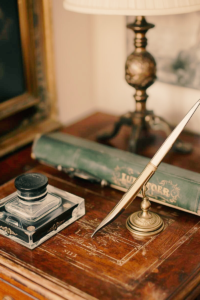
    Dip pen and inkwell on antique writing desk.

    Beyond the cognitive benefits, there is a profound aesthetic and sensory joy in the practice of handwriting. In a world of mass-produced plastic and digital pixels, using an antique fountain pen or a piece of heavy, textured stationery feels like a return to craftsmanship. There is a unique thrill in finding a vintage pen that has its own history and character, or in choosing a specific ink color that reflects your mood.

    The “feedback” of a nib on paper—the slight scratch or the smooth glide—provides a sensory satisfaction that a glass screen cannot offer. Collecting vintage writing instruments and high-quality paper transforms a mundane task into a hobby and a form of self-care. It turns a simple thank-you note or a journal entry into a personal artifact, something that carries the physical weight of the person who created it.

    BROWSE VINTAGE PENS, INKWELLS, & STATIONARY

    Take Part in a Timeless Tradition

    Handwriting is more than just a way to record words; it is a bridge between our physical bodies and our mental worlds. By engaging our brains more deeply, slowing our thoughts, and allowing us to interact with beautiful, tactile objects, it enriches our lives in ways that digital tools cannot. Whether you are a student trying to master a new subject or a creative looking for a fresh perspective, picking up a pen might be the mosthigh-tech thing you can do for your brain today.