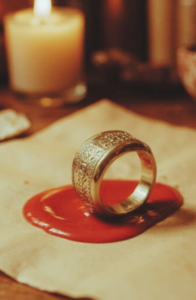

There’s something almost unfair about Victorian compartment rings (also known as poison rings): they’re too beautiful to be so unsettling.
At first glance, the piece looks like any other gem-set ring —an opal with a milky flash, a garnet glowing like a held ember, a sober onyx that drinks the light. But the mystery is not the stone. It’s what the stone hides. With a careful twist, a hinge, or a discreet latch, the setting opens to reveal a tiny cavity tucked behind the gemstone: a private chamber pressed against the skin, invisible to anyone who doesn’t know where to look.
And that’s where the ring’s dark charisma begins. The exact same design, this miniature secret compartment, served the two extremes of human experience. It could be a vessel for murder, meant to deliver poison with a theatrical flick of the hand. Or it could be a reliquary for love, meant to hold a lock of hair, a painted portrait, or a trace of the dead carried close as a vow. In a culture obsessed with memento mori —“Remember that you must die”— the compartment ring became a wearable paradox: romance and rot, devotion and danger, tenderness and threat.
A Secret Compartment, Not a Public Seal: Compartment Rings vs. Signet Rings
It helps to contrast compartment rings with their more straightforward cousin, the signet ring (discussed in another post). A signet is designed for declaration. Historically, it bore a family crest or personal emblem, pressed into wax to seal letters and announce identity. Even when worn purely as style, the signet’s job is still public: it says, this is who I am, in broad, readable strokes.
A compartment ring does the opposite. It is for concealment rather than proclamation. If a signet ring is a signature on display, a compartment ring is a locked drawer. Its meaning depends on what you can’t see and what the wearer won’t say.
Ancient Origins and Renaissance Intrigue
Jewelry with hidden spaces didn’t begin in the 1800s. Across ancient and medieval worlds, small personal containers such as amulets, pendants, and rings held everything from perfumes and medicinal compounds to sacred relics and protective charms. The idea is timeless: if something matters enough, you keep it close and well hidden.
By the Renaissance, the hidden compartment gained a more glamorous and sinister reputation. Tales of elite intrigue and courts full of shifting loyalties and sudden deaths made secrecy fashionable. Figures like the Borgias became shorthand for a whole genre of whispered history: beautiful objects, impeccable manners, and danger served in a goblet. Whether every story was true hardly mattered. The lore stuck. The “locket ring” became a character in the public imagination: a tiny stage prop for betrayal.
The Victorians and the Pleasure of the Dark
Victorian culture had an appetite for the macabre that feels startlingly modern. This was the era of gothic novels, sensational newspaper reports, spiritualism, séances, and graveyard imagery softened into art. Death was not hidden away. It was ritualized, symbolized, and—often—beautifully merchandised.
Memento mori wasn’t merely an aesthetic; it was an emotional philosophy. To remember death was to intensify life, to make love feel urgent and devotion feel sacred. A ring that literally contained a secret under a gemstone fit the worldview perfectly. It offered a controlled flirtation with mortality: a tiny “what if” worn on the hand.
Victorians were fascinated by the legend of poison rings for the same reason people today binge true crime or collect antique mourning jewelry on social media. The idea was thrilling precisely because it was intimate.
Queen Victoria and a Nation in Mourning
Then came the pivot from lethality to longing.
When Prince Albert died in 1861, Queen Victoria’s grief became national policy. Her prolonged, highly visible mourning shaped fashion, etiquette, and the emotional temperature of an entire society. Black clothing, jet jewelry, strict social rules around bereavement—mourning became both private suffering and public identity.
In that climate, compartment rings found a new purpose. The secret space behind the stone no longer had to suggest poison. It could hold something, in its own way, far more haunting: a fragment of the beloved. A curl of hair. A tiny painted portrait. A scrap of fabric. Sometimes even a small inscription folded tight, like a message meant to be read only by the living hand that wore it.
The compartment became a domestic shrine. The hand that once might have been imagined slipping a powder into wine could now be imagined stroking a coffin lid, then returning to daily life with grief hidden under a gemstone.
Hair Weaving: The Macabre Romance of Victorian Craft
Nothing captures Victorian sentimentality quite like hair jewelry. To modern sensibilities, it can feel unsettling. Hair is intimate in a way flowers and photographs aren’t. But that intimacy was the point.
Hair weaving transformed a physical remnant into a crafted artifact. Braided, plaited, or arranged into delicate patterns beneath glass, hair became a material of devotion, an enduring part of a person when everything else was subject to decay. It was also practical. Hair lasts. It is stubbornly permanent, a quiet rebuke to the body’s fragility.
Placed into the hidden compartment of a ring, a lock of hair became a private memento that could travel anywhere. Mourning jewelry wasn’t only about sadness; it was about continuity. The Victorians made grief wearable so that love wouldn’t have to end just because a life did.
The dichotomy of the compartment ring has a deep philosophical meaning. The same secret space that could carry death could also carry the refusal to let love die.
Why We’re Still Obsessed
We live in an era of glass screens and public oversharing. Yet the appeal of hidden compartments hasn’t faded. If anything, it has intensified. Victorian compartment rings speak to a craving that never goes away: the desire for mystery in a world that often feels too exposed.
They also offer connection. To hold an object that once held something—poison, prayer, hair, a miniature portrait—is to feel history as something tactile, not abstract. A compartment ring insists that the past was not just politics and dates, but hands and heartbeats, dinner parties and funerals, love letters and losses.
In the end, Victorian compartment rings endure because they refuse to choose a single meaning. They are simultaneously romantic and ominous, devotional and suspicious. They remind us that human beings have always been capable of tenderness and violence—sometimes in the same breath, sometimes in the same hand.
Partake in this Mysterious Tradition
Archivist’s Note: This briefing contains affiliate links. If you acquire an artifact through these links, the Archive may earn a small commission at no extra cost to you, which helps keep the candles lit.
You may come across a genuine Victorian compartment or poison ring in an antique store, or online auction. Until you find the perfect piece, you can get a modern replica of a vintage poison ring. Use only for a fashion statement or to store harmless items!
Learn more about the fascinating period of English history when Queen Victoria reigned.