
Before glowing orbs, alien theories, and midnight pranksters with planks of wood, England had another explanation for strange formations in its fields: the Devil had been at work.
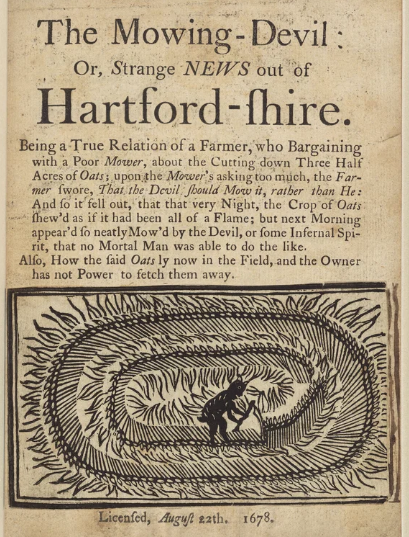
In August 1678, an anonymous pamphlet appeared with the wonderfully ominous title The Mowing-Devil: Or, Strange News out of Hartford-shire. It tells the story of a farmer in Hertfordshire whose ripe oat field became the setting for a dispute, a curse, and an alleged overnight visitation from something infernal.
It is now often called an early account of a crop circle. But like so many enduring mysteries, the real story is stranger and more revealing than the label suggests.
The tale begins not with lights in the sky, but with a wage argument.
According to the pamphlet, a “rich industrious farmer” needed three and a half acres of oats harvested. He approached a poor local mower to negotiate the work. The laborer named a price the farmer considered too high; the farmer offered much less. Sharp words followed. Even when the mower reportedly returned and offered to accept a lower wage, the farmer’s temper had hardened. He declared that “the Devil himself should mow his oats” before the man would be hired.
It is the sort of reckless phrase people still say in frustration, though perhaps with less theological weight than it carried in seventeenth-century England.
That night, passersby allegedly saw the oat field burning—or at least appearing to burn. By morning, the flames had vanished. In their place lay an unnervingly transformed field: the oats had been cut down in what the pamphlet called round circles, each stalk arranged with a precision no ordinary person could match. The farmer, terrified by what he had invited, supposedly refused to take the crop away.
The pamphlet’s woodcut is the detail that has captivated modern imaginations. It depicts a small horned devil wielding a scythe amid a swirling, circular arrangement of oats. When crop-circle fascination surged in the late twentieth century, the image was rediscovered and promoted as perhaps the earliest visual record of the phenomenon. The resemblance is certainly irresistible: a strange overnight formation in an English grain field, arranged in circles, blamed on a nonhuman force.
But the comparison has an important flaw. Modern crop circles are typically made from stalks bent or flattened into patterns. The Mowing-Devil story describes oats that were cut down. The central marvel is not that the crop was pressed into elaborate symbols, but that it had apparently been mown with impossible neatness. The pamphlet insists that the Devil had “cut them in round circles” and placed every straw with an exactness that would have taken a human “above an age” to accomplish.
So, rather than a direct ancestor of the familiar flattened circles seen in modern fields, the Mowing Devil is better understood as an early modern tale of supernatural harvest. Its connection to crop circles lives largely in its image and in our continuing desire to find eerie patterns in old stories.
The original pamphlet was licensed on August 22, 1678, and was written in the style of “strange news,” a popular early form of sensational print that mixed wonders, moral lessons, religious anxieties, and alleged eyewitness testimony. It presents itself as a true account but gives no farmer’s name and no precise location within Hertfordshire. That ambiguity makes the incident impossible to independently verify.
Its true purpose may not have been to document an agricultural mystery at all.
At its heart, the story is a moral fable about wealth, labor, and the consequences of exploiting workers. The farmer is repeatedly described as rich; the mower, as poor. The writer takes pains to portray the laborer’s requested payment as an understandable attempt to earn a living through “the sweat of his brows and marrow of his bones.” In contrast, the farmer’s refusal to pay a fair wage—and his angry invocation of the Devil—became the sins that summoned disaster.
The Devil, in this version of rural justice, is less an alien visitor than a grimly efficient laborer. He completes the harvest, but he does so in a manner that renders it useless to its owner. The crop lies in the field; the frightened farmer cannot bring himself to touch it. It is a supernatural punishment tailored perfectly to greed.
There are, of course, fewer spectral possibilities. The text’s claim that the field seemed to be on fire may point toward a real blaze, embellished into a moral tale. It is also possible that the story was invented entirely as cheap, entertaining print. Another possibility is far more earthly: a resentful laborer, or maybe a sympathetic neighbor, may have damaged or cut the field after the wage dispute, leaving the supernatural explanation to circulate afterward.
We’ll never know for sure after all this time. What remains is a small woodcut, a field of oats, and a warning that has survived more than three centuries.
The Mowing Devil may not be proof that crop circles existed in seventeenth-century England. But it is a compelling ancestor to the modern mystery: an image of patterned crops, unexplained labor, and a community confronting something it can’t explain. Long before people looked to the skies for answers, they looked at the darkened field beyond the cottage window and imagined a scythe moving through the grain.
Sources: The Public Domain Review’s illustrated overview of the 1678 pamphlet; a transcription and discussion of the original text; and context on the pamphlet’s moral and labor-dispute themes.
Leave a Reply