
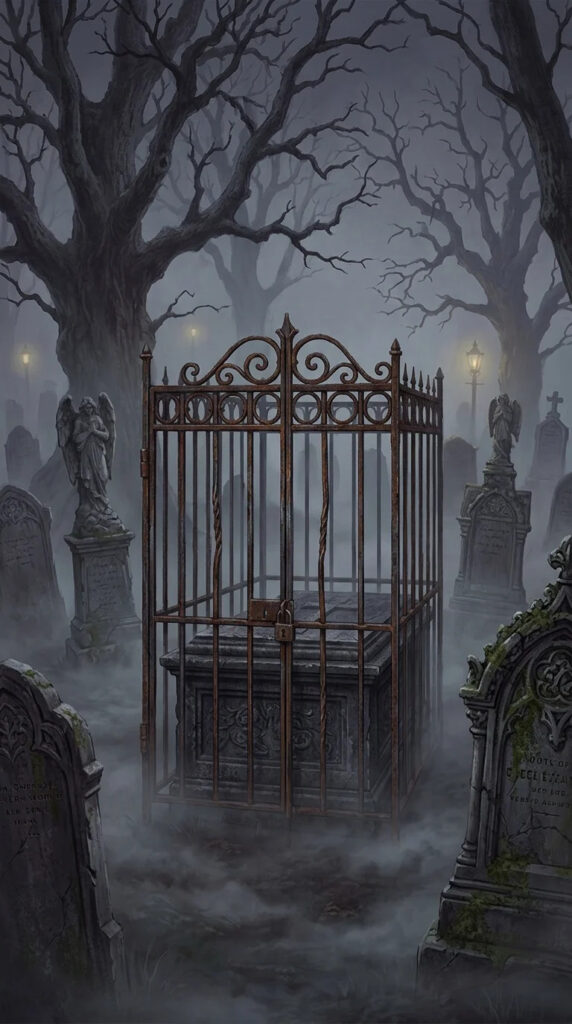
Walk through an old Victorian graveyard long enough and you may find them: graves enclosed in heavy iron bars, their dark metalwork rusted by rain and time. At first glance, they look like something imagined for a Gothic novel—a prison for the dead, perhaps, or a precaution against some unspeakable resurrection such as a zombie or vampire.
But these cages were not meant to keep anyone in.
They were designed to keep someone out.
During the early nineteenth century, medical science had an uncomfortable problem. Anatomy schools needed human bodies for teaching, yet the legal supply of cadavers was extremely limited. In Britain, anatomists could generally dissect only the bodies of executed criminals. As executions became less frequent while medical education expanded, demand vastly outstripped supply.
The result was a grim and lucrative black market.
“Resurrectionists,” as grave robbers were sometimes called, would dig into freshly made graves—often under the cover of darkness—and remove the body. Contrary to popular Gothic imagery, they usually had little interest in jewelry or coffins. Stealing possessions was a serious felony; stealing a corpse, bizarrely, was not treated in quite the same way. Their prize was the newly buried body itself, which could be sold to anatomy schools.
For grieving families, the thought was intolerable. Burial was meant to offer dignity, peace, and finality. Instead, mourners had to fear that a loved one might be taken from the earth only days after the funeral.
So communities devised defenses worthy of a Victorian nightmare.
One of the most striking was the mortsafe: a heavy iron structure placed over a fresh grave. Some were cage-like frameworks, while others used thick iron plates, stone slabs, or massive weighted devices. Their purpose was simple: make it too difficult and time-consuming for grave robbers to reach the coffin before dawn.
These devices were especially common in Scotland, where the body-snatching crisis became notorious in the early 1800s. Many mortsafes were not permanent. Families or parish authorities might rent one for several weeks, leaving it over the grave until the body had decomposed enough that it was no longer valuable to anatomists. Then the iron protection could be removed and used again for another burial.
It is a chilling detail: even grief could become a matter of practical logistics.
Not every ornate iron enclosure in a cemetery is necessarily a mortsafe. Some are decorative railings around family plots, intended to display status as much as protect a grave. But when you see low, severe ironwork hugging the earth around an individual burial, you may be looking at the remains of a very real battle between mourning families and the demands of medical progress.
Public outrage over body snatching eventually helped force legal change. Britain’s Anatomy Act of 1832 widened the lawful supply of bodies for medical study, reducing the incentives for resurrectionists to raid cemeteries. The law did not erase the moral unease surrounding anatomical dissection, but it marked a turning point in the strange and sorrowful history of the graveyard cage.
So, the next time you encounter an iron-bound Victorian grave, resist the vampire and zombie theories—tempting though they may be. The bars were not there to imprison the dead.
They were there because, for a time, even the grave was not considered safe.
Leave a Reply