Category: Victorian Curiosities

  • Secrets in the Stacks: The Mysterious History of Bibliocloaking

    Old books on shelves
    Photo by gretta vosper on Unsplash

    Walk into any grand, dimly lit library, and you immediately feel the weight of a thousand stories pressing down from the shelves. But in the shadowed world of the occult, espionage, and Victorian scandal, books were not always used for reading.

    Sometimes, they were the perfect hiding place.

    The practice of hollowing out the pages of a book to conceal an object is known as bibliocloaking. It is a tradition that marries the reverence of literature with the thrill of deception—and it has a surprisingly dark and fascinating history.

    A Vault Hidden in Plain Sight

    The genius of the book safe lies in human psychology. Thieves, spies, and highwaymen might tear apart a mattress, pull up floorboards, or pry off wall panels, but very few criminals have the patience to shake open every single volume in a 5,000-book library.

    During the Renaissance and the Spanish Inquisition, hollowed-out book bindings were occasionally used to transport illicit materials or banned philosophical treatises undetected. By the Victorian era, as personal libraries became a symbol of wealth, the book safe became a staple of the gentleman’s study. They were used to hide scandalous love letters, emergency stashes of coins, and in more sinister cases, vials of arsenic or laudanum.

    The Spy’s Best Friend

    Bibliocloaking wasn’t just for Victorian romance and poisoners. During World War II, British intelligence (specifically MI9) took the concept to a new level. They created specialized books for prisoners of war that had maps, compasses, and tools seamlessly hidden inside the bindings to aid in escapes. To the untrained eye of a guard, it was just a harmless novel.

    A Mystery Novel Staple (And a Cozy Fantasy Favorite)

    Because of its secretive nature, the hollowed-out book naturally became a beloved trope in mystery and gothic literature. From classic Agatha Christie whodunits to modern heist films, the moment a character pulls a specific book from a shelf and the cover swings open to reveal a hidden key or a missing will, the audience leans in.

    It is a trope we love so much here at the Archive that it actually plays a role in the upcoming cozy fantasy novella, The Changeling’s Bookshop! After all, what better place to hide a dangerous magical manuscript than inside the shell of a mundane one?

    🗝️ Hide Your Own Secrets

    (The Ink & Shadow Archive is reader-supported. As an Amazon Associate, we earn a small commission from qualifying purchases made through these links.)

    While we (hopefully) don’t need to hide from the Inquisition or conceal Victorian poisons today, the need for a clever hiding place remains. Whether you want to stash spare keys, emergency cash, or your own private letters, a modern diversion safe is a beautiful, practical addition to any bookshelf.

    Here are a few of our favorite creative hiding spots to add to your own library:

    • The Classic Dictionary Combination Safe – From the outside, it looks exactly like a standard English Dictionary. Inside, it features a heavy steel combination lockbox. Perfect for valuables.
    • Faux-Leather Vintage Book Boxes– If you want the Dark Academia aesthetic without the heavy metal lock, this set of wooden boxes looks like antique, gold-foiled tomes.
    •  The Hidden Compartment Wall Clock– Not a book, but a classic diversion! This working wall clock opens up to reveal shelves for keys and emergency cash, hidden right in plain sight.
  • Gazing Into the Void: The Dark and Mystical History of Scrying Mirrors

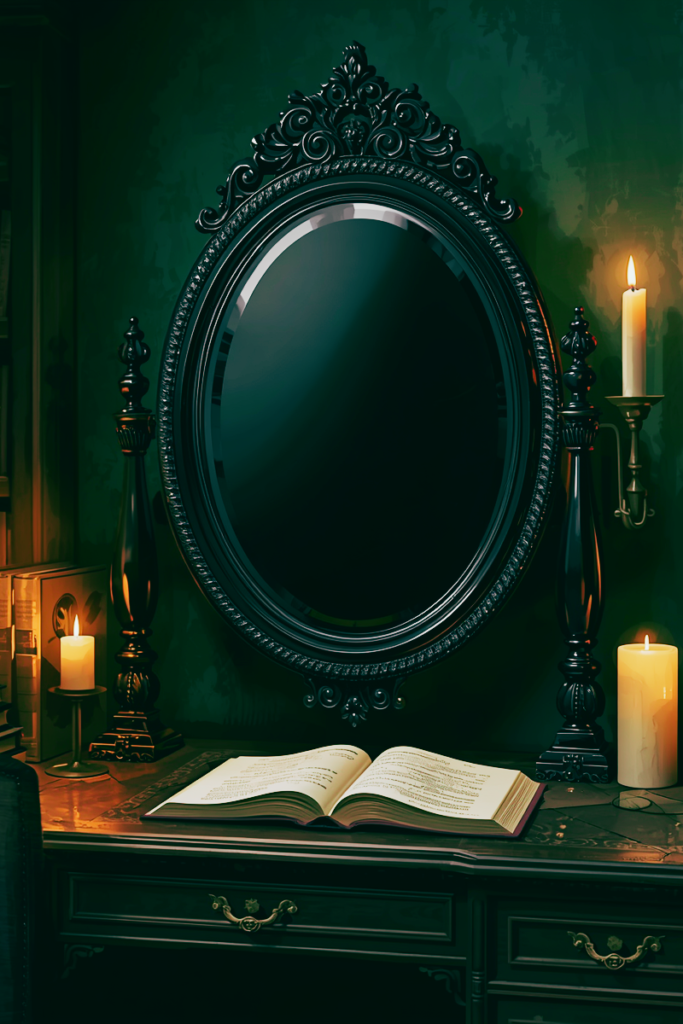
    Dark mirror on wall

    Archivist’s Note: This briefing may contain affiliate links. If you acquire an artifact through these links, the Archive may earn a small commission at no extra cost to you, which helps keep the candles lit.

    When you look into a mirror, you expect the world to reflect back at you exactly as it is. We use silvered glass every day to fix our hair, adjust a collar, or check for a smudge on our cheek. But for centuries, the mirror was not just a tool for vanity; it was a doorway.

    If you step away from the polished silver and look back through history, you will find a much darker artifact: the scrying mirror. Diviners, occultists, and royal advisors didn’t use mirrors to see themselves—they used them to peer into the unknown.

    The Art of the Black Mirror

    Black Mirror is the title of a popular TV show that focuses on dystopian (usually tech-centered) scenarios. But the name comes from something much older. The practice of “scrying” is ancient. It involves staring into a reflective, usually dark surface, like a pool of black ink, a bowl of water, or dark polished stone, until the eyes lose focus and visions begin to appear. It is less about seeing a reflection and more about creating a blank canvas for the subconscious (or the spirit world) to project upon.

    While many cultures practiced water-scrying, the most infamous mystical mirrors were made of solid black obsidian.

    Obsidian is volcanic glass. When highly polished, it becomes a dark, glossy void. Long before European occultists got their hands on them, these mirrors were sacred to the Aztecs in Mesoamerica. They were closely associated with the god Tezcatlipoca, whose very name translates to “Smoking Mirror.” He was the deity of the night sky, divination, and sorcery. The Aztecs believed these mirrors were portals that could bridge the mortal realm with the world of the divine.

    Dr. John Dee’s Angelic Conversations

    Following the Spanish conquest in the 16th century, these sacred obsidian mirrors were brought back to Europe. One of them fell into the hands of a man who would cement the black mirror’s place in Western occult history: Dr. John Dee.

    John Dee was no fringe eccentric; he was the mathematical and astrological advisor to Queen Elizabeth I. He was a brilliant scholar, but his pursuit of knowledge eventually pushed past the boundaries of science and into the occult. Dee wanted to understand the hidden mechanics of the universe, and he believed the answers lay with angels.

    Using an Aztec obsidian mirror, Dee would conduct exhaustive scrying sessions. Because Dee himself was not a gifted “seer,” he employed a medium named Edward Kelley to stare into the dark glass. Kelley would gaze into the black surface for hours, frantically reporting the angelic beings he saw and the cryptic, divine languages they spoke, while Dee dutifully transcribed every word.

    Today, John Dee’s obsidian mirror rests in the British Museum, a quiet, dark stone that once commanded the attention of the English court.

    The Victorian Parlor Seance

    Centuries later, the Victorians, who were always eager to blend the macabre with high society, revived the dark mirror. During the height of the Spiritualist movement in the 19th century, death was a cultural obsession. Grieving families and curious thrill-seekers alike gathered in dimly lit drawing rooms to attempt communication with the “other side.”

    Scrying mirrors became a popular tool for these parlor séances. But there is a very real, very unsettling psychological reason why staring into a dark mirror works. Modern science calls it the Troxler Effect. If you stare at a fixed point in a dim room for long enough, your brain begins to filter out unchanging stimuli. Your peripheral vision blurs, the edges of the mirror seem to warp, and your mind, desperate to recognize patterns in the dark, starts to invent them. Faces twist, shadows move, and suddenly, you are seeing ghosts.

    Whether it was true spiritual communication or just the mind playing tricks in the candlelight, the dark mirror solidified its place as an icon of the macabre.

    Curate Your Own Dark Academia Aesthetic

    If reading about John Dee’s dark mirrors has you wanting to add a little Dark Academia aesthetic to your own bookshelf , here are a few gorgeous, affordable pieces I found to recreate the vibe:

    Black Obsidian Scrying Mirror: A polished volcanic glass mirror, very similar to the ones used by the Victorians.

     Ornate Vintage Hand Mirror: If you prefer the look of the antique silver mirror from my video.

    Flickering LED Taper Candles: The safest way to get that perfect, moody seance lighting for your desk.