Category: Faery lore

  • The Peril of Fairy Rings: Portals, Stolen Time, and Disappearing Forever


    "Plucked From a Fairy Circle"—illustration by T.H. Thomas
    “Plucked from the Fairy Circle”—T.H. Thomas

    If you take a stroll through a mist-laden clearing or a sun-dappled pasture and stumble upon a perfect circle of mushrooms rising out of the turf, your first instinct might be wonder. Today, modern biology demystifies the phenomenon with clean, rational terms: an expanding underground fungal network, or mycelium, consumes nutrients from the soil as it grows radially outward, sprouting fruiting bodies at its outer perimeter after the center exhausts its resources.

    Yet for centuries across the British Isles and Western Europe, a circle of mushrooms was considered one of the most perilous anomalies in the natural world. Long before the term mycelium entered common parlance, Celtic and Victorian folk belief regarded these formations not as fungal quirks but as active thresholds to the Otherworld. They were warning signs etched into the forest floor, and the traditional advice passed down through generations was simple: whatever you do, never cross the boundary.

    Footprints of the Midnight Revelers

    The prevailing belief throughout Ireland, Scotland, Wales, and England was that these circles were forged by the nocturnal dances of the Good Neighbors, the Tuatha Dé Danann, or the Tylwyth Teg. Under the pale light of the moon, fairy folk were thought to gather hand-in-hand, their whirling revels tamping down the soil and causing the grass to wither, darken, or sprout a boundary of toadstools by morning.

    In Wales, where these features were known as cylchau’r tylwyth teg, the center of the ring was believed to be the subterranean roof of a fairy palace. To step onto that patch of earth was to tread directly on the threshold of an unpredictable, mercurial kingdom whose rules of hospitality could turn fatal in an instant.

    Across continental folklore, the interpretations took on an even more sinister cast. In German traditions, they were called Hexenringe, or witches’ rings, believed to mark the scorched clearings where sorceresses danced on Walpurgis Night. In Austrian and French folklore, legends cautioned that the fiery tail of a passing dragon had branded the earth. Across every culture, one core rule remained constant: the ring belonged to another realm entirely, and mortals entered at their own peril.

    The Trap of Endless Music and Lost Centuries

    The greatest danger facing anyone who strayed inside a fairy ring was the enchantment of the dance itself. According to lore, human wanderers—often farmers, pipers, or travelers caught after dusk—would suddenly hear ethereal, intoxicating melodies floating through the air. The music was impossible to resist, instantly sweeping the mortal into a manic, ecstatic waltz alongside invisible or shimmering beings.

    The true horror of this encounter lay in the temporal distortion of the fae realm, where time did not flow in linear strides. To the bewitched mortal, the spinning dance felt like a brief, joyous reverie of a few minutes or hours. In the human realm, however, days, decades, or entire centuries melted away.

    One famous Welsh legend tells of two farmhands, Rhys and Llewellyn, walking home in the twilight. When Rhys paused near a fairy ring, captivated by faint harps, he vanished before his companion’s eyes. Suspected of murder, Llewellyn spent an entire year searching for his friend until a local wise man advised him to return to the very same spot on the exact anniversary of the disappearance.

    With an iron tether tied around his waist to ground him in the mortal realm, Llewellyn reached into the circle and pulled Rhys out by his coattails. Rhys was clutching a handful of withered leaves, completely oblivious to his absence. He turned to Llewellyn and irritably asked why he had interrupted the dance after barely five minutes, only to discover that a full year had passed, his farm had fallen into disrepair, and his family had long since held his funeral.

    In darker tales, victims who were rescued and tasted mortal food or water crumbled instantly into dust, their bodies finally succumbing to the hundreds of years that had elapsed while their feet never stopped moving.

    Prisoners and Changelings

    For those who escaped the deadly dance, other fates awaited. Folklore held that the fairies used these rings as snare traps to procure human thralls, brides, or nursing mothers. A human pulled beneath the fungal threshold might be forced into an eternity of servitude within hollow hills, never to see daylight again.

    Worse still, entering a ring risked leaving a hollow space behind. Mothers were warned never to leave children sleeping near a circle of toadstools, lest the fae snatch the baby and leave behind a sickly, malevolent changeling—a decaying stick of enchanted wood or an ancient, withered fairy creature masquerading as an infant.

    Iron, Clovers, and Safe Passage

    Communities treated these supernatural sites with profound caution. Farmers refused to let their livestock graze within the darkened grass, believing the milk would turn sour, horses would go lame, and cows would wither away. Mowing or plowing a fairy ring was seen as an invitation for personal catastrophe, from crop blight to sudden household misfortune.

    For travelers who had no choice but to navigate known fairy haunts, traditional wards offered protection:

    • Cold Iron: Fairies possessed an instinctive dread of worked iron. Keeping an iron nail in your boot or carrying an iron knife ensured that no enchantment could bind your limbs.

    • Turned Pockets: Reversing your coat or turning your pockets inside out was believed to confuse fairy sight and break any illusions cast over your path.

    • The Four-Leaf Clover: Finding a rare four-leaf clover bestowed true sight upon a mortal, allowing them to see through fae glamours and spot the dancers before accidentally stumbling across the ring’s border.

    The Lingering Shadow in the Woods

    Even today, when we understand the spores and subterranean threads that conjure these biological formations overnight, a fairy ring still commands a quiet sense of reverence. Emerging silently from the damp soil in an immaculate, purposeful geometric circle, it feels distinctly deliberate.

    The old tales may be dismissed as superstition, but they endure as a poetic reminder of an older worldview—one in which the deep wilderness was untamable, unpredictable, and full of unseen eyes watching from the shadows. The next time you spot an unbroken ring of toadstools gleaming in the morning grass, take a photograph, appreciate the biology, but heed the ancient warnings: admire it from a distance, and keep walking.

    For more about faery lore, see W.B. Yeats and the Terror of the Changeling

  • Where the Lava Keeps Its Secrets: Icelandic Fairy Folklore

    "Wood-Nymphs" painting by Arthur Rackham


    Iceland is a landscape that seems designed to make certainty uncomfortable. Black volcanic fields stretch beneath low, changeable skies; waterfalls vanish into mist; steam rises from the earth as though the island itself is breathing. In such a place, it may feel less strange to imagine unseen inhabitants than to insist there are none.

    Among Iceland’s most enduring folkloric figures are the huldufólk—literally, the “hidden people.” Often rendered in English as elves, they occupy an ambiguous territory between myth, memory, religious imagination, and local custom. They are not necessarily the tiny, winged fairies of Victorian illustration, nor quite the radiant immortals of high fantasy. They are, in many tales, disquietingly close to human: beautiful, well-dressed, social, and capable of kindness or vengeance. They live, love, feast, and die, though, according to some accounts, they live much longer than ordinary people.

    The mystery begins with their name. Huldufólk suggests concealment rather than unreality. They are not called imaginary people, but hidden ones. That distinction matters. Folklore rarely asks for belief in the modern, binary sense. Instead, it asks for attention: do not mock the hill, do not disturb the stone, and do not assume the world ends at what you can see.

    Icelandic descriptions of these beings vary. Some traditions portray them as taller, slimmer, and more beautiful than humans. Others describe a subtler difference: softer flesh, finer bones, and an almost-human anatomy that fails under close inspection. In the old Norse cosmology preserved in texts such as the Prose Edda, elves were divided into ljósálfar, or light-elves, associated with beauty and brightness, and dökkálfar, dark-elves connected to the earth and underground places. The categories are not always neat, and later Icelandic folklore has developed its own rich and sometimes contradictory traditions.

    This instability is part of the hidden people’s power. Like all good fairy lore, they resist being reduced to a field guide.

    Their origins are equally unsettled. One Christian folktale claims that Eve concealed some of her unwashed children when God came to visit. When asked where they were, she denied their existence. God then declared that what humanity hid from him would be hidden from humanity, and the concealed children became the hidden people. Another story, recorded in collections associated with Jón Árnason, the great nineteenth-century collector of Icelandic folklore, offers a darker explanation. The hidden people are spirits who neither joined the rebellion in heaven nor opposed it and who were sent to inhabit rocks, hills, and mountains.

    Both tales give the huldufólk a strangely liminal status. They are neither fully angelic nor demonic, neither entirely human nor entirely alien. They exist in the moral twilight preferred by folklore: close enough to us to mirror our faults, distant enough to make us uneasy.

    This closeness appears in stories of accidental encounters. A traveler finds an unfamiliar farmstead, is welcomed inside, and meets an enchanting woman—only to discover that she has no physical substance beneath the shape she presents. Such tales are not simply ghost stories. They turn on seduction, hospitality, curiosity, and the danger of wanting too much from a world one does not understand.

    The hidden people are also bound to place. Certain rocks, lava formations, and hills are said to be their dwellings; to damage them is, at minimum, an act of discourtesy. Stories persist of construction projects rerouted around suspected elf homes and of machinery failing near stones that locals consider inhabited. A skeptic may attribute these accounts to coincidence, publicity, or the practical value of respecting cherished landmarks. Yet this explanation does not make the tradition less interesting. Whether or not one accepts the literal presence of elves, the lore creates a form of environmental etiquette. The landscape is seen as more than inert material awaiting improvement; it is old, occupied, and deserving of care.

    Dates When Elves are Most Often Seen

    There are also particular nights when the boundary between worlds grows thin. Christmas night, New Year’s Eve, January 6—the Twelfth Night period sometimes called the Thirteenth—and Midsummer Night have long been linked with the movements of hidden people. On these nights, elves may move house, travel in groups, or offer gifts to human witnesses. The gifts, naturally, are dangerous. Folklore advises refusing them, just as it warns against listening to cattle that suddenly acquire human speech. Knowledge may be offered freely, but it is rarely safe.

    Modern Iceland is not a nation uniformly convinced that elves walk beneath every stone. Survey results cited in contemporary discussions suggest a more nuanced position: many people do not profess firm belief, but neither do they dismiss the possibility outright. This may be the most fitting response. The hidden people don’t give rise to an established dogma. They thrive more in doubt and hesitation.

    For a dark academia imagination, Icelandic fairy folklore offers something more compelling than a simple question of whether elves are real. It proposes that the visible world may be incomplete—that a road can curve around a rock not because one has proven anything, but because one has learned the dignity of uncertainty. In the long Icelandic twilight, that may be enough.

  • W.B. Yeats and the Terror of the Changeling

    A woman beholds an empty cradle in the woods,

    There is a particular kind of silence that lingers in dusty archives and leather-bound anthologies—a stillness that feels less like peace and more like an intake of breath before something ancient stirs. When William Butler Yeats compiled The Celtic Twilight in 1889, he was not merely engaging in a romantic exercise of preserving quaint regional folklore. He was stepping into the mist of the Irish countryside to catalogue a living, breathing taxonomy of human dread.

    To modern sensibilities sanitized by Victorian children’s stories, the fair folk are delicate creatures of light and petal. To the rural Irish imagination, however, the Good People (the Tuatha Dé Danann or the Aos Sí) were cold, imperious, and predatory beings who governed the threshold between the known world and the fathomless dark. Among all the superstitions whispered around hearthfires, none carried a sharper edge of psychological terror than the lore of the changeling.

    "Come away, O human child!  
    To the waters and the wild  
    With a faery, hand in hand,  
    For the world’s more full of weeping than you can understand."  
    

    When Yeats penned these famous lines in The Stolen Child, he struck at the haunting duality that defines Celtic folkloric horror. On the surface, the call of the wild offers an escape from the weeping and sorrow of mortality. Beneath that lyrical veneer lies an abduction—the quiet erasure of a mortal life.

    Cover of The Celtic Twilight by W.B. Yeats

    The Architecture of a Theft

    The core terror of the changeling legend does not stem from overt violence, but from uncanny replacement. According to lore, the fae coveted healthy, beautiful mortal infants—either to strengthen their own ethereal lineage, to pay an ancient tithe, or simply out of possessive vanity. Slipping through the shadows of the cottage after twilight, they would steal the babe from its cradle and leave an imposter behind.

    This surrogate, i.e. the changeling, took several chilling forms. Sometimes it was an ancient, sickly fairy near the end of its centuries-long life, discarded by its own kind to be nursed on mortal milk. Other times, it was an inanimate effigy, a piece of enchanted wood (a stock) carved and magically masked to resemble the child, only to wither, fall mute, and appear to die within days.

    What made the changeling so profoundly disturbing was the unsettling friction of the almost-familiar. The creature shared the child’s eyes, lay in the child’s swaddling clothes, yet possessed an unnatural gluttony, erratic bouts of screeching, and a gaze that betrayed a wicked, ancient intellect trapped in infant limbs. It was the uncanny valley manifested in the cradle, turning the sanctuary of home into a place of quiet horror.

    The Uncomfortable Truth Behind the Myth

    Folklore is rarely just entertainment; it serves as a psychological mirror reflecting a society’s deepest griefs and fragile survival instincts. When we pull back the veil of enchantment, the changeling myth reveals how communities grappled with the inexplicable cruelty of disease and human frailty.

    In an era before modern medicine, a child who developed suddenly with profound developmental delays, sudden regressive illnesses, failure to thrive, or conditions like autism and cerebral palsy presented a terrifying mystery. To a desperate parent, believing that a malevolent entity had stolen their healthy infant was a devastating, yet oddly comforting, rationalization. It offered a cosmic scapegoat: the fault lay not in the family’s bloodline or care, but in the greedy hands of the unseen world.

    Tragically, this lore had real, dark consequences. The methods recorded in folklore to test or banish a changeling—exposing the suspected infant to fire, forcing them to consume noxious concoctions of foxglove, or abandoning them at crossroads—often led to fatal child neglect and abuse. The fear of the fae became a mechanism of cruelty, blurring the line between supernatural myth and mortal tragedy.

    Echoes in the Twilight

    As students of literature, history, and the arcane, we return to these tales not because we believe a spirit lurks behind every hawthorn bush, but because these stories reveal the contours of the human condition. Yeats understood that myth is the language humans invent when ordinary speech fails to capture the sheer weight of grief, vulnerability, and the terror of the unknown.

    The changeling remains one of our oldest anxieties committed to ink: the lingering fear that the ones we love might slowly become strangers right before our eyes, and that out in the deep woods beyond the treeline, something ancient is always watching, waiting for the cradle to be left unguarded.

    For a completely different view of changelings, see the upcoming novel The Changeling’s Bookshop. This cozy fantasy/time travel story revisits thechangeling myth in a way that suggests humans and fae can co-exist, even within a single being. 

  • The Creator of Sherlock Holmes and the Photographs That Fooled the World

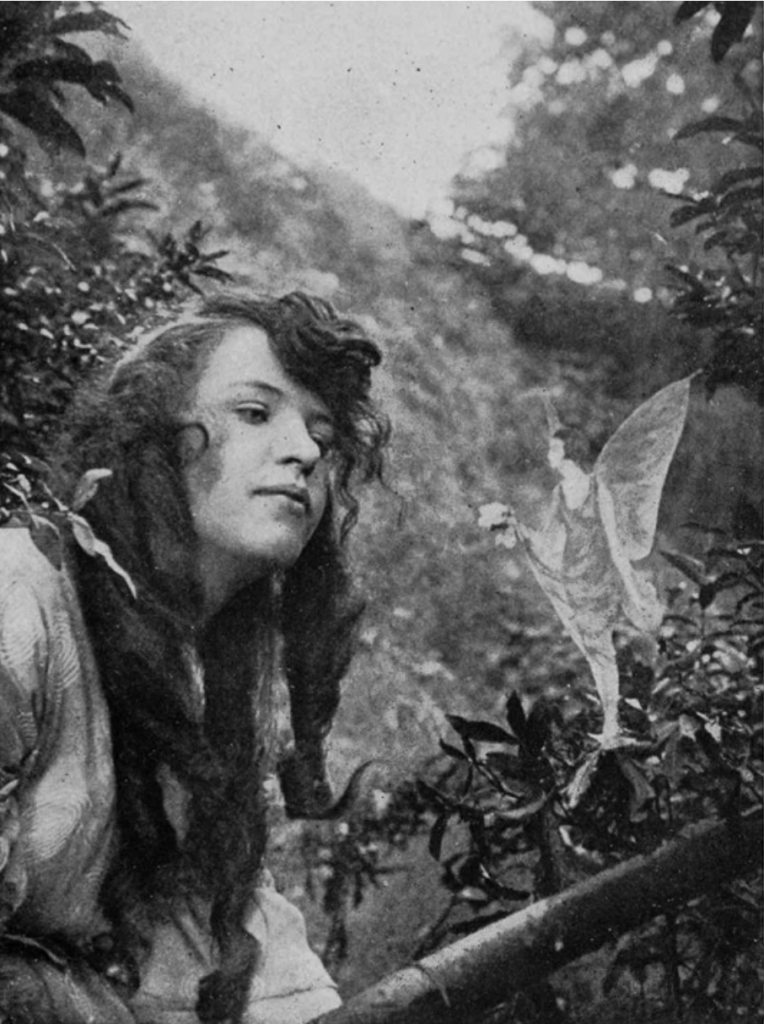
    Fairy image from Sir Arthur and the Fairies

    The late Victorian and Edwardian eras were defined by a massive clash of ideals. On one hand, it was the age of the industrial revolution, empirical science, and the birth of modern forensic logic. On the other hand, it was an era desperately grasping in the dark for magic, plagued by a cultural obsession with spiritualism, séances, and the occult. Nowhere is this contradiction more perfectly illustrated than in the strange, true story of the Cottingley Fairies.

    In the summer of 1917, two young girls named Elsie and Frances, playing in a garden in Yorkshire, England, borrowed a camera and took a series of photographs that purportedly showed them interacting with a troupe of winged faeries. To the modern eye, the mechanics of the hoax are obvious: Elsie had simply painted watercolors of fairies, cut them out of paper, and secured them to the foliage using hatpins. Yet, these flat, paper illusions managed to fool one of the most brilliant and famous minds of the generation: Sir Arthur Conan Doyle, the creator of Sherlock Holmes.

    Why Sir Arthur Conan Doyle Was Fascinated With the Afterlife

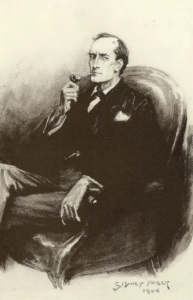
    Illustration of Sherlock Holmes by Sidney Paget.

    It is a profound historical irony that the man who invented the world’s most famous literary symbol of cold, calculating logic was himself a fervent spiritualist. In 1920, Conan Doyle penned a passionate article declaring the photographs were undeniable, scientific proof of psychic phenomena. He even published this claim in The Strand—the exact same popular magazine that had first published the highly logical adventures of Sherlock Holmes.

    But looking back through the archives, Conan Doyle’s belief becomes less foolish and more tragic. By the time he saw the Cottingley photographs, he had recently lost both his son and his brother in the horrors of World War I. For the grieving author, proving the existence of the supernatural wasn’t a parlor trick; it was a desperate, hopeful search for proof that there was a world beyond the grim, mechanized reality of the war.

    He was not alone in this pursuit. During this same era, the legendary poet W.B. Yeats was actively collecting Irish folklore and participating in the Hermetic Order of the Golden Dawn, a secret society devoted to the study of the occult. Yeats penned The Celtic Twilight, a beautiful but earnest documentation of myth and faerie encounters.

    As archivists, the Cottingley Fairies hoax remains a fascinating study. It reminds us that intellect cannot always protect us from grief, and that even the sharpest minds want to believe in magic when the mundane world becomes too heavy to bear.

    Curating Your Own Archive

    If you are fascinated by the dual nature of logic and the occult during this historical period, there are a few additions that belong on any literature lover’s desk.

    (The Ink & Shadow Archive is reader-supported. As an Amazon Associate, we earn a small commission from qualifying purchases made through these links.)

    • The Cottingley Fairies Book– Learn more about this fascinating case that still inspires study and debate with a dedicated look at the photographs that fooled the world.

    • Sherlock Holmes Leather-Bound Collection – For a dive into the analytical side of the era, picking up a vintage-style collection of Sir Arthur Conan Doyle’s original Sherlock Holmes stories provides a brilliant look at Victorian deduction.

    • W.B. Yeats – The Celtic Twilight – To balance logic with raw, atmospheric folklore, Yeats’s classic documentation of faerie sightings is essential reading for anyone curious about how the greatest poets viewed the supernatural.

    • Vintage Brass Magnifying Glass – Add a touch of authentic investigative atmosphere to your own workspace with a heavy, brass magnifying glass—an aesthetic nod to dissecting both historical documents and mysterious photographs.