

In every era, people have looked for signs that the visible world is not the whole world. In the nineteenth century, when photography was still a mysterious and almost magical new technology, some believed the camera might do more than preserve ordinary life. It might reveal what the human eye could not see: the dead.
That hope gave rise to one of the strangest chapters in photographic history: Victorian spirit photography.
Spirit photography emerged in the broader cultural climate of, a movement that became hugely popular in the mid-to-late 1800s in Britain and the United States. Séances, mediums, table-rapping, and attempts to communicate with departed loved ones were no longer fringe curiosities. They became a serious social phenomenon, especially in a century marked by high mortality rates, war, and disease. For grieving families, the promise that technology could offer evidence of survival after death was deeply comforting.
Photography seemed uniquely suited to that promise. Early cameras already felt uncanny to many people. They froze time. They captured likenesses with startling accuracy. Long exposure times could create strange blurs, faded figures, and accidental distortions. If a camera could record what the eye missed in ordinary life, why not a spirit standing just outside normal perception?
Did a Camera Capture Abraham Lincoln’s Ghost?
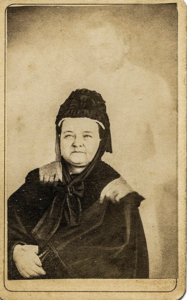
The most famous example of spirit photography is the image of Mary Todd Lincoln seated in a chair, with what appears to be the ghostly figure of Abraham Lincoln standing behind her, his hands resting protectively on her shoulders.
This photo was taken by William H. Mumler, a name central to the story of spirit photography. Mumler became famous in the 1860s for portraits in which faint, translucent extra figures appeared near the living sitter. He claimed these forms were spirits, often identified by clients as deceased relatives.
To believers, the Lincoln image was moving proof that the dead remained present. To skeptics, it was a masterclass in photographic deception.
How Spirit Photos Could be Faked
There were several ways ghost photos could be faked.
The most famous technique is double exposure, in which the same photographic plate is exposed twice. First, a “ghost” figure would be photographed, often draped in light fabric or posed against a dark background. Then the plate would be exposed again with the paying client seated normally. The result could make the first figure appear faint, transparent, and floating. To viewers unfamiliar with photographic processes, the effect could look astonishingly supernatural.
Another method involved composite printing, where separate negatives were combined during the printing process. Photographers could also use pre-exposed glass plates, hidden reflections, or subtle staging tricks to create mysterious forms. Because early photographic methods were technically complex and poorly understood by the public, photographers had an enormous advantage. Clients saw the finished image, not the manipulations behind it.
This did not mean every spirit photograph was a deliberate fraud. Some may have resulted from accidents, contamination, or misjudged exposures. But the history of the field strongly suggests that many practitioners exploited a mix of technical ambiguity and emotional vulnerability. Mumler himself was eventually tried for fraud in 1869, though he was acquitted. Acquittal did not prove his photos genuine; it mainly showed that proving photographic trickery in court was not easy. Today, more than 150 years later, we are facing similar issues when it comes to AI-generated photos and videos.
What makes spirit photography fascinating is not just the hoaxing, but the sincerity around it. Many people truly wanted to believe. The technology gave shape to grief. It turned longing into an image.
Kirlian Photography and Aura Cameras
That pattern did not disappear with the Victorian era. It resurfaced in newer forms, including the twentieth-century fascination with Kirlian photography. Developed in 1939 by Semyon and Valentina Kirlian, this technique produces glowing outlines around objects placed in a high-voltage electrical field. Leaves, fingertips, coins, and other objects can appear surrounded by radiant fringes of light. Unsurprisingly, some people interpreted these images as photographs of an aura, life force, or spiritual energy field.
Once again, a technology that produced visually striking, poorly understood effects became linked to the supernatural.
But as with spirit photography, the skeptical explanation is more grounded. The glow in Kirlian images is generally understood to result from coronal discharge: electrical ionization affected by moisture, pressure, conductivity, film type, and other physical conditions. A living leaf and a dry leaf may produce different patterns, not because one has a stronger soul, but because their material properties differ. Human fingertips can show changing “auras” depending on sweat, oils, contact, and voltage. The images are real photographs of a real phenomenon. But whether this reveals the actual colors of an aura is a matter that’s highly contested.
Spirit photography and Kirlian photography are both compelling for similar reasons. They belong to different centuries and different technologies, yet they express the same human impulse: to use instruments to reach beyond ordinary perception. In both cases, people hoped a machine could verify what intuition, religion, or personal experience suggested —that there is more to reality than material appearances.
An open-minded but skeptical view leaves room for wonder without abandoning critical thinking. It is possible to appreciate why spirit photographs moved people so deeply while also recognizing how easily they could be manufactured. It is possible to find Kirlian images beautiful and intriguing while accepting that electrical discharge is not the same thing as proof of an aura.
The supernatural has often borrowed the authority of technology. Cameras, radios, EVP recorders, thermal sensors, and now AI image tools all carry a similar promise: maybe this device will show us what we have missed. Maybe this time the invisible world will leave a trace.
So far, the evidence remains ambiguous at best. But the desire behind it is unmistakable. From Victorian mourning portraits to glowing Kirlian halos, these images reveal less about ghosts than about us: our grief, our curiosity, and our enduring hope that the boundary between worlds might not be final.
Learn More About Spirit Photography and Spiritualism
Archivist’s Note: This section contains affiliate links. If you acquire an artifact through these links, the Archive may earn a small commission at no extra cost to you, which helps keep the candles lit.
Spirits, Seers & Seances: Victorian Spiritualism, Magic & the Supernatural -a thorough study of this fascinating movement, including hypnotism, automatic writing, clairvoyance, and the belief in ghosts, by Steele Alexandra Douris.
The History of Spiritualism -Arthur Conan Doyle, the creator of Sherlock Holmes, was obsessed with spiritualism and wrote about it himself in this classic work.
Digital Kirlian Photography -Explore the mysteries of Kirlian photography and learn to take your own photos of auras.
Mini-Vintage Digital Camera -Get the best of both worlds with a vintage style camera that takes great digital photos.