
Archivist’s Note: This briefing may contain affiliate links. If you acquire an artifact through these links, the Archive may earn a small commission at no extra cost to you, which helps keep the candles lit.
Beneath the elegant boulevards, gilded cafés, and rain-slick streets of Paris lies another city entirely. It has no sunlight, no grand façades, and no bustling crowds. Instead, it is a labyrinth of silent passageways stretching for hundreds of kilometers beneath the French capital—a forgotten world where history, myth, and mystery intertwine in the darkness.
Paris is often called the City of Light. Yet some of its greatest secrets have always belonged to the shadows.
A Parallel City
Unlike abandoned castles or forgotten monasteries, the world beneath Paris has never truly been empty. It has always existed in parallel with the city above, inhabited in different ways by quarry workers, engineers, soldiers, explorers, artists, and those who simply preferred the anonymity of darkness. Every generation seems to leave traces behind. Some obvious, others almost impossible to interpret.
A faded inscription on a stone wall. A rusted doorway leading nowhere. A candle melted into limestone decades ago. Graffiti layered upon graffiti until the oldest messages can no longer be read. Each detail hints at stories whose authors are long gone.
And inevitably, there are stories that resist explanation altogether.
Legends tell of explorers who became hopelessly lost within the endless passages, wandering for days before finding an exit—or never emerging at all. While many such tales have grown through retelling, the maze is undeniably vast enough to humble even experienced navigators. Distances distort underground. Every tunnel begins to resemble the last. In the absence of daylight, time itself feels strangely unreliable.
Perhaps that is why the Catacombs continue to inspire so much speculation.
The Long History of the Catacombs
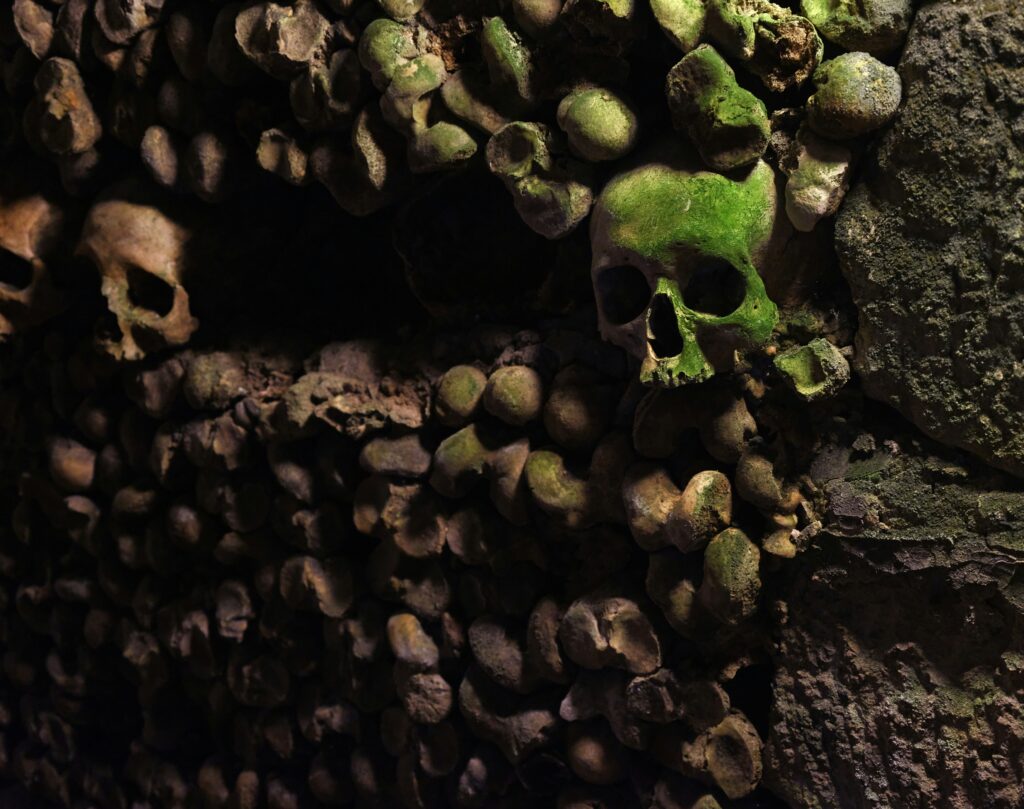
The Paris Catacombs are among the city’s most famous attractions, drawing millions of visitors eager to descend beneath the streets and walk among carefully arranged walls of human skulls and bones. The ossuary itself is unforgettable: a haunting reminder of mortality, born from necessity when overflowing cemeteries threatened public health in the eighteenth century.
But what most visitors don’t realize is that the official tour reveals only a tiny fragment of what exists below.
The accessible Catacombs represent just a small section of an immense underground network carved from former limestone quarries. Beyond the gated passages open miles upon miles of tunnels, sealed chambers, forgotten stairways, and hidden intersections. Much of this subterranean world remains inaccessible to the public, protected by law and monitored because of its instability and complexity.
Naturally, such a place invites stories.
Some are true enough to seem fictional.
An Underground Cinema
Over the years, explorers, historians, and the elusive community known as the cataphiles —urban explorers devoted to navigating the underground maze— have documented remarkable discoveries. Hidden rooms have appeared where no one expected them: chambers transformed into gathering spaces, carefully constructed meeting rooms concealed behind ordinary tunnel walls, and even an underground cinema complete with a projection booth and seating, discovered by authorities in the early 2000s.
The discovery was almost surreal. Electrical wiring had been installed, telephone lines connected, and a fully functioning bar operated nearby. Whoever created it had done so with remarkable ingenuity, fashioning an entire hidden social space beneath one of the world’s busiest cities. By the time officials returned with police, the occupants had vanished, leaving behind little more than a note implying the underground should not be disturbed.
It was as though Paris itself had quietly reclaimed the secret.
Other concealed spaces have reportedly served as speakeasies, art installations, private dining rooms, workshops, and gathering places known only to those familiar with the maze. Some are elaborate enough to suggest months—or years—of careful construction. Others appear suddenly, only to disappear again behind sealed entrances or collapsed passages.
An Ongoing Mystery
The underground has always attracted those who wished to remain unseen.
Resistance fighters used parts of the quarry network during the Second World War. Earlier generations found refuge, storage, or clandestine routes through its passages. For centuries, the tunnels have existed alongside the city above, witnessing revolutions, occupations, celebrations, and tragedies without ever revealing all they have observed.
The known history is already extraordinary. The unknown is almost irresistible.
How many hidden chambers remain undiscovered behind collapsed walls? How many secret gatherings took place without ever entering the historical record? What conversations echoed through those tunnels while Paris slept overhead? Which rooms served as sanctuaries, and which concealed less innocent purposes?
Even now, new discoveries occasionally emerge from the darkness, reminding us that the underground city is far from fully understood. Every sealed doorway invites curiosity. Every unexplored passage suggests another forgotten chapter waiting beyond the beam of a flashlight.
The official Catacombs allow visitors to glimpse only a carefully curated corner of this immense subterranean world. Beyond the barriers lies a labyrinth that has accumulated centuries of human ambition, fear, creativity, secrecy, and survival.
Perhaps the greatest mystery hidden beneath Paris is that after hundreds of years, we still haven’t uncovered all the activities, meetings, crimes, and unknown occurrences that the underground city hides.
Learn more about the Catacombs: The Catacombs of Paris: The History of the City’s Underground Ossuaries and Burial Network