
Tag: Samhain

  • The Sluagh, the Unforgiven Dead, and the Shadows of Samhain

    The Temptation of St. Anthony -Martin Schongauer
    The Temptation of St. Anthony—Martin Schongauer

    In the dimly lit archives of Gaelic folklore, few entities evoke the eerie chill of atmospheric dread quite like the Sluagh na Marbh—literally, the “Host of the Dead.” When autumn surrenders to the biting winds of late October, the hearth fire burns a little lower, and the shadows in the corner stretch a little longer. In the Highlands of Scotland and the western reaches of Ireland, rural households knew that the coming of winter brought more than frost; it carried the restless cries of the sky’s most terrifying hunters.

    Among the old traditions, one preventative ritual was treated with solemn urgency: never leave a west-facing window open when a soul lies on the precipice of death. To understand why this direction was guarded with such dread, one must delve into the spectral taxonomy of the Celtic otherworld. 

    The Hunger of the Unforgiven

    Unlike the benevolent ancestors honored during seasonal observances, the Sluagh are defined by an agonizing liminality. In Gaelic cosmology, they represent the unforgiven dead—souls of criminals, the cursed, and those whose sins were so grievous that they were deemed unfit for Heaven, denied by Hell, and rejected even by the cold embrace of the earth itself.

    Trapped in perpetual exile, they drift between the worlds. Scottish folklorist Alexander Carmichael, in his 1900 collection Carmina Gadelica documented the prevailing belief that the Sluagh traveled through the air in great multitudes, swarming across the moors like a colossal, murmuring flock of starlings or ravens. Witnesses described a sound like rushing autumn gale winds, broken by faint, agonizing whispers and the rustle of tattered feathers.

    Their purpose is singular and predatory: to stave off their eternal loneliness by conscripting others. When the Sluagh detect a weak, dying, or unprotected human soul, they descend in a violent whirlwind to tear the spirit away before it can receive last rites or cross safely to the afterlife. The newly captured soul is absorbed into the flock, bound to drift through the freezing night sky for eternity, partaking in an endless hunt alongside the very monsters that stole it.

    The West and the Geography of Death

    The mandate to shutter west-facing portals holds deep significance in Celtic lore. In pre-Christian and early Christian Gaelic geography, the west was intrinsically tied to the setting sun, sunset, and the threshold to the otherworld. In Irish mythology, the realm of the dead was often situated across the western ocean—toward Tech Duinn (the House of Donn), the dark gathering place of departed souls.

    Consequently, the Sluagh were believed to ride the biting western winds. While windows facing north, east, or south were sometimes left ajar to allow a peaceful soul to depart quietly toward the heavens, every west-facing aperture was bolted and shuttered. Families in the Outer Hebrides would sit vigil around the sickbed, clutching iron charms, rowan sprigs, and burning peat embers to ward off the chill that heralded the flock’s arrival.

    Samhain: The Thinning of the Veil

    The terror of the Sluagh reached its zenith during the festival of Samhain, the origins of Halloween. Marking the liminal threshold between the harvest and the dark half of the year, Samhain represented a collapse of ordinary metaphysical boundaries. When the veil between the mortal plane and the spirit realm wore thin, the Sluagh did not merely hunt the sickbed; they roamed freely across the physical world.

    Tales recount unwary travelers walking home along isolated moorland roads on the night of October 31st, only to be swept up into the sky. Folkloric accounts even tell of living mortals being forcibly lifted by the Sluagh, transported across counties in minutes, and forced to fire poison darts or fairy arrows (saigheid-sith) at livestock and neighbors before being dropped, battered and half-mad, into briars and bogs before dawn.

    To walk into the dark on Samhain was to tempt the aerial host. Communities lit great balefires on hilltops not only to purify the land, but to cast enough light to disrupt the flight paths of the shadow host above.

    An Echo in the Wind

    As autumn winds begin to strip the boughs bare and the air turns brittle with frost, the folklore of the Sluagh serves as a reminder of how our ancestors understood mortality, sin, and the vulnerability of the human soul. It speaks to a world where nature was alive with unseen perils, where direction and ritual carried genuine weight, and where the sky held horrors far older than modern memory.

    When the night settles in and the wind rattles against the glass, check your latches. Especially those facing the dark, fading western horizon.

    "They are not of the living, nor the dead that rest;  
    they fly upon the west wind, seeking the fragile spark."  
    -Unknown
  • The Old Dark: Samhain and the Night the World Came Undone


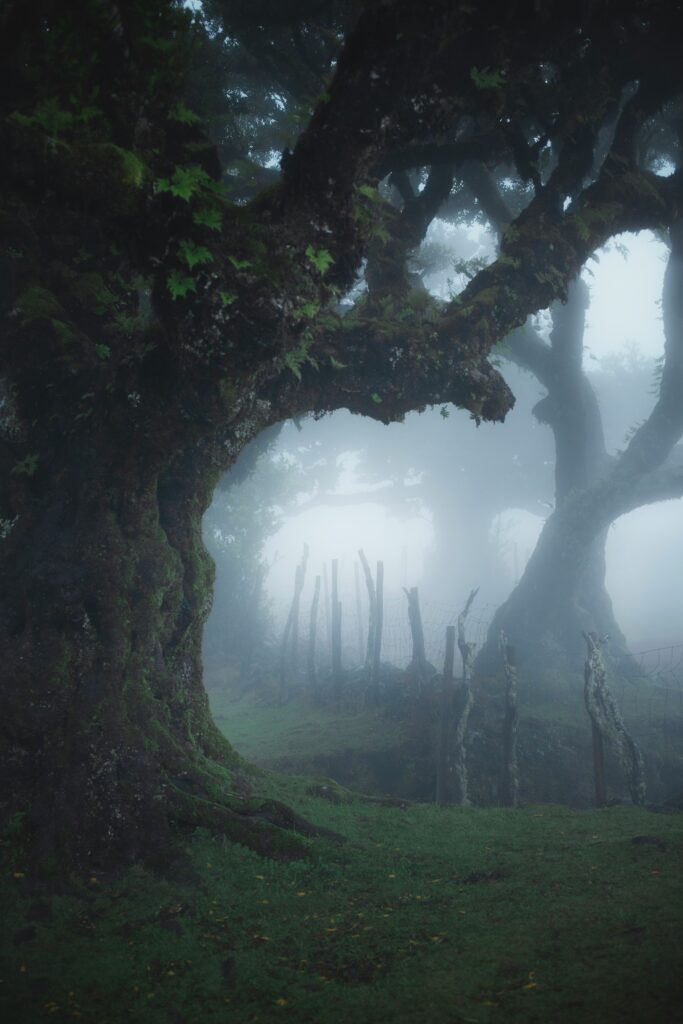
    Eerie tree in foggy forest.
    Photo by Lena Polishko on Unsplash

    Archivist’s Note: This briefing may contain affiliate links. If you acquire an artifact through these links, the Archive may earn a small commission at no extra cost to you, which helps keep the candles lit.

    There is a particular kind of darkness that belongs to late October. Not the comfortable darkness of a switched-off lamp, but something older and less negotiable. The Celts knew it. They built an entire festival around it. And though we have dressed it in plastic skeletons and supermarket candy, that ancient unease has never fully left us.

    We call it Halloween. They called it Samhain (pronounced Sah-win*, if you want to say it correctly in the dark)*. And the distance between the two is both enormous and, strangely, almost nothing at all.


    When the Year Died

    The ancient Celtic calendar was divided not by solstices but by the rhythms of agriculture and livestock. Samhain, falling on the 31st of October, marked the end of the harvest season and the beginning of winter. Which is to say, it marked the beginning of the dying time. Cattle were slaughtered. Stores were counted. The land went cold.

    But the Celts understood something that we, in our centrally heated modernity, prefer not to think about: that thresholds are dangerous. The moment between summer and winter, between abundance and scarcity, between life and death — that liminal space does not belong cleanly to either side. And on Samhain, that threshold extended beyond the seasons.

    It extended between the worlds.


    The Thinning

    The Celts believed that on the night of Samhain, the veil between the living and the dead grew thin to the point of translucence. The aos sí — spirits, faeries, and the restless dead — could cross over with terrifying ease. This was not metaphor. This was cosmology. The boundaries that normally kept the supernatural at bay simply… relaxed.

    And so the living faced a choice: hide, appease, or disguise.

    Many chose all three.

    Offerings of food and drink were left at the edges of fields and doorsteps — not out of generosity, but out of negotiation. Here is what you want. Take it and leave us alone. Bonfires were lit on hilltops, partly for warmth and ritual, and partly because fire had always been the most reliable barrier against things that should not be. Communities would extinguish their hearth fires and relight them from the communal flame, symbolically dying and being reborn alongside the year itself.


    The Face You Wear

    Here is where it gets interesting. The tradition of dressing in costume on this night did not begin as whimsy or theatre. It began as camouflage.

    If spirits were walking among the living, the solution was elegant in its logic: become one of them. By wearing grotesque masks and ragged disguises, people hoped to move through the dangerous night unrecognised, to blend into the procession of the dead and pass unharmed. The costume was not a disguise for fun. It was armour.

    There is something genuinely chilling about this when you sit with it. Every child waddling down a suburban street in a ghost costume is, whether they know it or not, participating in a ritual act of mimicry that is over two thousand years old.


    The Turnip in the Dark

    Before we go any further, we must talk about the turnip.

    The jack-o’-lantern, that grinning, orange icon of modern Halloween, is a North American invention born of practicality. When Irish and Scottish immigrants arrived in the New World in the 18th and 19th centuries, they brought their Samhain traditions with them, including the carving of lanterns to ward off evil spirits. In the old country, those lanterns were carved from turnips. Large, knobbly, difficult turnips, hollowed out with considerable effort, their faces far more unsettling than any pumpkin’s could ever be precisely because the medium resists you.

    If you have never seen a carved turnip lantern, seek one out. The flesh glows differently. The features have a quality that is less decorative and more genuinely wrong; a grimace rather than a grin. It is not hard to believe that such an object might actually frighten something.

    The pumpkin was simply more available, more compliant, and more photogenic. The turnip was scarier. Draw your own conclusions about which tradition was wiser.


    The Circle Closes

    Now consider this: in the United Kingdom and Ireland today, American-style Halloween, complete with pumpkins, trick-or-treating, store-bought costumes, themed parties, has become enormously popular, having crossed the Atlantic in the latter half of the twentieth century and accelerated dramatically in the 1990s and 2000s. There is no small irony here.

    The holiday emigrated from Ireland and Scotland to America. It was transformed there by a new continent, by different gourds, by the industrialisation of festivity. And now it has returned — polished, commercialised, orange — to the islands where it was born. In Dublin and Edinburgh and Cork, children now go trick-or-treating in plastic capes, past doorways decorated with imported pumpkins, on the same ground where their ancestors left offerings for the aos sí in genuine terror.

    The old festival has come home dressed in its own costume, unrecognisable to itself.


    Why It Endures

    What strikes me most about Samhain, and about Halloween in all its incarnations, is that it has survived because it answers something real. Every culture on earth has a version of this: a night when the dead are close, when the darkness is different, when it is prudent to acknowledge forces larger than yourself.

    We do not, perhaps, believe in the aos sí anymore. But there is a reason that late October still feels genuinely uncanny, that the thinning of the light in these weeks carries a weight that June darkness never does.

    The Celts didn’t invent that feeling. They just had the good sense to name it, and to take it seriously.

    Perhaps we should too.