
Archivist’s Note: This briefing contains affiliate links. If you acquire an artifact through these links, the Archive may earn a small commission at no extra cost to you, which helps keep the candles lit.
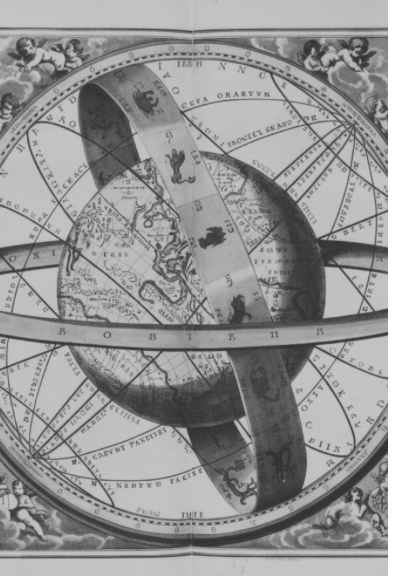
In 1660, the night sky was more than pretty scenery; it was a living theater and the realm where gods, heroes, and monsters dwelt.
There were no streetlights, no glowing screens, no light pollution softening the dark. When the sun went down, the heavens blazed to life—thousands upon thousands of stars stitched across an ink-black sky. For sailors navigating unknown seas and travelers crossing unmarked land, those stars weren’t poetic. They were essential. But they were also overwhelming. How do you memorize infinity?
The answer, it turns out, was storytelling.
Before astronomy became a discipline of data tables and telescope imagery, it was something closer to myth-making. Early celestial charts didn’t just plot coordinates. They populated the sky. That cluster of stars wasn’t merely a pattern—it was Orion, the hunter, forever pursuing the Pleiades. A curl of faint light became the tail of Scorpius. The art wasn’t decorative; it was mnemonic. Pictures helped observers remember what they were seeing. “That’s not just three stars,” a teacher might say. “That’s Orion’s Belt.” The sky became a cast of characters.
In this era—the sky before science as we know it—magic and measurement shared the same page.
The Most Famous Celestial Atlas of All Time
Enter Andreas Cellarius.
In 1660, the Dutch-German cartographer published Harmonia Macrocosmica, a celestial atlas that many consider the most beautiful ever created. If modern star charts are spreadsheets in the dark, Cellarius’s maps are theater. His pages glow with deep, velvety blues and luminous golds.
Constellations are more than just patterns noticed by people with vivid imaginations. They are grand figures sweeping across the heavens: heroes brandishing swords, sea monsters coiling between stars, zodiac figures marching along the ecliptic. Ornate borders frame the skies, filled with cherubs, classical scholars, and elaborate cartouches. It is science wrapped in spectacle.
Cellarius was working at a turning point. The 17th century was alive with astronomical revolution. It was the time of Copernicus, Galileo, and Kepler. The cosmos was being redrawn in radical ways. Yet Harmonia Macrocosmica still held onto the old visual language of myth. It mapped both competing models of the universe—the Earth-centered and the Sun-centered—without choosing sides too forcefully. In its pages, astronomy hadn’t yet shed its poetic skin.
That’s why the atlas feels so alive. It belongs to a moment when observing the sky was not just technical; it was existential. The stars were navigational tools, religious symbols, astrological omens, and scientific data all at once.
Today, our star maps look very different. Open a modern astronomy app and you’ll see clean lines, minimal design, precise labels. Efficient. Accurate. A triumph of clarity. But also, perhaps, a little sterile.
The Fascination With Celestial Charts Persists Today
Our fascination hasn’t faded.
We may no longer steer ships by Orion or consult the heavens for prophecy, but we still decorate our walls with vintage star charts. We hang zodiac prints in our bedrooms. We stick glow-in-the-dark stars to our children’s ceilings. In cities where the real constellations are washed out by sodium lamps and LED glare, we recreate them indoors. It’s an act of quiet longing.
Why?
Because ancient celestial charts remind us that the sky once felt personal. The stars were not just hydrogen spheres millions of light-years away —they were hunters, queens, dragons, and bears. They were stories we could hold onto in the dark.
In an age where we can barely see the Milky Way from our backyards, we still crave that sense of cosmic drama. We want the sky to mean something.
The lost art of the celestial chart shows us that before science became specialized, it was beautiful. Before it became all about data and abstract theories, it was narrative. And perhaps that’s why these old maps endure, not just as historical artifacts, but as reminders that the universe has always been more than a set of coordinates.