
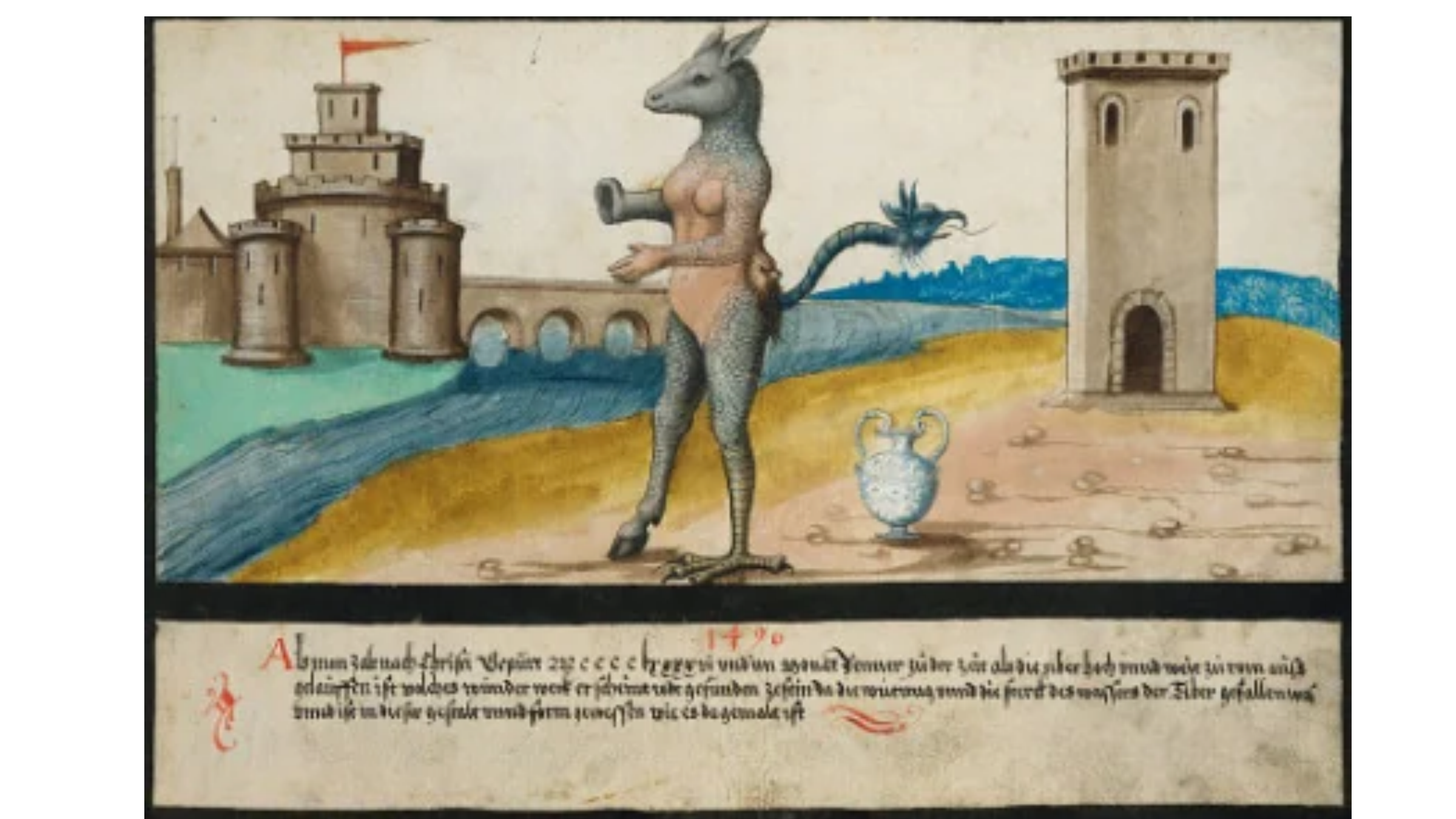
In January 1496, the swollen waters of the Tiber River receded from the low banks of Rome, leaving behind silt, wreckage, and a creature that defied the taxonomy of the known world. According to contemporary witnesses, the carcass possessed the head of an ass, the torso of a woman, a scaled serpentine arm, an elephantine foot, and a scaly tail terminating in the maw of a dragon. Dubbed the “Pope-Ass” (Papstesel), the monstrosity would later be weaponized by Martin Luther and Philip Melanchthon as an apocalyptic emblem of papal corruption. But decades after the creature washed ashore, its likeness was painstakingly drafted in opaque gouache and luminous tempera, cataloged not as fantastical art but as an empirical historical event in one of the most astonishing illuminated manuscripts ever salvaged from the early modern world: the Augsburg Wunderzeichenbuch, or the Augsburg Book of Miracles.
The Resurfacing of an Apocalyptic Relic
For almost five centuries, art historians and codicologists possessed no knowledge of the manuscript’s existence. It had eluded institutional archives, surviving in private obscurity until 2007, when it surfaced quietly at a provincial auction house in Munich, Germany. Discovered in an uncatalogued private estate, the manuscript was swiftly acquired by London antiquarian dealer Daniel Crouch before being purchased by a private collector. In 2013, the German art publisher Taschen produced the first comprehensive facsimile, revealing to the academic world a visual codex unlike anything in the European canon.
Scholars date the creation of the manuscript to approximately 1552 in the Imperial Free City of Augsburg—a wealthy hub of Renaissance banking, printing, and humanist thought dominated by families like the Fuggers and Welsers. At the time of its rediscovery, the manuscript comprised roughly 167 surviving leaves (several folios having been dispersed to public collections such as the National Gallery of Art in Washington, D.C., before the codex’s true provenance was recognized). Yet within its binding, it preserved no colophon, no author’s signature, and no preface dedicating the work to a patron. It arrived in the twenty-first century as a silent, anonymous chronicle of disaster.
Prodigies, Omens, and the Sky in Flames
Created during the tumultuous wake of the Protestant Reformation and the catastrophic religious upheavals that fractured the Holy Roman Empire, the Book of Miracles reflects a sixteenth-century worldview consumed by eschatological dread. To the Renaissance mind, nature was not a neutral, clockwork mechanism; it was a living manuscript written by the hand of the Divine, capable of cracking open to reveal messages of wrath or redemption.
The artists responsible—attributed stylistically to the workshops of prominent Augsburg masters, likely associated with Heinrich Vogtherr the Younger or Hans Burgkmair the Younger—compiled a chronological history of supernatural interventions spanning from the Old Testament through antiquity to their contemporary sixteenth-century doorstep. Biblical catastrophes, such as Noah’s flood and the fall of manna, transition seamlessly into historical anomalies.
Among its pages are
-
Rains of Blood and Fire: Detailed depictions of crimson deluges falling across medieval German villages, turning snow red and withering crops.
-
Celestial Portents: Atmospheric parhelia (sundogs), luminous bleeding crosses hovering over night skies, fiery swords suspended in the heavens, and clashing spectral armies battling among the clouds over Vienna.
-
Chthonic Horrors: Fiery dragons twisting above Swiss mountain passes, massive locust swarms devouring towns, and composite oceanic horrors dredged up from the Baltic.
-
The Vision of the Apocalypse: The manuscript culminates in literal scenes from the Book of Revelation, illustrating the seven-headed beast rising from the sea, the fall of Babylon, and the casting of the dragon into the abyss.
The Unflinching Eye of Renaissance Observation
What makes the Augsburg manuscript uniquely mesmerizing—and deeply unsettling—is its visual execution. Unlike early medieval bestiaries, which rendered monsters as symbolic, flattened allegories, the Augsburg artists employed the cutting-edge realism of the Northern Renaissance.
They utilized sophisticated linear perspective, delicate architectural rendering of Bavarian and Italian cityscapes, and nuanced naturalism in their landscapes. The dragons, rains of pitch, and deformed chimeras are rendered with the same disciplined, observational precision that Albrecht Dürer applied to a hare or a clump of turf. It is an archive where the impossible is treated with bureaucratic sobriety.
Each double-page spread features a magnificent, near-full-page gouache illustration accompanied below by a brief, matter-of-fact German inscription recording the date, location, and nature of the anomaly, often citing classical or medieval historians such as Livy, Josephus, and the Nuremberg Chronicle. The entries avoid sensationalist sermonizing; they present the omen with the chilling detachment of a case file.
The Lingering Shadow
Why an anonymous Augsburg patron commissioned this monumental, exorbitantly expensive work remains a subject of scholarly fascination. Some historians suggest it was intended as a visual catalog of divine warnings. It’s a talismanic compendium compiled during an era of apocalyptic hysteria when comets and strange births were understood as a dire warning that the terrestrial clock was running out.
Centuries later, the Augsburg Book of Miracles sits as a monument to human vulnerability. It captures an era standing at the threshold of the scientific revolution, attempting to measure, paint, and preserve the inexplicable before the modern rational world drew its curtains over the dark.