
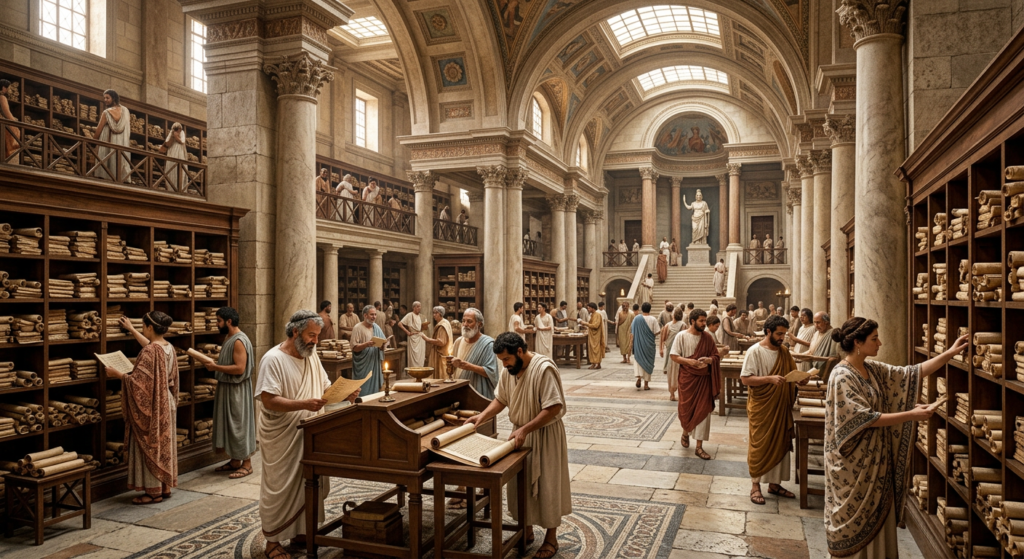
We are taught to view the destruction of the Great Library as a tragedy of art and philosophy, leading to a cultural dark age brought on by fire and hubris. History books tell us to mourn the lost plays of Sophocles, the missing dialogues of Aristotle, and the vanished verses of Sappho. However, the tragedy of Alexandria wasn’t only the loss of our poetry. It was also the severing of our technological timeline.
Look past the marble statues and the philosophical debates, and you will find a different kind of archive. The Library of Alexandria was the ancient world’s premier research and development laboratory. In addition to literature, it was a repository of schematics, diagrams, and the tactile, mechanical blueprints of a future that has faded into obscurity. Aside from losing history, we lost our science fiction –and, according to some theories, incredibly advanced technology. We lost blueprints for machines that could have propelled humanity into an industrial revolution almost 2,000 years before the Victorian era.
The Archive at the Center of the Ancient World
Before we sift through the ashes, we must understand the monument that burned. Founded in the 3rd century BC under the Ptolemaic dynasty, the Great Library was a royal obsession. The mandate given to its scholars was simple but terrifying in its scope: collect all the knowledge in the world.
One thing many people don’t realize is that the Library had an imperialistic quality. You have to remember the historical context; we aren’t talking about a modern democracy but an ancient monarchy. The librarians of Alexandria were ruthless acquirers. They didn’t just ask politely for donations. By royal decree, any ship docking in the city’s harbor was searched. If a manuscript or scroll was found, it was confiscated and copied by scribes. The copy was handed back to the ship’s captain; the original was locked away in the Library’s vaults.
At its height, the archive held hundreds of thousands of papyrus scrolls, encompassing the collective memory of the Mediterranean, the Middle East, and beyond.
A Gradual Destruction
While popular legend blames a single, apocalyptic fire set by Julius Caesar in 48 BC (and, later, by Muslim invaders) the truth is a slower, more agonizing death by a thousand cuts. There were centuries of sieges, riots, and bureaucratic neglect. The end result was that the world’s greatest concentration of human intellect was erased from the map.
Engineers and Futurists of the Ancient World
Consider Hero of Alexandria. Walking the halls of the Great Library in the first century AD, Hero was a mathematician and a visionary engineer. Many of his ideas weren’t implemented for over a millennium after his death. Among his surviving texts are the schematics for the aeolipile –the world’s first recorded steam engine.
Picture it: a brass sphere spinning violently on its axis, powered entirely by pressurized steam, centuries before the coal-choked skies of industrial age London. Hero also designed wind-powered organs, automated theatrical props that operated on complex pulley systems, and even the world’s first vending machine. These were not mere fanciful works of art; they were the prototypes of a mechanized society, meticulously drafted on papyrus scrolls that were housed within the Library’s walls.
The World’s First Computer
Then, there is the Antikythera mechanism. Recovered from a shipwreck off the coast of a Greek island, this corroded lump of bronze and wood was initially dismissed by historians. But under the penetrating gaze of modern X-rays, it revealed itself to be an analog computer of staggering complexity. Dating back to the 2nd century BC, its interlocking gear trains tracked the cycles of the solar system, predicted eclipses, and calculated the irregular orbit of the moon with a precision that wouldn’t be seen again until the development of Swiss clockmaking in the 14th century.
The Forbidden Histories
If the Library held the blueprints for tomorrow, it also guarded the forbidden maps of antiquity. When you gather all the knowledge of the known world into one place, you inevitably collect the ghosts of civilizations that came before. This is where history, speculation, and even conspiracy theories merge.
We know that the Library housed the exhaustive works of historians like Manetho, an Egyptian priest, and Berossus, a Babylonian astronomer. Both wrote sweeping, multi-volume histories of their respective cultures, detailing chronologies of kings and cataclysms that stretched back tens of thousands of years —long before the conventionally-dated dawn of human civilization. Today, their original scrolls are entirely lost, surviving only as fragmented quotes in the texts of later, often skeptical, writers.
Perhaps the most tantalizing speculation surrounds the original source material for the world’s most famous lost empire. The most widely known accounts of Atlantis were recorded by Plato. His accounts, though often dismissed as myth, weren’t created in a vacuum. He claimed the story was passed down from the Greek statesman Solon, who had translated it directly from the sacred pillars of Egyptian priests at Sais. Given the Ptolemaic dynasty’s obsession with hoarding Egyptian records, it is certainly plausible that the original, unfiltered accounts of Atlantis, not as a philosophical allegory, but as a geographical and historical reality, rested on the shelves of Alexandria.
Today, you can find countless books, documentaries, and websites on topics such as alternative or “forbidden” history, with theories ranging from aliens to angels that explain lost wonders. The Library, meanwhile, serves as a tenuous bridge between recorded history and wild speculation.
What if the Library contained the true, unredacted history of humanity? Accounts of antediluvian empires, maps of sunken continents, and the records of a species that had risen to technological heights and fallen back into the mud long before the first pharaoh took the throne.
New Discoveries
Perhaps not all of this fascinating history was erased. In fact, archeologists are uncovering artifacts all the time, including remnants of Pharos, the Lighthouse of Alexandria. This can give us hope that more evidence from the Library may still be found.
For over a millennium, the ruins were thought to be lost forever. But recent underwater archaeological expeditions have begun to pull the ancient city back from the abyss. Divers navigating the murky harbor floor have discovered colossal sphinxes, submerged temples, and massive granite blocks belonging to the Pharos—the Great Lighthouse of Alexandria. The Lighthouse itself was a marvel of ancient high-tech engineering, reportedly utilizing a massive, mysterious mirror system to project light for miles, or, as some darker legends claim, to focus the sun’s rays and burn enemy ships.
The ramifications of these underwater discoveries are staggering. If the monumental architecture of the Ptolemies survived beneath the waves, what else lies buried in the silt? Could there be sealed, water-tight vaults? Bronze mechanisms encased in coral? The discovery of the sunken city proves that Alexandria’s secrets weren’t entirely vaporized into ash; some were swallowed by the sea. And the sea is slowly starting to yield its ghosts.