Category: Manuscripts

  • The Devil’s Scribe: Unlocking the Dark Mystery of the Codex Gigas

    Illustration from Codex Gigas
    Image of The Devil from the Codex Gigas

    Deep within the climate-controlled vaults of the National Library of Sweden in Stockholm rests an artifact that feels less like a historical document and more like something conjured from a gothic nightmare. Bound in thick wooden boards and pale leather, the Codex Gigas—literally the “Giant Book”—is an object of both staggering scholarly wonder and chilling folklore. It is a medieval leviathan that demands two people just to lift it, but its true weight lies in the eerie legend of its creation and the full-page portrait of Lucifer staring out from its vellum pages.

    The Legend of the Doomed Scribe

    The story begins in the early thirteenth century inside the Benedictine monastery of Podlažice in Bohemia (modern-day Czech Republic). According to lore, a monk known simply as Herman the Recluse broke his monastic vows, committing a transgression so severe that the abbey sentenced him to the most brutal punishment imaginable: to be walled up alive behind cold stone.

    Desperate to escape this agonizing fate, the monk pleaded for one chance to save his life. He promised the monastery that, in a single night, he would write and illuminate a magnificent book that would contain all human knowledge and glorify the monastery forever. The abbot agreed, convinced the task was impossible.

    As midnight drew near, the monk’s fingers cramped and his candle burned low. Realizing the sheer impossibility of his vow, he did not turn to the heavens for divine intervention. Instead, he uttered a forbidden prayer to the fallen one. Legend says Lucifer answered, completing the monumental tome before sunrise in exchange for the monk’s soul. To honor the infernal pact, the newly penned tome featured an unprecedented, towering portrait of the Devil itself.

    A Colossus of Vellum and Ink

    Even stripped of its supernatural folklore, the physical reality of the Codex Gigas is nothing short of breathtaking. Measuring nearly three feet tall, over twenty inches wide, and weighing an astonishing one hundred and sixty-five pounds, it is the largest surviving medieval manuscript in the world. Crafting its more than three hundred parchment leaves required the skins of an estimated one hundred and sixty donkeys or calves.

    The contents inside read like an ambitious, obsessive attempt to bind the entire medieval world into one cover. It houses a complete Latin Vulgate Bible alongside encyclopedic texts by Isidore of Seville, Josephus’s Antiquities of the Jews, a chronicle of Bohemia, medical treatises on treating fevers and illnesses, calendars, and a list of monastery brethren.

    Nestled among these scholarly and sacred texts are darker, more unsettling curiosities. The manuscript includes esoteric magic formulas, complex incantations for casting out demons, protection against sudden illnesses, and an extensive guide on confession and penance.

    What Forensic Science Reveals

    Modern paleographers and forensic handwriting experts have thoroughly examined the vast expanse of Latin script across all six hundred and twenty pages. What they uncovered only deepens the atmosphere of obsession surrounding the book.

    The handwriting analysis confirms that the entire manuscript was undeniably written by a single scribe. There are no shifts in style, no changes in ink composition, and no signs of age, fatigue, or tremors that usually occur as a scribe grows old over decades. The calligraphy maintains a terrifying, almost mechanical consistency from the first stroke to the last.

    Scholars estimate that if a scribe worked without pause for six hours a day, copying text and illustrating elaborate illuminated initials, it would have taken roughly twenty to thirty years of uninterrupted, solitary labor. This implies a level of monkish isolation and relentless devotion so extreme that it borders on madness, giving rise to why contemporaries whispered of a supernatural hand at work.

    The Green Devil and the Missing Pages

    The heart of the book’s notoriety belongs to page 290. Spanning nearly the entire leaf is a vivid, colorful illustration of Satan: a horned, two-tongued, green-faced creature squatting between two towers with clawed hands outstretched. Facing this portrait on the opposite page is an illustration of the Heavenly City, creating a deliberate theological contrast between salvation and damnation.

    Adding to the book’s dark aura, several pages immediately following the portrait of the Devil were cleanly sliced out of the binding centuries ago. What was written on those missing leaves remains unknown. Whether they contained heretical texts, secret rituals, or simply monastic records that someone wanted erased from history, their absence only fuels the lingering mystery.

    The Spoils of War

    The journey of the Codex Gigas across Europe is as turbulent as its origin. It passed through multiple monasteries before catching the eye of the Holy Roman Emperor Rudolf II, a monarch deeply obsessed with the occult, alchemy, and esoteric knowledge, who added it to his castle in Prague.

    During the Thirty Years’ War in 1648, the Swedish army laid siege to Prague and looted the Emperor’s prized collection, carrying the giant book back to Stockholm as a trophy of war. There it survived a catastrophic palace fire in 1697, reportedly hurled from a high window onto the ground below to escape the flames.

    Today, heavily guarded and preserved in Stockholm, the Codex Gigas remains an enduring testament to medieval ambition, artistic obsession, and the thin veil between divine devotion and the occult. Whether crafted by an unholy pact or a lifetime of relentless penance, the Devil’s Bible continues to hold humanity spellbound across the centuries.
  • The Cipher Manuscript: the Book That Refuses to be Read

    Archivist’s Note: This briefing may contain affiliate links. If you acquire an artifact through these links, the Archive may earn a small commission at no extra cost to you, which helps keep the candles lit.

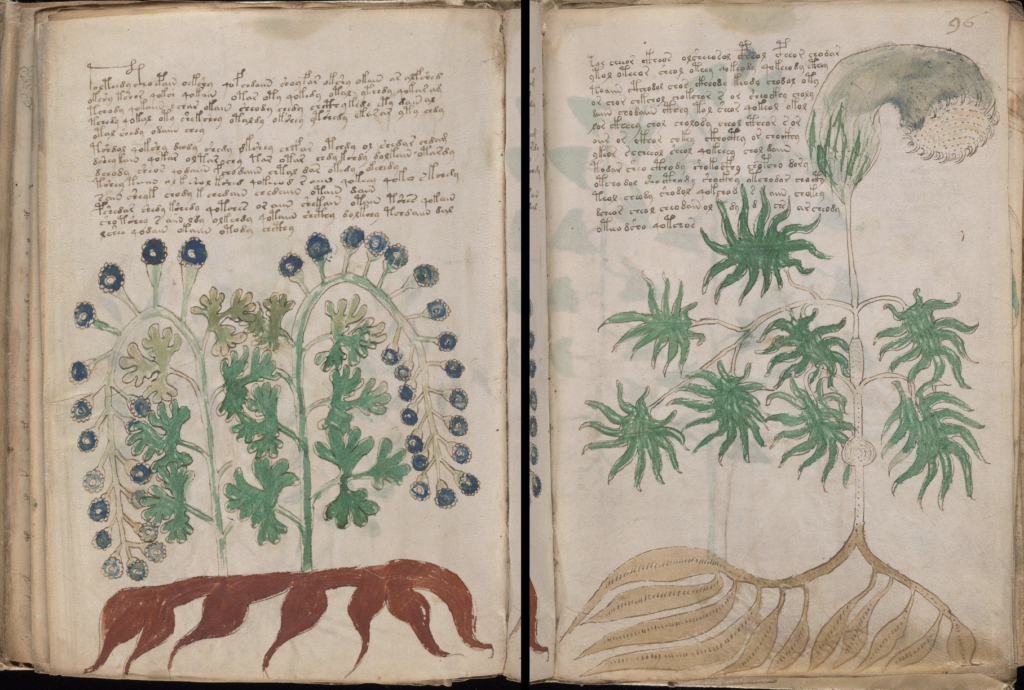
    Cipher Manuscript:illustrations of plants.

    In 1912, a Polish book dealer named Wilfrid Voynich was rummaging through a chest of old books at a Jesuit college near Rome. Among the dusty theological texts, he found something that didn’t belong. It was an unassuming volume, roughly 9 by 6 inches, bound in blank, limp vellum.

    When he opened it, he found himself staring at an entirely alien world.

    The 240 pages were filled with a looping, elegant script that resembled nothing Voynich had ever seen. It wasn’t Latin, passing for Arabic, or a messy shorthand. It was an entirely unknown alphabet. Even more baffling were the illustrations: watercolor drawings of strange, unidentifiable plants with swollen roots, complex anatomical diagrams featuring naked women wading through intricately plumbed pools of green liquid, and bizarre astrological charts mapping star systems that don’t exist.

    Some Popular Theories

    Over a century later, the Voynich Manuscript remains entirely undeciphered. Top military codebreakers from World War I and II, modern supercomputers, and thousands of amateur cryptographers have thrown themselves at the text. All have failed.

    But if we can’t read the text, can we guess the author? The history of the Cipher Manuscript, also known as the Voynich Manuscript, is a history of brilliant, desperate speculation.

     A Renaissance Con Job

    For a long time, the manuscript was traced back to the court of Emperor Rudolf II of Bohemia in the late 16th century. Rudolf was notoriously obsessed with the occult, alchemy, and the bizarre, creating a “Cabinet of Curiosities” that attracted charlatans from across Europe.

    Legend has it that Rudolf purchased the book for a staggering 600 gold ducats (a fortune at the time). Based on a letter found tucked inside the cover, it was believed the book was the work of Roger Bacon, a 13th-century friar and philosopher with a reputation for magic.

    However, modern historians suspect a far more entertaining origin. Enter Edward Kelley, a notorious 16th-century English alchemist, fraudster, and associate of the occultist John Dee. Kelley once claimed he could turn copper into gold and speak to angels using a crystal ball. Did this master con artist invent a fake language, draw some fantastical plants, and pass it off as an ancient magical tome to fleece a gullible, wealthy Emperor? It remains one of the most popular, and plausible, theories.

    A Secret Women’s Health Manual

    In recent years, researchers trying to crack the code have shifted their focus away from the text and onto the illustrations—specifically, the strange drawings of women bathing in pools connected by elaborate tubes.

    In the Middle Ages and early Renaissance, the mechanics of female reproduction and gynecology were heavily stigmatized by the Catholic Church. Some historians have theorized that the manuscript is actually a covert medical text, written by a midwife or a progressive physician. To avoid charges of heresy or witchcraft, the author might have encrypted their medical knowledge. The strange plants could be forgotten herbal remedies for childbirth, and the elaborate water systems could represent medieval understandings of the body’s internal plumbing.

    An Extinct Spoken Language (or a Conlang)

    What if it isn’t a code at all? Linguists have analyzed the text and found that it follows “Zipf’s law”—a mathematical pattern of word frequency found in all natural human languages. The “Voynichese” script flows too naturally to be a crude substitution cipher.

    This has led to the theory that the manuscript is a phonetic transcription of an obscure, undocumented dialect that never developed a written alphabet of its own. Alternatively, the author may have invented a “constructed language” (a conlang). If true, it means someone in the 15th century did what J.R.R. Tolkien did with Elvish, but hundreds of years earlier.

    For decades, linguists have been stumped by the mathematical structure of the Voynich manuscript. The text behaves somewhat like a real language—following specific word-frequency rules—but no single symbol consistently translates to a specific letter. It is too messy to be a simple substitution code, but too structured to be complete gibberish.

    However, a groundbreaking study published in January 2026 in the journal Cryptologia suggests we may have been looking at the problem backward.

    Rather than trying to translate the existing text, researcher Michael Greshko asked a different question: Could a 15th-century scribe, using only the technology available at the time, generate this exact type of encrypted text?

    The answer appears to be yes. The study proposed the “Naibbe cipher,” named after a medieval Italian card game. Greshko demonstrated that by taking ordinary Latin or Italian text, breaking it into short groups of letters, and running it through a complex substitution table randomized by the roll of dice and the drawing of playing cards, you can produce a text that perfectly mimics the bizarre statistical properties of the Voynich manuscript.

    This revelation is massive for codebreakers. It proves that the “Voynichese” script doesn’t require a supercomputer or a lost civilization to create. A single, dedicated scholar equipped with a quill, some parchment, and a deck of cards could have systematically encoded a real text into an unbreakable cipher.

    Of course, the Naibbe cipher hypothesis doesn’t tell us what the book says—only how it might have been written. The original Latin or Italian text remains hidden beneath layers of 15th-century chance and card-shuffling. But it strongly reinforces the idea that the manuscript isn’t a hoax. It is a genuine, hyper-complex vault of information, locked by a mechanism we are only just beginning to understand.

    Source: A new study suggests the mysterious Voynich Manuscript may be a medieval cipher – Archaeology Magazine

    The AI Frontier

    Plants and text from the Cipher Manuscript

    While human cryptographers look for historical ciphers, the latest attempts to decode the manuscript have been handed over to artificial intelligence. Between 2025 and 2026, researchers fed the Voynich pages into advanced AI systems closely related to modern protein-folding models. The results have sparked the most radical speculations yet.

    Recent AI analysis suggests that the manuscript might not be a spoken language at all. Instead, it operates closer to a “procedural notation system” or a technical algorithm.

    According to this highly speculative “Biological Blueprint Theory,” the bizarre, impossible plants are not botched botanical drawings. The AI cross-referenced the illustrations with molecular biology diagrams and proposed that they might actually be depictions of high-resolution protein folding. In this view, the text isn’t a narrative; it is a series of recursive algorithms—a literal “user manual” or instruction set for bioengineering, perhaps even detailing methods for splicing genetic material.

    While traditional historians remain deeply skeptical of these claims, the sheer fact that an ancient, 15th-century manuscript can be interpreted by modern AI as a technical manual for synthetic biology only deepens its mystique. Is it possible that a Renaissance genius was conceptualizing the building blocks of life through algorithmic code, centuries before the discovery of DNA?

    The Carbon Dating Curveball

    In 2009, researchers at the University of Arizona finally subjected the vellum pages to radiocarbon dating. The results were a shock: the animal skins used to make the book were verified to date between 1404 and 1438.

    This finding completely killed the theory that the 13th-century friar Roger Bacon wrote it. However, it also complicated the Edward Kelley “con job” theory. While it’s entirely possible Kelley acquired 150-year-old blank vellum to make his forgery look authentic, it requires a staggering level of premeditation.

    Was the author an unknown 15th-century genius, a cunning heretic hiding forbidden knowledge, or a brilliant artist playing a joke on history?

    In an era where every question can be answered in milliseconds on a smartphone, the Voynich Manuscript remains a sacred anomaly. It is the book that refuses to be read, challenging us to accept that some shadows are too deep for our modern lights to penetrate.

    The Manuscript Now

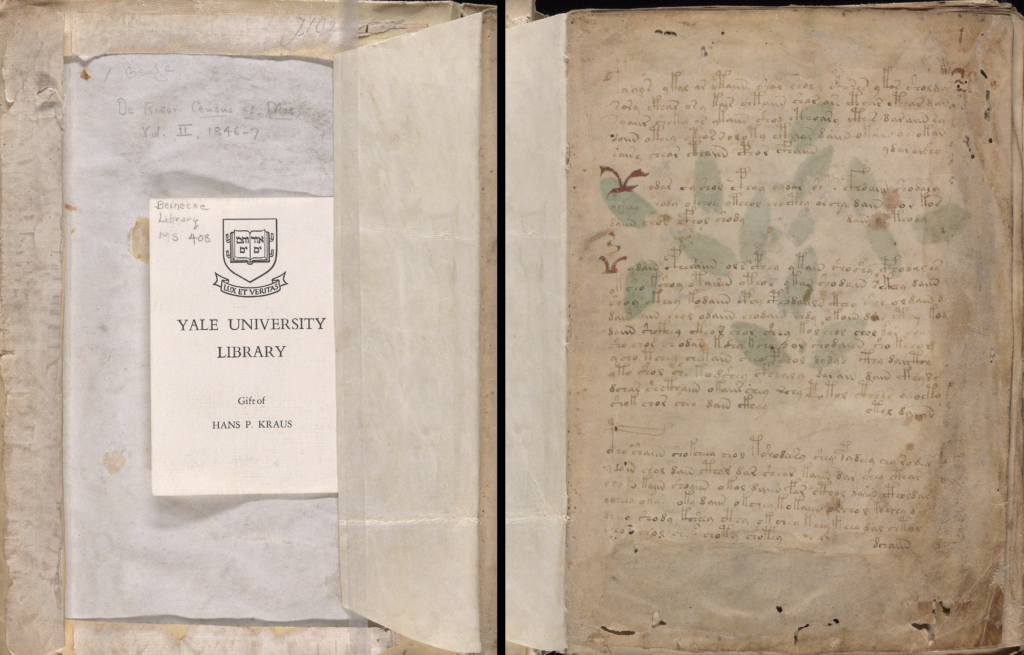
    Cipher Manuscript: Inside Front Cover

    Today, the Voynich Manuscript (officially cataloged as MS 408) rests quietly in the temperature-controlled vaults of in New Haven, Connecticut at the Beinecke Rare Book & Manuscript Library.

    You don’t need a top-secret security clearance to view it. In a beautiful twist of irony, the world’s most unreadable book is completely accessible. The Beinecke Library has digitized the entire manuscript, providing free, high-resolution scans of every single page to the public online.

    For now, the Voynich Manuscript remains a mirror. Cryptographers see ciphers, linguists see lost dialects, and artificial intelligence sees biological code. It continues to defy our attempts to categorize it, standing as a quiet, beautifully illustrated reminder that even in the digital age, some shadows refuse to surrender their secrets.


    Images of the Voynich Manuscript provided courtesy of the public domain. Citation: Cipher manuscript (Voynich manuscript). General Collection, Beinecke Rare Book and Manuscript Library, Yale University.


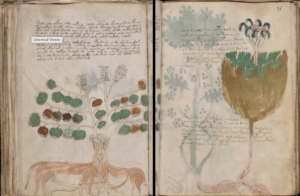
    Image of unidentified plants from the Cipher Manuscript

    The Voynich Manuscript: Complete Facsimile Edition
    Published by Yale University Press

    Click here to examine or acquire the official reproduction for your archive.