Category: Libraries

  • The Cipher Manuscript: the Book That Refuses to be Read

    Archivist’s Note: This briefing may contain affiliate links. If you acquire an artifact through these links, the Archive may earn a small commission at no extra cost to you, which helps keep the candles lit.

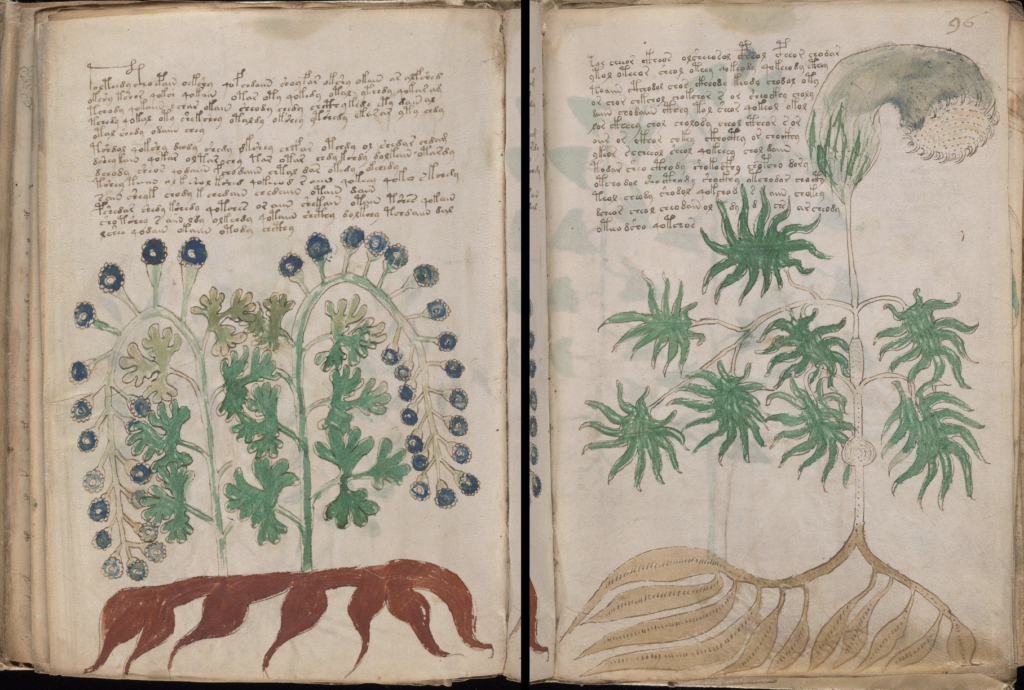
    Cipher Manuscript:illustrations of plants.

    In 1912, a Polish book dealer named Wilfrid Voynich was rummaging through a chest of old books at a Jesuit college near Rome. Among the dusty theological texts, he found something that didn’t belong. It was an unassuming volume, roughly 9 by 6 inches, bound in blank, limp vellum.

    When he opened it, he found himself staring at an entirely alien world.

    The 240 pages were filled with a looping, elegant script that resembled nothing Voynich had ever seen. It wasn’t Latin, passing for Arabic, or a messy shorthand. It was an entirely unknown alphabet. Even more baffling were the illustrations: watercolor drawings of strange, unidentifiable plants with swollen roots, complex anatomical diagrams featuring naked women wading through intricately plumbed pools of green liquid, and bizarre astrological charts mapping star systems that don’t exist.

    Some Popular Theories

    Over a century later, the Voynich Manuscript remains entirely undeciphered. Top military codebreakers from World War I and II, modern supercomputers, and thousands of amateur cryptographers have thrown themselves at the text. All have failed.

    But if we can’t read the text, can we guess the author? The history of the Cipher Manuscript, also known as the Voynich Manuscript, is a history of brilliant, desperate speculation.

     A Renaissance Con Job

    For a long time, the manuscript was traced back to the court of Emperor Rudolf II of Bohemia in the late 16th century. Rudolf was notoriously obsessed with the occult, alchemy, and the bizarre, creating a “Cabinet of Curiosities” that attracted charlatans from across Europe.

    Legend has it that Rudolf purchased the book for a staggering 600 gold ducats (a fortune at the time). Based on a letter found tucked inside the cover, it was believed the book was the work of Roger Bacon, a 13th-century friar and philosopher with a reputation for magic.

    However, modern historians suspect a far more entertaining origin. Enter Edward Kelley, a notorious 16th-century English alchemist, fraudster, and associate of the occultist John Dee. Kelley once claimed he could turn copper into gold and speak to angels using a crystal ball. Did this master con artist invent a fake language, draw some fantastical plants, and pass it off as an ancient magical tome to fleece a gullible, wealthy Emperor? It remains one of the most popular, and plausible, theories.

    A Secret Women’s Health Manual

    In recent years, researchers trying to crack the code have shifted their focus away from the text and onto the illustrations—specifically, the strange drawings of women bathing in pools connected by elaborate tubes.

    In the Middle Ages and early Renaissance, the mechanics of female reproduction and gynecology were heavily stigmatized by the Catholic Church. Some historians have theorized that the manuscript is actually a covert medical text, written by a midwife or a progressive physician. To avoid charges of heresy or witchcraft, the author might have encrypted their medical knowledge. The strange plants could be forgotten herbal remedies for childbirth, and the elaborate water systems could represent medieval understandings of the body’s internal plumbing.

    An Extinct Spoken Language (or a Conlang)

    What if it isn’t a code at all? Linguists have analyzed the text and found that it follows “Zipf’s law”—a mathematical pattern of word frequency found in all natural human languages. The “Voynichese” script flows too naturally to be a crude substitution cipher.

    This has led to the theory that the manuscript is a phonetic transcription of an obscure, undocumented dialect that never developed a written alphabet of its own. Alternatively, the author may have invented a “constructed language” (a conlang). If true, it means someone in the 15th century did what J.R.R. Tolkien did with Elvish, but hundreds of years earlier.

    For decades, linguists have been stumped by the mathematical structure of the Voynich manuscript. The text behaves somewhat like a real language—following specific word-frequency rules—but no single symbol consistently translates to a specific letter. It is too messy to be a simple substitution code, but too structured to be complete gibberish.

    However, a groundbreaking study published in January 2026 in the journal Cryptologia suggests we may have been looking at the problem backward.

    Rather than trying to translate the existing text, researcher Michael Greshko asked a different question: Could a 15th-century scribe, using only the technology available at the time, generate this exact type of encrypted text?

    The answer appears to be yes. The study proposed the “Naibbe cipher,” named after a medieval Italian card game. Greshko demonstrated that by taking ordinary Latin or Italian text, breaking it into short groups of letters, and running it through a complex substitution table randomized by the roll of dice and the drawing of playing cards, you can produce a text that perfectly mimics the bizarre statistical properties of the Voynich manuscript.

    This revelation is massive for codebreakers. It proves that the “Voynichese” script doesn’t require a supercomputer or a lost civilization to create. A single, dedicated scholar equipped with a quill, some parchment, and a deck of cards could have systematically encoded a real text into an unbreakable cipher.

    Of course, the Naibbe cipher hypothesis doesn’t tell us what the book says—only how it might have been written. The original Latin or Italian text remains hidden beneath layers of 15th-century chance and card-shuffling. But it strongly reinforces the idea that the manuscript isn’t a hoax. It is a genuine, hyper-complex vault of information, locked by a mechanism we are only just beginning to understand.

    Source: A new study suggests the mysterious Voynich Manuscript may be a medieval cipher – Archaeology Magazine

    The AI Frontier

    Plants and text from the Cipher Manuscript

    While human cryptographers look for historical ciphers, the latest attempts to decode the manuscript have been handed over to artificial intelligence. Between 2025 and 2026, researchers fed the Voynich pages into advanced AI systems closely related to modern protein-folding models. The results have sparked the most radical speculations yet.

    Recent AI analysis suggests that the manuscript might not be a spoken language at all. Instead, it operates closer to a “procedural notation system” or a technical algorithm.

    According to this highly speculative “Biological Blueprint Theory,” the bizarre, impossible plants are not botched botanical drawings. The AI cross-referenced the illustrations with molecular biology diagrams and proposed that they might actually be depictions of high-resolution protein folding. In this view, the text isn’t a narrative; it is a series of recursive algorithms—a literal “user manual” or instruction set for bioengineering, perhaps even detailing methods for splicing genetic material.

    While traditional historians remain deeply skeptical of these claims, the sheer fact that an ancient, 15th-century manuscript can be interpreted by modern AI as a technical manual for synthetic biology only deepens its mystique. Is it possible that a Renaissance genius was conceptualizing the building blocks of life through algorithmic code, centuries before the discovery of DNA?

    The Carbon Dating Curveball

    In 2009, researchers at the University of Arizona finally subjected the vellum pages to radiocarbon dating. The results were a shock: the animal skins used to make the book were verified to date between 1404 and 1438.

    This finding completely killed the theory that the 13th-century friar Roger Bacon wrote it. However, it also complicated the Edward Kelley “con job” theory. While it’s entirely possible Kelley acquired 150-year-old blank vellum to make his forgery look authentic, it requires a staggering level of premeditation.

    Was the author an unknown 15th-century genius, a cunning heretic hiding forbidden knowledge, or a brilliant artist playing a joke on history?

    In an era where every question can be answered in milliseconds on a smartphone, the Voynich Manuscript remains a sacred anomaly. It is the book that refuses to be read, challenging us to accept that some shadows are too deep for our modern lights to penetrate.

    The Manuscript Now

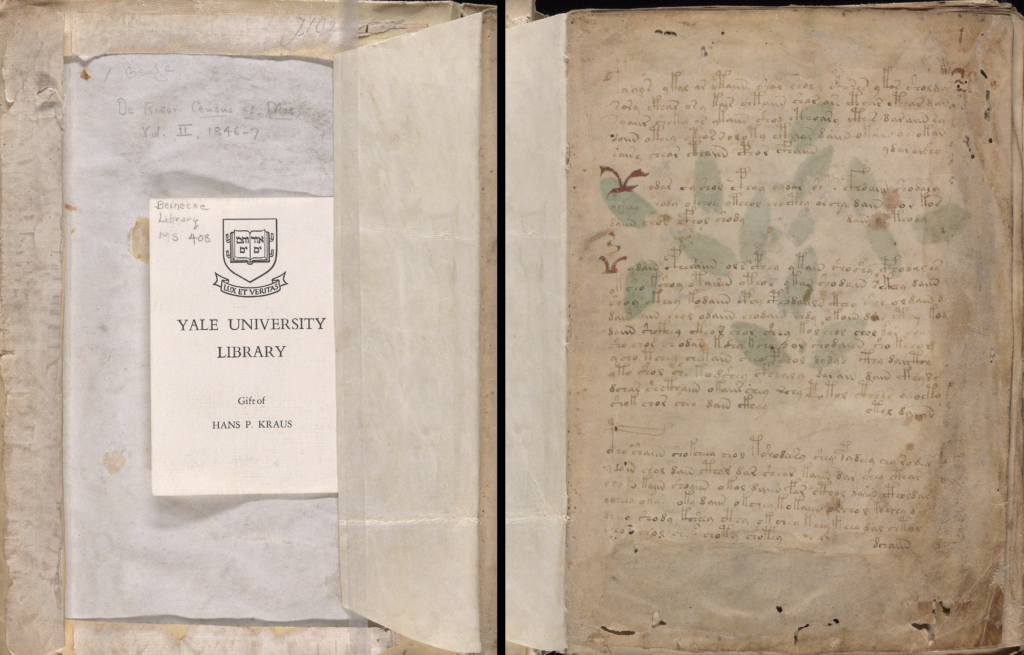
    Cipher Manuscript: Inside Front Cover

    Today, the Voynich Manuscript (officially cataloged as MS 408) rests quietly in the temperature-controlled vaults of in New Haven, Connecticut at the Beinecke Rare Book & Manuscript Library.

    You don’t need a top-secret security clearance to view it. In a beautiful twist of irony, the world’s most unreadable book is completely accessible. The Beinecke Library has digitized the entire manuscript, providing free, high-resolution scans of every single page to the public online.

    For now, the Voynich Manuscript remains a mirror. Cryptographers see ciphers, linguists see lost dialects, and artificial intelligence sees biological code. It continues to defy our attempts to categorize it, standing as a quiet, beautifully illustrated reminder that even in the digital age, some shadows refuse to surrender their secrets.


    Images of the Voynich Manuscript provided courtesy of the public domain. Citation: Cipher manuscript (Voynich manuscript). General Collection, Beinecke Rare Book and Manuscript Library, Yale University.


    Image of unidentified plants from the Cipher Manuscript

    The Voynich Manuscript: Complete Facsimile Edition
    Published by Yale University Press

    Click here to examine or acquire the official reproduction for your archive.


  • The Ancient Library of Alexandria: Clues to Ancient Technology and Lost Civilizations

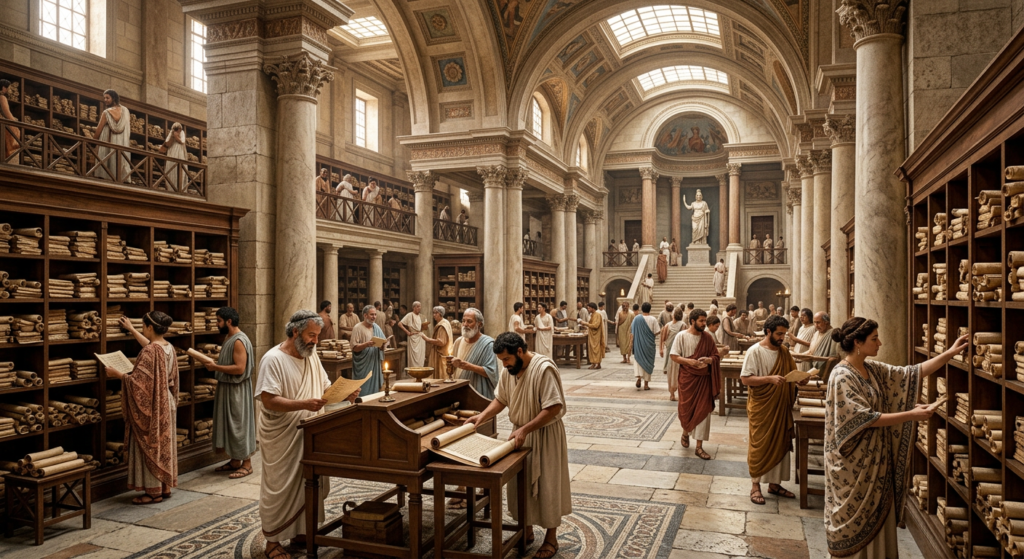
    Ancient Library of Alexandria

    We are taught to view the destruction of the Great Library as a tragedy of art and philosophy, leading to a cultural dark age brought on by fire and hubris. History books tell us to mourn the lost plays of Sophocles, the missing dialogues of Aristotle, and the vanished verses of Sappho. However, the tragedy of Alexandria wasn’t only the loss of our poetry. It was also the severing of our technological timeline.

    Look past the marble statues and the philosophical debates, and you will find a different kind of archive. The Library of Alexandria was the ancient world’s premier research and development laboratory. In addition to literature, it was a repository of schematics, diagrams, and the tactile, mechanical blueprints of a future that has faded into obscurity. Aside from losing history, we lost our science fiction –and, according to some theories, incredibly advanced technology. We lost blueprints for machines that could have propelled humanity into an industrial revolution almost 2,000 years before the Victorian era.

    The Archive at the Center of the Ancient World

    Before we sift through the ashes, we must understand the monument that burned. Founded in the 3rd century BC under the Ptolemaic dynasty, the Great Library was a royal obsession. The mandate given to its scholars was simple but terrifying in its scope: collect all the knowledge in the world.

    One thing many people don’t realize is that the Library had an imperialistic quality. You have to remember the historical context; we aren’t talking about a modern democracy but an ancient monarchy. The librarians of Alexandria were ruthless acquirers. They didn’t just ask politely for donations. By royal decree, any ship docking in the city’s harbor was searched. If a manuscript or scroll was found, it was confiscated and copied by scribes. The copy was handed back to the ship’s captain; the original was locked away in the Library’s vaults.

    At its height, the archive held hundreds of thousands of papyrus scrolls, encompassing the collective memory of the Mediterranean, the Middle East, and beyond.

    A Gradual Destruction

    While popular legend blames a single, apocalyptic fire set by Julius Caesar in 48 BC (and, later, by Muslim invaders) the truth is a slower, more agonizing death by a thousand cuts. There were centuries of sieges, riots, and bureaucratic neglect. The end result was that the world’s greatest concentration of human intellect was erased from the map.

    Engineers and Futurists of the Ancient World

    To understand what burned, we must examine the fragments that survived.  The ancient world was not a primitive landscape of stone and superstition; it was a realm of bronze gears, hydraulic valves, and programmable automata.

    Consider Hero of Alexandria. Walking the halls of the Great Library in the first century AD, Hero was a mathematician and a visionary engineer. Many of his ideas weren’t implemented for over a millennium after his death. Among his surviving texts are the schematics for the aeolipile –the world’s first recorded steam engine.

    Picture it: a brass sphere spinning violently on its axis, powered entirely by pressurized steam, centuries before the coal-choked skies of industrial age London. Hero also designed wind-powered organs, automated theatrical props that operated on complex pulley systems, and even the world’s first vending machine. These were not mere fanciful works of art; they were the prototypes of a mechanized society, meticulously drafted on papyrus scrolls that were housed within the Library’s walls.

    The World’s First Computer

    Then, there is the Antikythera mechanism. Recovered from a shipwreck off the coast of a Greek island, this corroded lump of bronze and wood was initially dismissed by historians. But under the penetrating gaze of modern X-rays, it revealed itself to be an analog computer of staggering complexity. Dating back to the 2nd century BC, its interlocking gear trains tracked the cycles of the solar system, predicted eclipses, and calculated the irregular orbit of the moon with a precision that wouldn’t be seen again until the development of Swiss clockmaking in the 14th century.

    The Antikythera mechanism proves that the theoretical physics and advanced mathematics stored in Alexandria were actively being translated into high-tech hardware. If a device of this magnitude were lost to the bottom of the sea, we must ask ourselves: What other impossible machines were cataloged in the Great Library? What other blueprints were reduced to cinders before they could be built?

    The Forbidden Histories

    If the Library held the blueprints for tomorrow, it also guarded the forbidden maps of antiquity. When you gather all the knowledge of the known world into one place, you inevitably collect the ghosts of civilizations that came before. This is where history, speculation, and even conspiracy theories merge.

    We know that the Library housed the exhaustive works of historians like Manetho, an Egyptian priest, and Berossus, a Babylonian astronomer. Both wrote sweeping, multi-volume histories of their respective cultures, detailing chronologies of kings and cataclysms that stretched back tens of thousands of years —long before the conventionally-dated dawn of human civilization. Today, their original scrolls are entirely lost, surviving only as fragmented quotes in the texts of later, often skeptical, writers.

    Perhaps the most tantalizing speculation surrounds the original source material for the world’s most famous lost empire. The most widely known accounts of Atlantis were recorded by Plato. His accounts, though often dismissed as myth, weren’t created in a vacuum. He claimed the story was passed down from the Greek statesman Solon, who had translated it directly from the sacred pillars of Egyptian priests at Sais. Given the Ptolemaic dynasty’s obsession with hoarding Egyptian records, it is certainly plausible that the original, unfiltered accounts of Atlantis, not as a philosophical allegory, but as a geographical and historical reality, rested on the shelves of Alexandria.

    Today, you can find countless books, documentaries, and websites on topics such as alternative or “forbidden” history, with theories ranging from aliens to angels that explain lost wonders. The Library, meanwhile, serves as a tenuous bridge between recorded history and wild speculation.

    What if the Library contained the true, unredacted history of humanity? Accounts of antediluvian empires, maps of sunken continents, and the records of a species that had risen to technological heights and fallen back into the mud long before the first pharaoh took the throne.

    New Discoveries

    Perhaps not all of this fascinating history was erased. In fact, archeologists are uncovering artifacts all the time, including remnants of Pharos, the Lighthouse of Alexandria. This can give us hope that more evidence from the Library may still be found.

    For over a millennium, the ruins were thought to be lost forever. But recent underwater archaeological expeditions have begun to pull the ancient city back from the abyss. Divers navigating the murky harbor floor have discovered colossal sphinxes, submerged temples, and massive granite blocks belonging to the Pharos—the Great Lighthouse of Alexandria. The Lighthouse itself was a marvel of ancient high-tech engineering, reportedly utilizing a massive, mysterious mirror system to project light for miles, or, as some darker legends claim, to focus the sun’s rays and burn enemy ships.

    The ramifications of these underwater discoveries are staggering. If the monumental architecture of the Ptolemies survived beneath the waves, what else lies buried in the silt? Could there be sealed, water-tight vaults? Bronze mechanisms encased in coral? The discovery of the sunken city proves that Alexandria’s secrets weren’t entirely vaporized into ash; some were swallowed by the sea. And the sea is slowly starting to yield its ghosts.