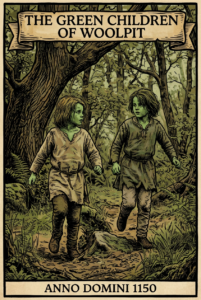
 In the agrarian quietude of late twelfth-century Suffolk, the earth yielded something far stranger than the harvest. Near the village of Woolpit, its very name derived from the Old English wulf-pytt, the deep subterranean pits dug to trap the island’s prowling predators, reapers encountered an anomaly at the edge of the cultivated fields. Crawling out from one of these ancient earthworks were two children, a brother and sister. They were not merely lost travelers: their clothing was woven from an unfamiliar, glistening textile, their speech consisted of a fluid, incomprehensible dialect, and their flesh bore a striking, uniform cast of pale green.
The account survives not through cheap broadsheets, but within the sober monastic chronicles of medieval England’s most disciplined minds: Ralph of Coggeshall’s Chronicon Anglicanum and William of Newburgh’s Historia Rerum Anglicarum, both written near the dawn of the thirteenth century during the tumultuous reigns of King Stephen and King Henry II. Neither chronicler was prone to casual fable. William of Newburgh himself recorded his initial skepticism, writing that the event seemed unnatural and improbable, yet was attested by so many venerable witnesses that dismissal became an intellectual failure.
Taken to the hall of the local landowner, Sir Richard de Calne, the children presented a picture of visceral distress. They wept inconsolably and rejected every plate of bread and meat offered to them, visibly starving before their captors. It was only when workers brought freshly harvested green bean stalks into the manor kitchen that the children exhibited frantic recognition, tearing open the raw stalks—not the pods, but the pith of the stalks themselves—in desperate search of sustenance.
For months, the children subsisted almost entirely on this diet. The fragile boy, perpetually sullen and afflicted by a deep melancholia, soon succumbed to illness and was buried in consecrated ground. His sister, however, proved resilient. As her diet adapted to common English bread and her exposure to the midday sun increased, the verdant pigment faded from her skin, leaving the ruddy complexion of a typical mortal maiden. She was baptized into the Christian faith, entered domestic service in de Calne’s household, and slowly mastered the English tongue.
When interrogators finally pressed her to explain their provenance, her answers only deepened the unease. She described a subterranean homeland called the Land of Saint Martin, presumably named after the patron saint of pastoral flocks and monastic twilight, where the inhabitants were all Christian, shaded in the same emerald hue, and lived without the harsh radiance of a sun. Instead, her people inhabited a realm bathed in perpetual, somber dusk, gazing across a broad, luminous river toward a country of light they could never reach. She recounted that while tending their father’s cattle, they heard the sudden, resonant tolling of great church bells echoing from the cavernous dark. Mesmerized by the chimes, they wandered into a yawning fissure, walked through subterranean tunnels, and suddenly broke into the blinding heat and glare of the Suffolk fields, completely unable to retrace their path back into the dark.
For modern historians and pathologists, rationalism offers a tidy diagnosis. The children’s green tint is frequently attributed to hypochromic anemia, historically dubbed “chlorosis” or “green sickness,” a condition induced by extreme malnutrition that lends the skin an uncanny greenish cast and is remedied by an iron-rich diet. Culturally, twelfth-century East Anglia was a landscape scarred by ethnic cleansing. Under Henry II, hundreds of Flemish weavers and mercenaries were massacred at the Battle of Fornham in 1173, not far from Woolpit. It is plausible that the pair were the traumatized orphans of slaughtered Flemish settlers, wandering through the dense wilderness of Thetford Forest, speaking Middle Dutch, which would have been utterly unintelligible to Anglo-Norman ears, and stumbling into wolf traps dressed in Continental linen.
Yet the clinical explanation leaves curious shadows in the margins. It fails to fully extinguish the strangeness recorded by Newburgh and Coggeshall, who knew the Flemish well and were familiar with the ailments of poverty. The girl herself, reported to have grown into an obstinate, spirited woman who eventually married a royal official at King’s Lynn, never altered her testimony. Whether they were displaced casualties of medieval statecraft or emissaries from a realm where the light never rises, the Green Children remain an unclosed folio in the archives of English mystery—a reminder that in the twelfth century, the boundary between history and the abyss was as narrow as a pit dug in the earth.
Woolpit still exists and is a popular tourist destination, largely due to the famous green children.