Archivist’s Note: This briefing contains affiliate links. If you acquire an artifact through these links, the Archive may earn a small commission at no extra cost to you, which helps keep the candles lit.
In the year 806 AD, the sky over the Scottish island of Iona darkened with the sails of Viking longships. When the raid was over, 68 monks lay dead. The survivors fled across the sea to Ireland, seeking sanctuary in the Abbey of Kells.
They left behind their homes, their safety, and their silver. But they carried one object with them—a book so valuable, so painstakingly crafted, that it was worth dying to protect.
This wasn’t just a copy of the Gospels. It was a masterpiece of obsession. Today, we call it the Book of Kells. It’s one of the most famous illuminated manuscripts ever created. It also served to inspire thousands of artists who continued the tradition of traditional Celtic iconography.
The Architecture of a Masterpiece
To understand the Book of Kells, you have to forget everything you know about modern publishing. This book wasn’t printed; it was grown, hunted, and mined.
The pages themselves, all 680 of them, are made of vellum, requiring the skins of an estimated 185 calves. But the true magic lies in the ink. The monks didn’t just use local pigments. They used crushed lapis lazuli brought all the way from the mountains of Afghanistan, bright red lead, and iron gall ink that literally bites into the vellum as it dries.
But the materials are only half the story. The real mystery is what they chose to draw with them.
Zoomorphic Illusions: The Beasts in the Ink
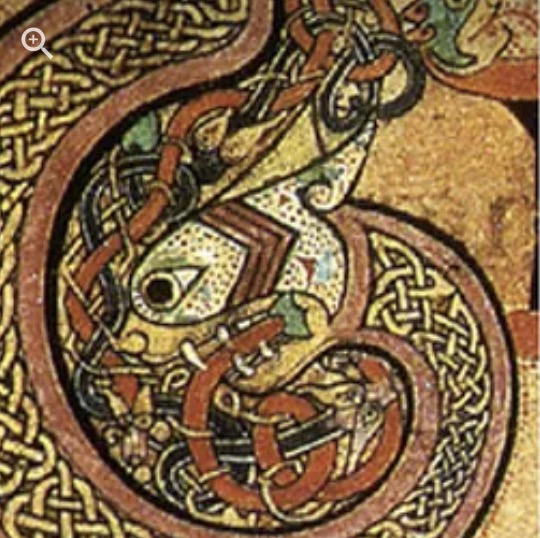
When you look at the Book of Kells, your eyes are immediately drawn to the massive, labyrinthine Celtic knots. The geometry is so complex, so impossibly tight, that some historians have joked it must have been drawn by angels.
But look closer, and the geometry begins to move.
The Book of Kells is famous for its “zoomorphic” imagery—art where animals and mythical beasts are twisted, stretched, and knotted together to form patterns and letters. A capital letter is more than just a letter; it’s also a serpent swallowing its own tail. A border isn’t just a line; it is a tangled mass of elongated hounds, birds, and lions, biting and gripping one another in an eternal, silent struggle.
Why would monks fill a sacred text with such chaotic, almost pagan imagery?
Because they were Irish and Scottish scribes, and the old world was still in their blood. They took the ancient Celtic tradition of knotwork—symbols of eternity and the interconnectedness of life—and fused it with their new faith. They drew peacocks (a symbol of immortality), snakes (representing resurrection through the shedding of skin), and mythical beasts that seem to defy categorization entirely.
A Living Legacy
The monks of Iona and Kells created a beautiful, decorative book that’s still admired centuries later. Beyond this, they codified an entire visual language.
Consider Celtic art today and you’ll see elements like the intricate knotwork on a silver ring, all kinds of zoomorphic tattoos, the fantasy illustrations of dragons and wolves woven into endless loops. Many are the direct descendants of the Book of Kells (though artists, naturally, have all kinds of influences). Those anonymous scribes, working by candlelight while the world outside descended into the Dark Ages, created an aesthetic that has survived for over a thousand years.
It is a reminder that sometimes, the most enduring way to protect a secret is to hide it in plain sight, tangled in the ink.
The Book of Kells Today: The Road to Dublin
The fact that we can still look at these monsters today is nothing short of a miracle. The Book of Kells had to survive the Vikings and, subsequently, all kinds of political chaos.
In the year 1006, the manuscript was stolen from the church at Kells in the dead of night. It was missing for months, eventually found buried under a pile of dirt. Its jewel-encrusted gold cover had been violently ripped off and lost to history, but the vellum pages miraculously survived the damp Irish soil.
Centuries later, during the brutal Cromwellian campaigns of the 1650s, the church at Kells was occupied by cavalry. To save the book from being trampled or burned by soldiers, it was secretly smuggled out of the ruins and sent to Dublin for safekeeping. In 1661, it was presented to Trinity College. It has rested there ever since, safely locked away in the shadowy alcoves of the Long Room library.
If you want to experience this historic wonder for yourself and aren’t near Trinity College in Dublin right now, you can find some beautiful illustrated reprints.