
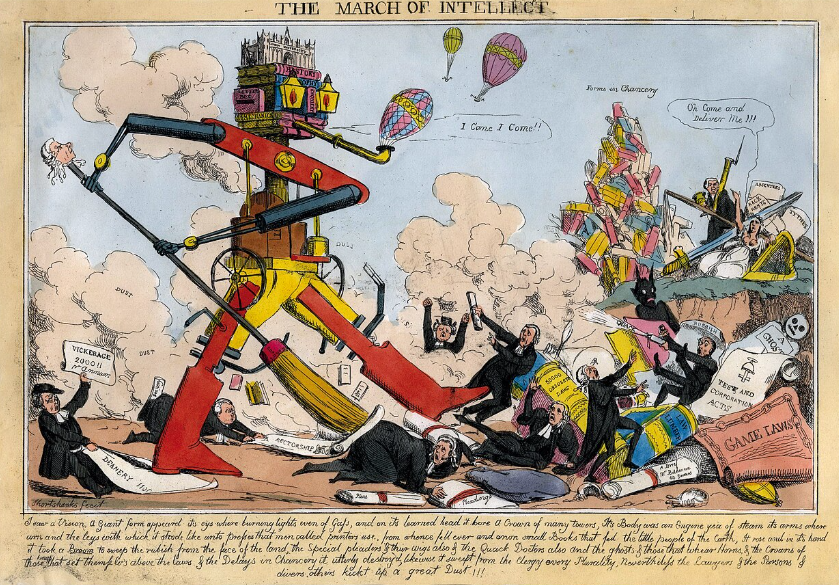
In an 1828 satirical print, a giant strides across the landscape with a steam engine for a body and a stack of books for a head. Gas lamps serve as its eyes; London University crowns its brow. Armed with a broom, it sweeps aside obsolete laws, legal delays, and the privileged figures obstructing its advance.
Note: see a transcription of the text under the illustration below.
Robert Seymour’s The March of Intellect imagines knowledge given a mechanical body: education and industry joined into something powerful enough to overturn the established order. Whether that prospect promised liberation or catastrophe depended, perhaps, on where one stood beneath its feet. As the Grolier Club explains, the print appeared when reformers were using mechanized printing and inexpensive publications to spread learning beyond its traditional confines.
The giant was imaginary. The fascination that animated it was not. In exhibition rooms and traveling shows, audiences were already watching artificial figures write, draw, and apparently defeat human beings at chess. Some were genuine marvels of mechanical craftsmanship. Others concealed a much older source of intelligence.
The Chess Player with a Human Heart
The most notorious of these machines entered the world before the nineteenth century began. First exhibited in 1770, Wolfgang von Kempelen’s Mechanical Turk remained a sensation well into the industrial age.
A turbaned figure sat behind a wooden cabinet, facing a chessboard. Before play began, its exhibitor opened compartments to reveal an impressive arrangement of machinery. Once the doors were closed, the figure moved its arm, lifted pieces, and conducted a game that seemed to demand calculation rather than mere repetition.
Its celebrated opponents included Napoleon Bonaparte, who played against it in 1809. Accounts of their encounter acquired theatrical embellishments, including stories of Napoleon making illegal moves to provoke the machine. The essential deception, however, requires no embellishment: a skilled human player was concealed inside.
The cabinet’s arrangement allowed the operator to shift out of sight during the preliminary inspection. Magnetic indicators beneath the board communicated the opponent’s moves, while mechanical linkages enabled the hidden player to control the figure’s arm. The machinery was real; the independent mechanical mind was not. The history of the Turk’s construction reveals an ingenious apparatus for making human thought appear to originate elsewhere.
Edgar Allan Poe examined the mystery in his 1836 essay Mälzel’s Chess Player, named for the machine’s later owner and exhibitor. He correctly suspected human agency, although several details of his explanation were mistaken. As Thomas Jefferson University’s account notes, his arguments included the erroneous assumption that a genuine chess machine would necessarily win every game.
The Turk was destroyed in a Philadelphia museum fire in 1854. Its long career had demonstrated something more durable than artificial intelligence: how readily an audience could become absorbed in the possibility of it.
The Mechanical Child Who Wrote Poetry
Not every extraordinary automaton concealed a person. Around 1800, the Swiss-born mechanician Henri Maillardet constructed a figure capable of producing four drawings and three poems—two in French and one in English.
Known as the Draughtsman-Writer, it lowered its head over a sheet of paper and guided a pen through elaborate movements. Here, unlike the Turk, the performance genuinely belonged to the mechanism.
Its memory was stored in shaped brass discs called cams. As these turned, metal followers traced their contours, transmitting motion through rods and levers to the writing hand. Each curve and stroke existed first as a physical instruction within the machine.
An important distinction lies beneath the spectacle: the automaton could write out poetry, but it did not compose new poems. It reproduced a repertoire encoded by its makers. Nevertheless, the sight unsettled the boundary between craftsmanship and creativity. A mechanical arm performed an activity associated with education, sensibility, and the private workings of the mind.
Its later history offers an almost Gothic episode of recovered identity. When the damaged machine arrived at Philadelphia’s Franklin Institute in 1928, its origins were misunderstood. Following repairs, it produced its drawings and poems—and, in the border of its final poem, wrote an inscription identifying itself as Maillardet’s automaton.
As the Franklin Institute recounts, the decisive clue came from the machine’s own mechanical memory. Its maker had been forgotten, but the brass retained his name.
When Clockwork Entered the Imagination
The nineteenth-century fascination with automatons inherited much from eighteenth-century watchmaking. The celebrated figures associated with Pierre Jaquet-Droz and his collaborators included a writer, a draughtsman, and a musician. These were not simply dolls accompanied by hidden music: the musician’s fingers actually operated the keys of her instrument. The writer could be configured to produce different short texts, an impressive departure from a single unchanging routine. The Mechanical Art & Design Museum describes the intricate mechanisms behind these performances.
Such figures made the imitation of life both intimate and disquieting. A machine did not need to threaten anyone to disturb them. It only needed to perform a familiar gesture with sufficient conviction.
Writers recognized the unease. E. T. A. Hoffmann’s The Sandman placed an artificial woman at the center of a story about desire, perception, and catastrophic misrecognition. The automaton became more than an engineering curiosity: it offered a way to question whether affection, manners, and apparently spontaneous behavior could themselves be mistaken for mechanical routines. Historian Laura Tradii explores this intersection of automata, social criticism, and the uncanny.
Outside the exhibition room, industrial machinery gave such questions a material urgency. The mechanical writer might be a luxury spectacle, but the possibility of machines performing human work was no longer confined to a cabinet.
The Intelligence Behind the Curtain
It is tempting to treat these automatons as primitive versions of modern artificial intelligence. The comparison is suggestive, but it should not erase their differences. Maillardet’s writer replayed movements stored in brass. The Turk transmitted the decisions of a concealed person. Seymour’s towering machine was a satirical image of knowledge and reform, not a working invention.
Yet together they reveal a remarkably familiar uncertainty. When a machine performs an impressive act, how much do we understand about the process behind it? Whose intelligence, skill, and labor have made the performance possible—and whose have disappeared from view?
The nineteenth century supplied no single answer. It left instead a collection of eloquent objects: a chessboard above a hidden chamber, a mechanical child bent over a poem, a giant crowned with books.
Their mechanisms can be explained. The sense of unease has continued right into our present age.
Text Handwritten under March of Intellect:
“I saw a Vision, A Giant form appeared its eyes where [were] burning lights even of Gass, and on its learned head it bore A Crown of many towers, Its Body was an Engine yea of steam its arms where [were] iron and the legs with which it strode like unto presses that men called printers use, from whence fell ever and anon small Books that fed the little people of the earth, It rose and in its hand it took a Broom to sweep the rubish [rubbish] from the face of the land, the Special pleaders & their wigs also & the Quack Doctors also and the ghosts & those that whear [wear] Horns, & the Crowns of those that set thems’elves above the laws & the Delays in Chancery it utterly destroy’d, likewise it swept from the Clergy every Plurality, Nevertheless the Lawyers & the Parsons & divers others kickt up a great Dust!!!”